


What happens when a medical system rooted in millennia-old wisdom meets one of the most transformative technologies of our time? The convergence of Ayurveda and artificial intelligence (AI) is beginning to reshape how traditional knowledge is practised, validated, and delivered in the modern world. At the heart of this transformation is the Ayush Grid initiative – envisioned as the digital backbone of the sector – integrating data platforms, digital health records, and AI-enabled tools across research, education, and clinical care. From personalised wellness recommendations and predictive insights to large-scale evidence generation, AI is unlocking new possibilities within the Ayush ecosystem. As India accelerates its digital health ambitions, the Ministry of Ayush is positioning Ayurveda at the intersection of tradition and technology – quietly but decisively redefining its role in the future of global healthcare.
In this overview, Ayur World brings together key initiatives led by the Ministry of Ayush that are shaping this transformation. At the same time, significant developments are also unfolding within the private sector – across industry and healthcare delivery – which we will cover as more detailed information becomes available.
The integration of artificial intelligence (AI) with traditional medicine is creating new opportunities to strengthen healthcare delivery, research, and knowledge dissemination. Ayurveda is increasingly benefiting from digital technologies that enhance patient care, expand access, and support evidence generation. Recognising this potential, the Ministry of Ayush has initiated several digital initiatives under the Ayush Grid project to integrate AI, data platforms, and digital tools into the Ayush ecosystem. AI enables analysis of complex datasets, supports clinical decision-making, disease prediction, and personalised wellness recommendations based on Ayurvedic concepts while enabling digital health records and decision-support systems that bridge traditional knowledge with modern technology. AI technologies also facilitate the digital documentation of patient records, integration of clinical data across institutions, and development of decision-support systems for practitioners. These capabilities help bridge traditional knowledge with modern healthcare technology while maintaining the foundational principles of Ayurveda.
Ministry of Ayush and WHO collaborative Initiatives
The effort made by the Ministry of Ayush for global relevance of digital health technologies in traditional medicine has widely been recognised by the World Health Organisation (WHO). WHO has emphasised the importance of digital tools, AI, and data-driven research in strengthening traditional medicine systems across the world. One significant collaborative initiative is releasing a technical brief titled ‘Mapping the Application of Artificial Intelligence in Traditional Medicine’ in 2025. This document highlights the potential of AI to strengthen traditional healthcare systems globally in which the Ministry of Ayush was the key contributor. Also WHO m-Yoga application, developed in the Ministry of Ayush, provides standardised yoga training modules based on internationally validated practices and demonstrates how digital platforms can promote traditional health knowledge globally. The Ministry of Ayush has been the main driver for Global Initiative for Artificial Intelligence in Health (GIAI4H).
Ayush Grid: Building the Digital Backbone of Ayush
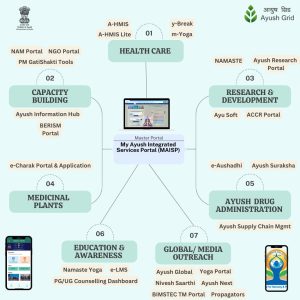
A major step towards integrating AI and digital technologies in Ayush, including Ayurveda, has been the establishment of the Ayush Grid, a comprehensive digital health platform developed by the Ministry. Ayush Grid aims to create an integrated digital ecosystem for healthcare delivery, research, education, drug regulation, and knowledge dissemination in the Ayush sector.
Under Ayush Grid, several digital platforms have been developed to streamline healthcare services and enable data-driven governance. Applications such as the Ayush Hospital Management Information System (AHMIS) facilitate the digital management of hospital records, clinical workflows, and patient data across Ayush institutions. These digital records provide a valuable foundation for future AI-based analytics, predictive models, and clinical research in Ayurveda.
Similarly, the Ayush Research Portal (ARP) hosts 43,000 research papers related to Ayush systems, providing a structured digital repository for researchers and policymakers. The availability of such large datasets is critical for developing machine learning models that can analyse patterns in Ayurvedic treatments, outcomes, and therapeutic approaches. Namaste application has been developed for the development of National ASU (Ayurveda, Siddha, Unani) morbidity code and through the AI-enabled application these have been mapped with ICD11 (International Classification of Diseases – 11th Revision).
AI-powered Chatbots and Digital Assistants
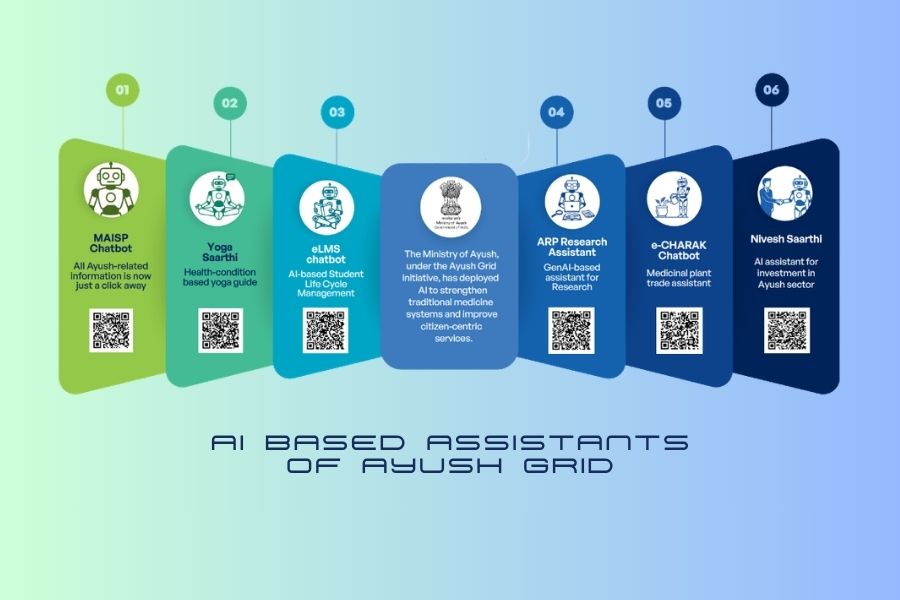
To further enhance user engagement and knowledge dissemination, the Ministry of Ayush has also introduced several AI-enabled chatbots and digital assistants under the Ayush Grid initiative. These chatbots provide quick access to information related to Ayush policies, research, wellness practices, and investment opportunities in the sector.
Some of the notable AI-based assistants include:
- MAISP Chat Assistant, developed for the Master Portal of the Ministry of Ayush to help users navigate Ayush-related information.
- Yoga Saarthi, an AI-enabled chatbot designed to recommend suitable yoga asanas based on user needs and wellness goals.
- Ayush Nivesh Saarthi, which provides guidance on investment opportunities and policies in the Ayush sector.
- Ayush Research Portal Chat Assistant, which helps researchers and scholars quickly locate relevant research publications.
These AI-driven tools demonstrate how emerging technologies can simplify access to knowledge while promoting wider adoption of Ayurveda and other Ayush systems.
Showcasing Ayurveda and AI on Global Platforms
The growing convergence of Ayurveda and AI was prominently showcased during the India AI Impact Expo and Summit 2026, held at Bharat Mandapam, New Delhi. At the event, the Ministry of Ayush set up a dedicated Ayush Pavilion, highlighting various digital initiatives and AI-enabled solutions developed under the Ayush Grid project.
The pavilion demonstrated several digital platforms, research tools, and AI-powered applications designed to strengthen the Ayush ecosystem. Visitors from across the technology and healthcare sectors were introduced to the innovative ways in which AI is being used to support traditional medicine systems. The event also served as a platform for collaboration between healthcare experts, technology developers, researchers, and policymakers, fostering discussions on the future of AI in traditional medicine.
The integration of AI with Ayurveda holds immense potential for the future of healthcare. With the continued development of digital health infrastructure, large-scale datasets from Ayush hospitals, and increasing adoption of AI technologies, new opportunities are emerging in areas such as predictive healthcare, personalised medicine, pharmacological research, and global knowledge dissemination.
The Ministry of Ayush, through initiatives such as Ayush Grid, digital health platforms, AI-enabled chatbots, and international collaborations, is laying the foundation for a technology-enabled ecosystem that preserves the authenticity of Ayurveda while making it accessible to the modern world.
As digital innovation continues to evolve, the convergence of ancient wisdom and modern AI has the potential to transform Ayurveda into a globally integrated, evidence-informed,
and technology-driven healthcare system benefitting billions of people seeking holistic and preventive healthcare solutions