


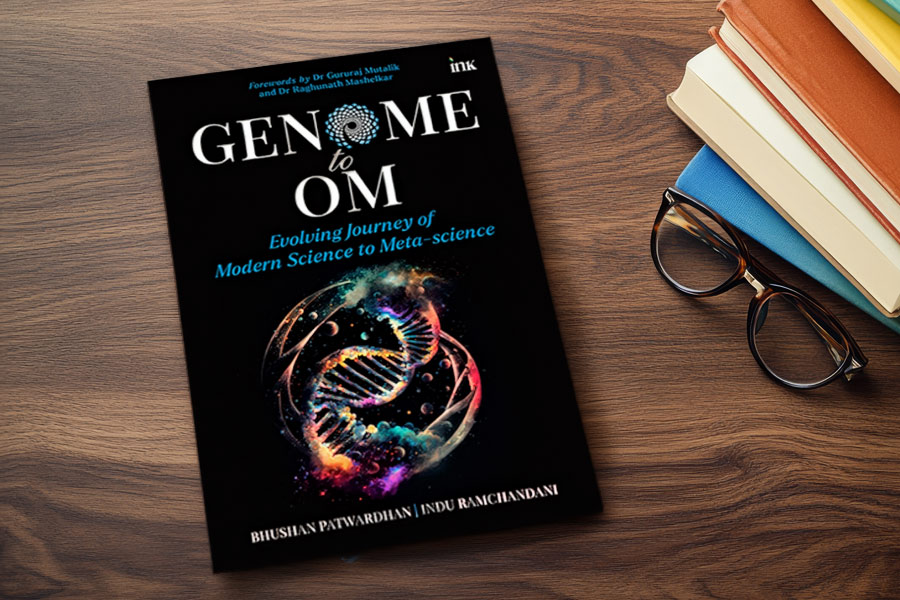
GENOME to OM
Authors: Prof. Bhushan Patwardhan, Ms Indu Ramchandani
Publisher: BluOne Ink, India
Pages: 495
ISBN-13: 9789365478235
Website: https://www.bluone.ink/books/genome-to-om-evolving-journey-of-modern-science-to-meta-science-9789365478235
(Available on Amazon)
Genome to Om: Evolving Journey of Modern Science to Meta Science, authored by Prof. Bhushan Patwardhan and Ms Indu Ramchandani, is a thoughtful and timely exploration of a mystery that defines our age: the visible triumph of science and technology in the Anthropocene on the one side and the enduring spiritual orientation of societies such as India on the other. The scenario gets increasingly complex when spirituality is often misunderstood or dismissed as superstition by modern discourse.
Rather than positioning science and spirituality as oppositional forces, the book undertakes an inward journey, that of self-introspection, to examine the epistemological roots of knowledge systems, both ancient and modern. It asks fundamental questions: What is science? How does modern science differ from ancient science? What do we mean by tradition, wisdom, and philosophy? These questions are not merely academic; they go to the heart of how societies understand progress and purpose.
The authors remind readers that language shapes perception. While English –through which Western scientific ideas are largely communicated—offers terms such as science and technology, Indian knowledge systems recognise more nuanced distinctions: Dnyan (knowledge), Tatvadnyan (philosophy), Vidnyan (science), Tantradnyan (technology), and Vikriti (ethical deviation). These conceptual categories reveal a civilisational understanding in which empirical inquiry, moral reasoning, and ethical restraint coexist.
The book situates science and technology – ancient or modern – as inherently empirical and evidence-based, while philosophy provides the ethical framework that guides their application. Values, the authors argue, emerge from long-standing traditions shaped by sages, seers, and social norms, becoming what anthropologists describe as the hard core of culture – deeply ingrained patterns of thought resistant to change. By contrast, material culture and technology transform rapidly, often without corresponding ethical evolution.
Through historical and cultural illustrations – ranging from the technological prowess of figures in the Ramayana and Mahabharata to the modern-day paradox of technologically skilled yet ethically violent extremism – the book demonstrates that technological advancement does not automatically translate into moral progress. Power, when detached from wisdom, can become destructive.
A particularly engaging section traces human biological and cultural evolution—from the domestication of fire and food processing to brain development, agriculture, surplus economies, and organised power structures. Drawing connections between Darwinian evolution, genetics, and ancient Indian concepts such as Anu, Renu, and Prakriti, the authors illustrate how different civilizations attempted to understand human diversity long before modern biology formalised it.
Scientific and technological progress has delivered comfort, but not necessarily happiness; wisdom determines how knowledge serves humanity.
— Genome to Om —
Yet the central concern of Genome to Om lies in the present. Despite unprecedented scientific and technological progress, humanity faces ecological imbalance, climate change, and deep social inequities. Unbridled consumerism has replaced harmony with exploitation – echoing Mahatma Gandhi’s timeless warning that the world has enough for everyone’s need, but not for everyone’s greed. As the authors write, the current ‘humanity-versus-nature’ crisis presents an existential ultimatum: coexist in harmony or face extinction.
The phrase Genome to Om functions as a powerful metaphor, signifying a journey from molecular understanding to meta-scientific wisdom. While modern science has delivered remarkable innovations, its industrial and profit-driven applications have often failed to deliver happiness or equity. In contrast, the book highlights how Yoga, meditation, and spiritual counselling – now recognised globally through initiatives such as International Yoga Day and World Meditation Day – offer secular, universally accessible tools for well-being.
In bringing together scientific reasoning, philosophical inquiry, and civilisational wisdom within a single narrative, the authors perform a valuable service. Genome to Om invites scientists, policymakers, and lay thinkers alike to reflect on the direction of human progress and its consequences for future generations.
The book deserves wide readership, discussion across disciplines, and translation into regional languages. In a world searching for balance between knowledge and wisdom, Genome to Om positions India’s philosophical traditions as a possible compass for humanity’s future.
Prof. R K Mutatkar
(Former Director School of Health Sciences, Savitribai Phule Pune University, Pune; former chairman, Indian National Confederation & Academy of Anthropologists, and Indian Association for the Study of Traditional Asian Medicine; Patron, United Indian Anthropology Forum and Society for Indian Medical Anthropology)