



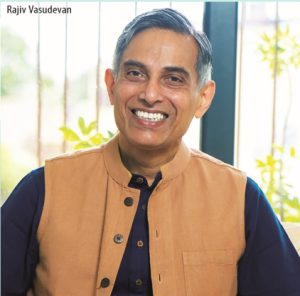
Rajiv Vasudevan
Founder and CEO, Apollo AyurVAID Hospitals
The world is living through a period of deep and multiple overlapping crises – economic uncertainty, environmental stress, cultural fragmentation, and growing health burdens. Yet, amidst this turbulence, India continues to project relative stability and ambition, positioning itself as a potential global guide – a civilisational mArgdarshak. At the heart of this aspira-tion lies an unlikely but powerful force: Ayurveda. The classical Roman ideal – mens sana in corpore sano, a healthy mind in a healthy body – has long served as a short-hand for well-being. But centuries earlier, the ancient Indian surgeon Sushruta Acharya articulated a far more expansive vi-sion: SwasthyAvastha, meaning a state of dynamic equilibrium of body, mind, senses, and spirit – internally, and externally with the environment that the individual is part of. Today, that idea feels less philosophical and more urgently practical. Modern healthcare faces a paradox. People are living longer, but not necessarily healthier. The rise of multimorbid-ity – where individuals live with multiple chronic condi-tions
simultaneously – has become the norm rather than the exception. Alongside this is a quieter but equally pervasive ‘wellbeing burden,’ where multiple swAsthya lakshanAs are compromised, additionally. Global health metrics reflect this strain. Gains in disability-adjusted life years (DALYs) are slowing, and the gap between life expectancy and healthy life expectancy remains stub-bornly wide. Health systems worldwide are spending more but achieving diminishing returns. It is in this context that the call for Integrative Medicine is growing louder. Globally, integrative medicine has often been framed through a Western lens, where biomedicine dominates and traditional systems play a supporting role. But this hierarchy is neither inevitable nor optimal. An Indian perspective offers a more patient-centric model. Instead of a one-size-fits-all approach, care can be tailored to the rogi–roga avastha – the unique interaction between patient and disease. Depending on the stage and severity of illness, as well as the individual’s physical, mental, and metabolic profile, either Ayurveda or biomedicine may take precedence. Healthcare, in this view, is not a battleground of systems but a continuum – from prevention and early intervention to acute care, rehabilitation, and long-term management. Each stage opens space for collaboration. This is particularly relevant in the era of non-communicable diseases, which accounts for the bulk of healthcare demand. Symptom-focused approaches alone are proving insufficient. Addressing root causes such as metabolic, inflammatory, behavioural, and psychological factors has become essential. Ayurveda’s ‘whole person’ framework, which integrates diet (ahara), lifestyle (vihara), thought patterns (vichara), and therapeutics (aushadha), offers a complementary lens, one that extends beyond the purely biological.
Not Mixopathy, but Co-managed Care
One of the biggest misconceptions about integrative medicine is that it involves a single practitioner prescribing a blended package of treatments from multiple systems simultaneously. In reality, the model is far more nuanced. A patient may be treated by different clinicians for different conditions – say, hypertension and joint pain – or for primary and secondary health concerns. Care pathways may also shift across stages: acute intervention may rely on biomedicine, followed by long-term disease reversal strategies rooted in Ayurveda. In some cases, Ayurveda may offer conservative manage-ment, while biomedicine provides surgical or emergency care. In others, integrative approaches may be most valuable at the primary care level, especially in triaging patients and determining appropriate referral pathways. What emerges is not ‘mixopathy,’ but a structured model of co-managed care, where each system contributes where it is most effective.
An ethically grounded, scientifically robust model of Ayurveda-based integrative medicine could redefine healthcare delivery – not just for India, but globally.
The Case for an Integrative Mindset
At its core, integrative medicine is less about systems and more about mindset. Different medical traditions operate on distinct diagnostic and therapeutic paradigms. Yet, they share a common ground – the human body and its responses to disease and intervention. An integrative mindset enables clinicians to understand each other’s frameworks, collaborate meaningfully, and make patient-centred decisions, both in the short and long term. It also encourages appropriate referrals and the development of credible evidence across systems. Crucially, it recognises a simple truth: no single system has all the answers
Structural Barriers to Integration
Despite its promise, integrative medicine in India faces some structural and regulatory hurdles. The major ones are listed below.
Insurance and payer support remain a major constraint. While policy directives have sought parity between Ayush systems and biomedicine, gaps persist, particularly in cashless access and coverage for integrative care. The exclusion of Ayurveda from flagship schemes like Ayushman Bharat Pradhan Mantri Jan Arogya Yojana continues to limit access and scale.
Medical education remains siloed. A shared foundational curriculum – covering subjects like anatomy and physiology – could foster early cross-system understanding. Targeted integrative training, particularly at postgraduate and specialty levels, offers a more pragmatic path forward.
Regulatory ambiguity around Ayurveda medicines also persists. Their widespread availability as over-the-counter products dilutes their positioning as part of a rigorous medical system. Strengthening prescription frameworks and clinical protocols could enhance credibility and safety.
- Despite its promise, integrative medicine in India faces some structural and regulatory hurdles. The major ones are listed below.
- Insurance and payer support remain a major constraint. While policy directives have sought parity between Ayush systems and biomedicine, gaps persist, particularly in cashless access and coverage for integrative care. The exclusion of Ayurveda from flagship schemes like Ayushman Bharat Pradhan Mantri Jan Arogya Yojana continues to limit access and scale.
- Medical education remains siloed. A shared foundational curriculum – covering subjects like anatomy and physiology – could foster early cross-system understanding. Targeted integrative training, particularly at postgraduate and specialty levels, offers a more pragmatic path forward.
- Regulatory ambiguity around Ayurveda medicines also persists. Their widespread availability as over-the-counter products dilutes their positioning as part of a rigorous medical system. Strengthening prescription frameworks and clinical protocols could enhance credibility and safety.
Co-location and the Rise of Collaborative Care
There are, however, signs of progress. The co-location of Ayush services within mainstream institutions, such as All India Institute of Medical Sciences hospitals and district health centres, has created new opportunities for collaboration. Joint research initiatives between bodies like Indian Council of Medical Research and Central Council for Research in Ayurvedic Sciences are also helping build an evidence base for integrative care. These efforts now need to evolve into structured referral systems and scalable care models – moving from co-location to true collaboration
A Policy Moment Waiting to Be Seized
India’s National Health Policy 2017 has already articulated a pluralistic vision for healthcare. But translating that vision into practice will require coordinated action across policy, education, insurance, and research. Equally important is a shift in how evidence is defined. Conventional frameworks such as double-blind randomised controlled trials may not fully capture the complexity of Ayurveda’s personalised, multi-dimensional interventions. Emerging approaches, including real-world evidence and pragmatic trials, could bridge this gap.
A Global Opportunity
As the world searches for more sustainable, affordable, and patient-centred healthcare models, India has a unique op-portunity to lead. An ethically grounded, scientifically robust model of Ayurveda-based integrative medicine could redefine healthcare delivery – not just for India, but globally. In that sense, this is more than a policy debate. It is a civilisational moment – a tryst with destiny. And this time, patients and their sustained wellbeing may well be at its centre.