


Dr Mahadevan Seetharaman
Dean, California College of Ayurveda (CCA), Hindu University of America (HUA)
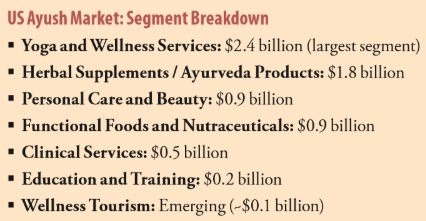
The Government of India’s ambition to expand the Ayush sector to $200 billion by 2030 reflects a decisive shift in global healthcare towards preventive, integrative, and holistic approaches. Over the past decade, the sector has already wit-nessed remarkable growth, with the Ayush sector expanding nearly eightfold to an estimated $43 billion. At the heart of this rise lies Ayurveda, widely regarded as the system’s central pillar due to its depth of knowledge, therapeutic potential, and growing global credibility. While India continues to dominate the supply side – span-ning manufacturing, raw materials, Panchakarma centres, and practitioner training – the next phase of growth will be driven by global markets. Among these, the US stands out as a critical engine. With an estimated 15% share of the global Ayush market, the US already represents one of the largest consumers of yoga services, herbal supplements, and integrative wellness solutions. With the right strategy, this market could expand from roughly $6–7 billion today to $30–40 billion by 2030. This opportunity is underpinned by
powerful structural trends. The US faces a growing burden of lifestyle and car-diometabolic diseases, accounting for a significant share of its nearly $5 trillion healthcare expenditure. At the same time, consumer demand for wellness, natural products, and preven-tive care continues to surge. Yoga’s widespread adoption pro-vides a familiar entry point, while Ayurveda’s principles such as personalised nutrition, digestive health, and mind–body balance align closely with emerging fields such as lifestyle and functional medicine. Yet, significant barriers remain. Regulatory ambiguity limits Ayurvedic products largely to the dietary supplement category, constraining therapeutic positioning. The absence of a stan-dardized licensing framework for practitioners restricts integra-tion into mainstream healthcare and limits insurance coverage. Although growing, the clinical evidence base is relatively weak,
Global Ayush Market Snapshot
| India: | $20–22 billion (~50% share) |
| United States: | $6.5–7.0 billion (~15%–16%) |
| Germany / EU: | $3.0–3.5 billion (~7%–8%) |
| Middle East (UAE-led): | $2.5–3.0 billion (~6%–7%) |
| Australia & New Zealand: | $1.5–2.0 billion (~4%–5%) |
especially large-scale trials aligned with biomedical standards. This further slows policy acceptance. Compounding this is a perception gap: Ayurveda is often reduced to herbal remedies or spa therapies, rather than understood as a comprehensive system of medicine.
Addressing these challenges requires a coordinated and strategic approach.
First, a strong global branding effort is essential. Ayurveda must be positioned not merely as an alternative therapy, but as a science of preventive health and personalised medicine. Second, expanding accredited education and professional training in the US will be key to building credibility and scale. Partnerships between Indian Ayush institutions and US universities can help standardise curricula and strengthen academic legitimacy.
Third, investment in clinical research must accelerate. Collaborative studies focusing on major health challenges such as diabetes, cardiovascular disease, and mental health can demonstrate Ayurveda’s relevance in modern clinical settings. Fourth, integrative healthcare models that embed Ayurveda within multidisciplinary clinics and wellness programmes can drive adoption, particularly in chronic disease management and preventive care.
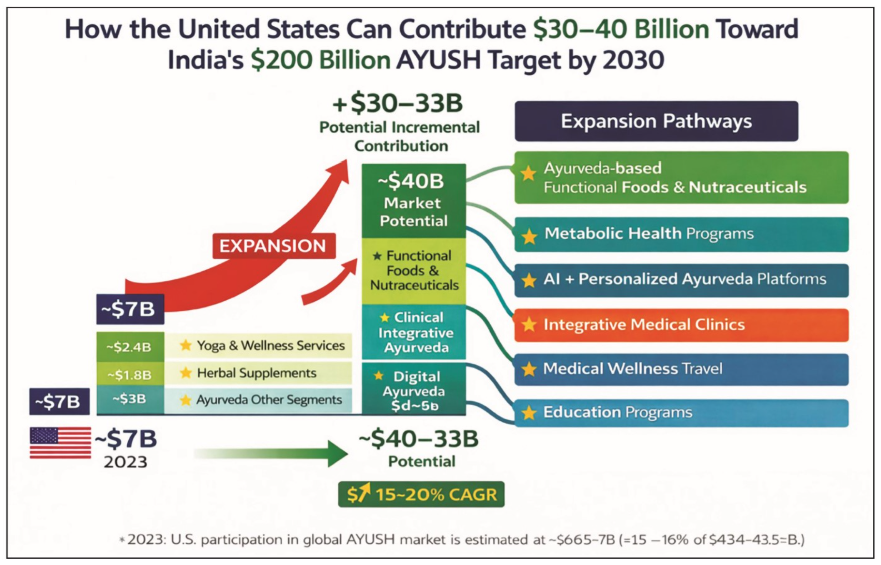
Equally important is the expansion of Ayurvedic nutraceuti-cals and functional foods, one of the fastest-growing segments of the US wellness market. Botanicals such as turmeric and ash-wagandha already enjoy strong consumer interest and can serve as scalable entry points. Digital health platforms, teleconsulta-tions, and AI-enabled personalisation tools can further amplify reach and accessibility. Meanwhile, strengthening medical value travel through structured referral pathways to certified centres in India can deepen experiential engagement with Ayurveda.
The path to a $200 billion Ayush economy will depend on how effectively India leverages global markets, with the US at the forefront. Beyond being a large consumer base, the US also offers strengths in research, innovation, and healthcare entrepreneurship, making it a potential hub for the next phase of Ayurveda’s evolution.
As global healthcare increasingly shifts towards prevention, personalisation, and holistic well-being, Ayurveda is uniquely positioned to contribute. With clear strategy, stronger evidence, and global collaboration, the coming decade could mark a defining chapter, not just for Ayush, but for the future of healthcare itself
The author can be reached at Mahadevan.Seetharaman@hua.edu.