


Prof. Bhushan Patwardhan, PhD, FNASc, FAMS
National Research Professor-Ayush, Savitribai Phule Pune University
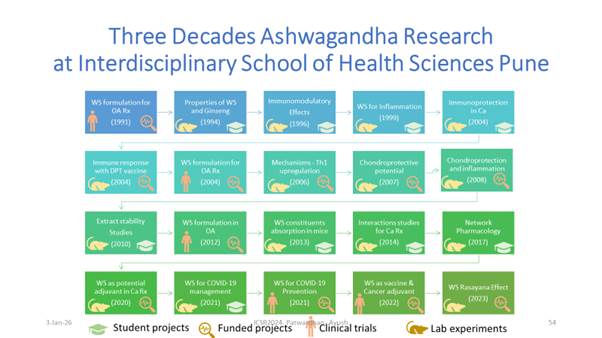
Systematic research on Withania somnifera (Ashwagandha) from the perspective of Ayurveda has evolved steadily over several decades, alongside parallel efforts by multiple groups across the world. This particular research journey of our group began in the early 1990s with a comparative pharmacology of Ashwagandha and ginseng. Published in 1994, the study, as part of an M.Pharm dissertation, demonstrated that Ashwagandha possessed immunomodulatory activity comparable to ginseng. In addition, it has significant anti-inflammatory effects, making it a better drug of choice.¹ Over subsequent years, multiple generations of research students systematically expanded this work, examining immunomodulatory mechanisms, stress-response pathways, anti-inflammatory actions, and safety profiles.²
A major phase of this programme during the next decade unfolded several collaborative studies that contributed to positioning Ashwagandha at a global stage.3 Scientific publications arising from such work demonstrated that Ayurvedic botanicals could be evaluated with methodological rigor comparable to that applied to conventional therapeutics.
In 2004, Ashwagandha became a core component of the CSIR–NMITLI Herbal Drug Research Programme, which aimed to develop evidence-based herbal formulations through structured public–private partnerships. Within this initiative, Ashwagandha-based formulations were evaluated for inflammatory and degenerative conditions, including arthritis, reinforcing their relevance to chronic disease management. This phase marked a transition from single-target drug studies to synergistic, multi-target formulation science guided by the reverse pharmacology approach, consistent with both Ayurvedic principles and modern systems biology.4
This continuity of inquiry enabled steady progression from pharmacological observations to mechanistic insights, drug repurposing, and translational relevance.5 The research followed a deliberate, hypothesis-driven trajectory, informed by classical Ayurvedic knowledge and examined using experimental biomedical frameworks.
The COVID-19 pandemic provided an unanticipated but important test of decades of foundational research. Building on existing evidence of immunomodulatory and anti-inflammatory effects, Ashwagandha emerged as a plausible candidate for prophylactic and supportive care. Comparative analyses during this period suggested advantages over widely discussed agents such as hydroxychloroquine, particularly with respect to safety and biological plausibility.⁶ More recently, a large multicentric, randomized, double-blind, placebo-controlled trial was completed to evaluate the effect of Ashwagandha on the immunogenicity of COVID-19 vaccines.⁷ These developments were possible only because of cumulative, systematic research conducted over many years.
The impact of this sustained effort extends beyond academia with the involvement of leading universities, research laboratories, and industries. As a result, the market presence of Ashwagandha has grown globally, expected to reach $1 billion. Its increasing presence in clinical research, nutraceutical markets, and public health discourse reflects scientific credibility built through long-term investigation rather than short-term commercial trends.
At the same time, this growing prominence has brought new geopolitical and regulatory challenges. A unilateral ban imposed by the Danish government, based on a flawed assessment by the Danish Technological University, illustrates how regulatory decisions may be influenced by reasons other than science. An editorial published in the Journal of Ayurveda and Integrative Medicine critically examined and exposed the methodological limitations of this assessment.⁸ However, the adoption of similar restrictions by other countries without independent scientific evaluation risks limiting public access to a widely used and well-studied herbal medicine.
Over the years, Ashwagandha has thus emerged as a credible drug candidate in the global health landscape.⁹ This three-decade journey illustrates how traditional knowledge, when investigated patiently, rigorously, and transparently, can generate robust and enduring scientific evidence (see Figure[ek1] ).
It also underscores a broader lesson: many other medicinal plants from Ayurveda now require similarly sustained and systematic research. In recognition of this need, the Ministry of Ayush is pursuing evidence-based initiatives aimed at strengthening the scientific credibility of Ayurveda at the global level.
(The author can be reached at <bpatwardhan@gmail.com>.)