



Prof. (Dr) Pawan Kumar Godatwar
Professor, National Institute of Ayurveda, Jaipur
Long before the term ‘antimicrobial resistance’ (AMR) entered medical vocabulary, Ayurveda cautioned that human excess could invite invisible enemies no medicine might ultimately defeat. Today, as antibiotics falter worldwide and millions succumb to drug-resistant infections, that warning feels uncannily prophetic. Modern science describes AMR as a silent pandemic; Ayurveda frames it as Janapadodhwansa— the breakdown of communities arising from ecological imbalance, intellectual error, and weakened biological resilience. Viewed through this lens, the antibiotic crisis is not merely a failure of pharmaceutical innovation, but of health stewardship itself. In this article, Dr Pawan Kumar Godatwar, Ayurveda professor at the National Institute of Ayurveda, Jaipur, examines AMR through an Ayurvedic framework and argues for an integrative ‘Fusion Medicine’ approach to safeguard global health.
The recent warnings from global health experts, as reported in various media outlets, paint a sobering picture of our medical landscape: antibiotics are failing faster than new ones are being developed. With nearly 1.27 million annual deaths globally attributable to antimicrobial resistance (AMR) – a figure projected to rise to 8 million by 2050 – humanity faces a ‘silent pandemic’. From an Ayurvedic perspective, this crisis is not merely a failure of pharmaceutical innovation; it is a profound manifestation of Janapadodhwansa (the destruction of communities) and a systemic collapse of Vyadhikshamatva (biological resistance).
As modern medicine grapples with ‘superbugs’ that have evolved to bypass our strongest chemical defences, the 5000-year-old wisdom of Ayurveda offers a paradigm shift. Rather than viewing the crisis as a war against external pathogens that we are losing, Ayurveda invites us to examine the ‘inner terrain’ of the host and the collective ethical conduct of society.

The Concept of Janapadodhwansa: When Society Loses its Balance
In Charaka Samhita, one of the foundational texts of Ayurveda, the phenomenon of large-scale epidemics and the destruction of populations is described as Janapadodhwansa. Interestingly, the text identifies four factors common to all inhabitants – Vayu (air), Jala (water), Desha (land), and Kala (time/seasons) – the corruption of which leads to mass illness.
Media reports note that hospital-acquired infections and environmental contamination (such as drug waste in rivers like the Ganga) are major drivers of AMR. Ayurveda attributes such environmental degradation to Adharma (unrighteousness or ethical failure) fuelled by Prajnaparadha – the ‘intellectual blasphemy’ or ‘error of the intellect’. In the context of AMR, Prajnaparadha is the indiscriminate and irresponsible use of antibiotics, driven by a desire for ‘quick fixes’ and corporate greed, ignoring the long-term ecological and biological consequences. When we disrupt the natural order through the misuse of powerful substances, the environment (Desha and Jala) becomes a breeding ground for resistant ‘invisible organisms’ (Krimi).
Moving Beyond the ‘Magic Bullet’: the Theory of Krimi
In modern medicine, the focus has long been on the ‘seed’ (the bacteria). If a seed is harmful, we invent a chemical to kill it. However, the bacteria have proven to be evolutionary masters, adapting to every new ‘poison’ we throw at them.
Ayurveda approaches infection through the lens of Krimi Chikitsa (the management of parasites/microbes), which focuses as much on the ‘soil’ as the ‘seed’. The management involves three distinct steps:
- Apakarshana (Removal): Physically removing the pathogens and toxins through purification (Panchakarma).
- Prakriti Vighata (Changing the Environment): Altering the internal environment of the body so that it is no longer hospitable to the pathogen.
- Nidana Parivarjana (Avoidance of Causes): Eliminating the diet and lifestyle habits that allow microbes to flourish.
The antibiotic crisis is essentially a failure of the ‘attack-only’ strategy. By focusing solely on killing the microbe, we have neglected to strengthen the host’s internal environment. When we overuse antibiotics, we often destroy the Agni (digestive fire) and the beneficial microflora (Sahaja Krimi), leaving the body’s ‘soil’ weakened and prone to more virulent, resistant strains.
Strengthening Vyadhikshamatva and Ojas
In the India Today article on AMR, it emphasizes that ‘the problem cannot be solved by science alone’ and that India must prioritize prevention. This aligns perfectly with the Ayurvedic concept of Vyadhikshamatva – the capacity of the body to resist the onset of disease or to suppress its intensity.
At the heart of this immunity is Ojas, the vital essence of all bodily tissues. Modern antibiotics, while life-saving in emergencies, are often Ruksha (drying) and Tikshna (sharp/penetrating) in nature. Chronic use can deplete Ojas, leading to a state of Kshaya (depletion) where the body loses its natural resilience.
To combat AMR, Ayurveda suggests a return to Rasayana therapy. Herbs like Guduchi (Tinospora cordifolia), Amalaki (Emblica officinalis), and Ashwagandha (Withania somnifera) are not antibiotics in the traditional sense; they are immunomodulators. They work by enhancing the body’s own defense mechanisms, making the ‘soil’ so robust that the ‘seed’ of the resistant bacteria cannot take root.
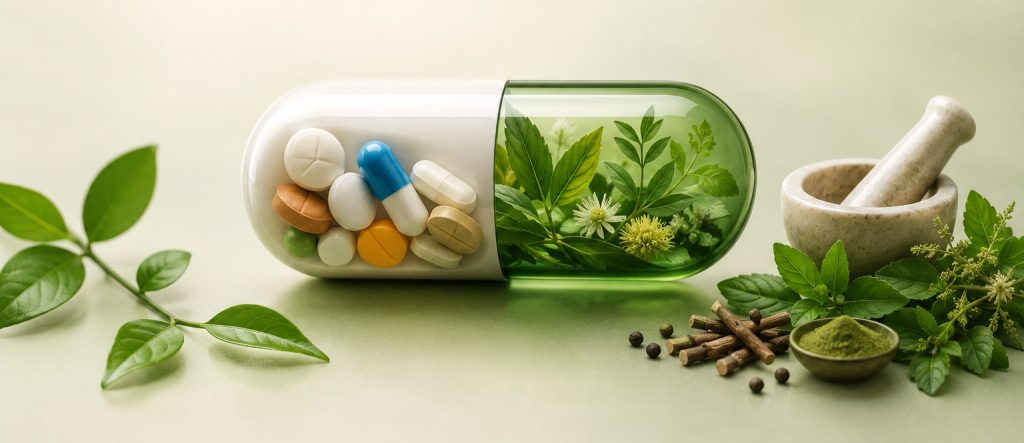
The Role of ‘Fusion Medicine’
The way forward is not to abandon modern medicine, but to integrate it with Ayurvedic principles to create a ‘stewardship of health’.
Synergistic Action: Research into Agada Tantra (toxicology) and herbal bioactives suggests that certain Ayurvedic herbs can act as ‘efflux pump inhibitors’, essentially breaking down the resistance mechanisms of bacteria and making modern antibiotics effective again at lower doses.
Naimittika Rasayana: Using specific rejuvenative therapies during and after an antibiotic course can protect the Agni and Ojas, preventing the secondary infections that often drive further antibiotic use.
Dietary Discipline: Ayurveda emphasizes Aahara (diet) as the first medicine. Reducing the intake of Abhishyandi foods (those that cause blockage and dampness, like excessive sugar and processed dairy) reduces Kleda (excessive moisture/waste), which is the primary breeding ground for Krimi.
Conclusion: a Call for Intellectual Wisdom
Media reports warn that society must take action now to reduce this growing threat. From an Ayurvedic viewpoint, this action must start with correcting Prajnaparadha. We must stop viewing health as something that can be bought in a pill and start viewing it as a state of balance (Sama Dosha, Sama Agni).
The global antibiotic crisis is a signal that our current war on microbes is unsustainable. By shifting from a purely ‘bactericidal’ mindset to one of ‘biological harmony’, we can use Ayurveda to fortify the human host. If we restore the balance of our internal and external environments, we may find that the ‘superbugs’ of tomorrow no longer find us to be a welcoming home.
In the battle against AMR, the ultimate shield is not a new drug, but the ancient wisdom of living in accordance with the laws of nature. As the Charaka Samhita reminds us, even in the face of Janapadodhwansa, those who maintain their Sattva (mental clarity), follow a righteous path, and protect their Agni can survive the storm.
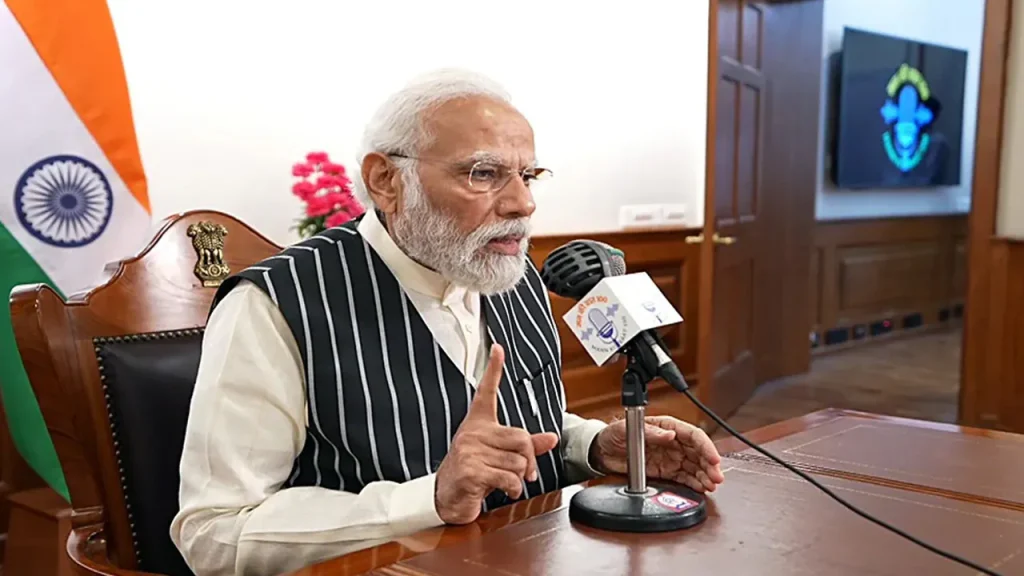
In his last ‘Mann Ki Baat’ address of 2025, Prime Minister Narendra Modi raised serious concerns about the rising threat of Antimicrobial Resistance (AMR) in India, citing findings from the Indian Council of Medical Research (ICMR). He emphasized that the misuse and overuse of antibiotics – often taken without medical supervision – are making common infections, such as pneumonia and urinary tract infections, harder to treat.
Key Aspects of Modi’s Message on AMR
- ‘Antibiotics Require Doctors’: Modi warned that antibiotics are not a ‘quick fix’ for every ailment and should only be taken when prescribed by a qualified doctor.
- Danger of Self-Medication: He highlighted that indiscriminate use of antibiotics allows microbes to adapt and become resistant, rendering life-saving medicines ineffective.
- Public Health Alert: He described AMR as a ‘silent pandemic’ that could make routine infections and surgeries life-threatening.
- National Commitment: The Prime Minister emphasized the need for responsible antibiotic use, better hygiene, and public awareness as part of the National Action Plan (NAP) 2.0 to combat AMR.