


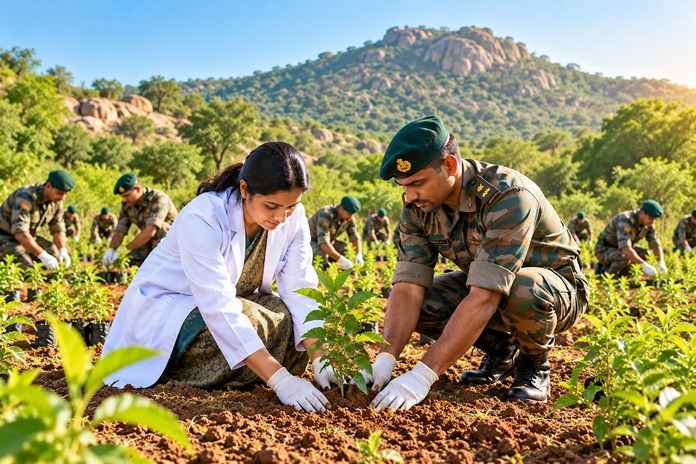
The All India Institute of Ayurveda (AIIA), New Delhi, and the 132 Infantry Battalion (Territorial Army) ECO RAJPUT have launched a joint Ashwagandha plantation and research initiative at Bhatti Mines in South Delhi. On September 25, 2026, the Ministry of Ayush announced the initiative, which aims to plant and scientifically monitor 10,000 Ashwagandha saplings, linking medicinal plant research with biodiversity conservation and ecological restoration in the Aravalli landscape.
AIIA and Territorial Army Collaborate on Medicinal Plant Research
The initiative was launched on September 24, 2026, at Terriers Herbal Garden, Bhatti Mines, South Delhi. The programme was led by AIIA Director Professor (Vaidya) Pradeep Kumar Prajapati and Commanding Officer Colonel Mohan Singh of the 132 Infantry Battalion (Territorial Army) ECO RAJPUT.
The collaboration combines AIIA’s expertise in Ayurveda, medicinal plants and scientific research with the Territorial Army unit’s experience in plantation, biodiversity conservation and the restoration of environmentally degraded areas.
According to the Ministry of Ayush announcement published through the Press Information Bureau (PIB), the project will focus on cultivating Ashwagandha and documenting how the plants grow and adapt to local climatic and environmental conditions.
10,000 Ashwagandha Saplings to Be Monitored Scientifically
The initiative includes the planned planting and scientific monitoring of 10,000 Ashwagandha saplings at Terriers Herbal Garden.
Ashwagandha, scientifically known as Withania somnifera (L.) Dunal, is an important medicinal plant in Ayurveda.
The plants are intended to be monitored and documented regularly to generate information about their growth and adaptation to the Aravalli landscape.
The planned activities include:
- Medicinal plant cultivation: Growing 10,000 Ashwagandha saplings in the designated herbal garden.
- Scientific observation: Recording how the plants grow and adapt to the local environment.
- Ayurveda research: Integrating traditional knowledge of medicinal plants with systematic scientific documentation.
- Biodiversity conservation: Supporting the conservation of medicinal plant species.
- Environmental restoration: Connecting plantation activities with the restoration of mining-affected and environmentally degraded areas.
The announcement describes the planned activities. It does not confirm that all 10,000 saplings have already been planted or that the research has produced results.
Terriers Herbal Garden Supports Medicinal Plant Conservation
Terriers Herbal Garden already contains approximately 200 species of medicinal and Ayurvedic plants. Examples include Parijata, also known as Harshringar; Amla, or Indian gooseberry; and Ghritkumari, commonly known as Aloe vera.
AIIA has been tasked with providing technical support for garden maintenance, scientific management and related guidance.
The collaboration aims to strengthen the garden’s role in medicinal plant conservation while providing an environment for systematic observation and research.
The initiative may also create opportunities for researchers and Ayurveda students to learn about medicinal plant cultivation, environmental adaptation and the importance of documenting plant resources. Specific research outputs and educational programmes will depend on subsequent implementation.
Significance of Bhatti Mines and the Aravalli Landscape
The plantation site at Bhatti Mines forms part of Delhi’s Southern Ridge and the wider Aravalli landscape.
The 132 Infantry Battalion (Territorial Army) ECO RAJPUT has been involved in plantation and restoration activities in mining-affected areas. The Ashwagandha initiative extends this environmental restoration work by adding a medicinal plant research component.
In degraded landscapes, plantation programmes may support vegetation recovery and biodiversity conservation when species selection, site conditions and long-term maintenance are appropriately managed. The environmental benefits of this particular initiative will need to be assessed through monitoring over time.
The project therefore has two complementary objectives: supporting medicinal plant research and contributing to the restoration of a landscape affected by past human activity.
Connecting Ayurvedic Knowledge with Scientific Research
The project aims to combine traditional Ayurvedic knowledge of medicinal plants with systematic scientific observation.
Monitoring Ashwagandha under local climatic and environmental conditions may help document its growth and adaptation at the selected site. Such observations could contribute to understanding how the plant develops in that particular environment.
The Ministry of Ayush has also referred to the National Medicinal Plants Board’s “Ashwagandha – A Health Promoter” campaign, which aims to raise awareness about the plant and its importance.
However, this plantation and research initiative should not be interpreted as a clinical trial or as proof of Ashwagandha’s effectiveness for a particular health condition. The announced project concerns cultivation, plant monitoring, research and environmental conservation rather than testing a medical treatment.
What Comes Next?
The initiative plans to involve the planting and regular monitoring of 10,000 saplings. Their growth and adaptation to local environmental conditions are expected to be recorded over time.
The announcement does not specify a completion deadline, detailed research protocol, monitoring period or public registration process. It also does not provide a timetable for publishing research findings.
Interested readers should monitor updates from the All India Institute of Ayurveda and the Ministry of Ayush. Researchers and students should look for subsequent official notices regarding participation, academic collaboration or access to research findings.
Why This Initiative Matters
The AIIA–132 ECO Task Force collaboration provides a framework for linking medicinal plant research with biodiversity conservation and ecological restoration.
Its significance lies in bringing together scientific documentation, Ayurvedic knowledge and plantation activities at a site associated with environmental restoration. The existing collection of approximately 200 medicinal plant species at Terriers Herbal Garden also provides a broader conservation context.
The project’s long-term value will depend on the survival and growth of the plants, the quality of scientific monitoring and the environmental outcomes documented over time.
Conclusion
On September 24, 2026, AIIA and the 132 Infantry Battalion (Territorial Army) ECO RAJPUT launched an Ashwagandha plantation and research initiative at Bhatti Mines, South Delhi, with a target of planting and scientifically monitoring 10,000 saplings.
The project aims to document plant adaptation and support environmental management in the Aravalli landscape by connecting Ayurveda research with medicinal plant conservation and ecological restoration.
Its long-term scientific and environmental contributions will become clearer as the plantation develops and monitoring results become available.