


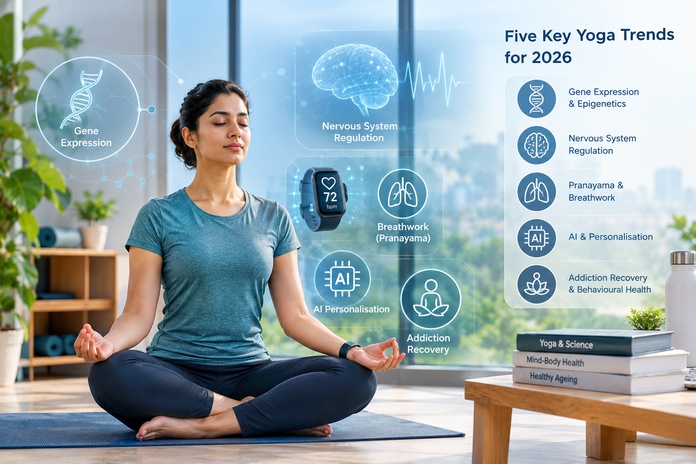
So what happens when an ancient practice meets genomics, wearables, artificial intelligence and modern healthcare? Yoga is being studied increasingly, not just as a form of physical exercise, but also as a mind-body practice that might influence stress regulation, mental health and other biological processes.
A report by the Global Wellness Institute’s Science of Yoga Initiative, released in 2026, identifies five emerging trends shaping the way yoga is researched, taught and practised around the world. These trends range from gene-expression studies and nervous-system regulation to AI-assisted personalisation and yoga’s role in behavioural health.
What’s Evolving in Yoga Research?
Yoga research is moving beyond the question of whether yoga is only good for flexibility or relaxation.
Specific yoga practices, such as movement, meditation and pranayama, the traditional yogic discipline of breath regulation, are increasingly being studied for their potential effects on physiological and psychological processes.
The Global Wellness Institute describes this as a growing bridge between traditional knowledge of yoga and modern research. Its 2026 trends report highlights five areas: genomics, nervous-system regulation, breathwork, artificial intelligence and addiction recovery.
These trends should be interpreted as areas of evolving research and practice, rather than as evidence that every claim associated with yoga has been scientifically validated.
1. Yoga and Gene Expression Research
One of the most interesting areas is epigenetics and gene expression.
Genes provide biological instructions. However, their activity can be influenced by many factors. Researchers are exploring whether lifestyle practices such as yoga may influence this activity.
According to the Global Wellness Institute, a 2025 systematic review of randomised controlled trials examined the effects of yoga on gene expression. The review reported changes in genes and biological pathways involved in immune regulation and inflammatory responses.
This does not mean yoga changes a person’s DNA or that yoga can turn disease-causing genes on or off in a clinically predictable manner.
Instead, researchers are investigating whether behavioural practices can influence biological processes involved in stress, inflammation and metabolism.
The research is still at an early stage. More studies are needed to understand how consistent these molecular changes are and whether they translate into meaningful long-term health outcomes.
2. Yoga and Your Nervous System
Another important research area is the autonomic nervous system, which controls functions such as heart rate, breathing and the body’s response to stress.
Yoga combines physical movement, breathing and meditation. Scientists are investigating whether these techniques can affect the balance between the body’s stress-response and recovery systems.
One commonly studied measure is heart-rate variability (HRV), the natural variation in the time between heartbeats. HRV provides information about autonomic nervous-system activity, but it is not a straightforward, stand-alone marker of overall health.
The report references clinical studies exploring HRV and yoga-based interventions, including studies involving anxiety and panic disorder.
This has helped fuel interest in what the wellness industry calls neurowellness, which focuses on stress regulation, resilience and nervous-system health.
For the public, the important point is that researchers are studying measurable physiological responses to yoga, not just subjective descriptions of relaxation.
3. Pranayama Joins the International Breathwork Conversation
Controlled breathing has become popular beyond the traditional practice of yoga.
Many contemporary breathwork practices are associated with pranayama, but the two terms are not necessarily synonymous. In traditional yoga, pranayama is part of a broader philosophical and contemplative system.
Scientific researchers are particularly interested in slow-paced breathing.
The Global Wellness Institute cites research on breathing patterns, autonomic regulation, HRV and stress-related outcomes. One example is a 2023 meta-analysis of randomised controlled trials examining the effects of breathwork on stress and mental health.
However, the science should not be reduced to a single universally ideal breathing rate or technique.
Studies differ in their protocols, populations and outcomes. More research is required to understand which approaches are most useful in specific circumstances.
There is also an important cultural consideration. Pranayama techniques are increasingly marketed as breathwork. Researchers and practitioners are discussing how to share these practices internationally while respecting their origins and traditional context.
4. Artificial Intelligence May Transform How Yoga Is Taught
Technology is bringing another significant change.
Wearable devices already collect data on heart rate, sleep patterns and movement. According to the report, this information could be used by AI-driven platforms to personalise yoga routines.
Imagine a digital platform that analyses recent sleep, movement and physiological data and suggests a gentler practice after a poor night’s sleep, or a more active session when appropriate.
Such technology could make yoga more accessible and provide feedback to users about their practice.
However, there is an important caveat: data cannot replace human judgement in every situation.
In the traditional context, a teacher observes a student’s physical and emotional responses and adjusts practices accordingly. This is especially important in yoga therapy, where individual assessment and safety are essential.
The likely future may therefore involve a combination of technology and human instruction rather than a fully automated yoga experience.
5. Yoga for Recovery from Addictions
Yoga is also attracting interest as a complementary practice in addiction recovery and behavioural health.
The report describes growing interest in using yoga as part of broader treatment programmes for conditions involving addiction, anxiety and depression. Researchers are investigating whether yoga can help with cravings, emotional regulation, awareness of bodily sensations and stress.
One relevant concept is interoception, the ability to notice and interpret signals from inside the body.
This research is particularly interesting because addiction is complex, involving biological, psychological and social factors. Yoga cannot address all these factors on its own.
The appropriate way to understand this development is that yoga is being studied as a supportive element of multidisciplinary care, not as a replacement for evidence-based addiction treatment.
What Does This Mean for Regular People?
These trends do not mean yoga has suddenly become a scientifically proven treatment for every health problem.
Instead, they indicate that researchers are asking increasingly specific questions.
For instance:
- Do specific yoga practices affect biological markers?
- What is the effect of meditation and breathing on stress regulation?
- Can wearable technology help personalise yoga practice?
- How can traditional practices be studied without losing their cultural context?
- How might yoga be incorporated into mainstream healthcare?
These questions are more useful than universal claims about yoga as a cure-all.
From the Perspective of Traditional Yoga
Scientific research today often examines individual components of yoga, such as postures, breathing, meditation and mindfulness.
However, traditional yoga is a much broader system.
Asanas are physical postures, while pranayama refers to the practice of controlled breathing. Meditation and other contemplative practices are also important elements of various yoga traditions.
This presents both an opportunity and a challenge for researchers.
Breaking yoga down into measurable components can make scientific research easier. However, studying individual components may not capture the full experience or philosophical framework of traditional yoga.
A balanced approach can recognise both perspectives without assuming that traditional concepts are automatically scientifically proven.
What Should Readers Take Away?
The five trends reflect an evolving research and wellness landscape, not a final scientific consensus.
Several important caveats should be kept in mind.
Early biological findings are not equivalent to clinical outcomes.
A change in gene expression or HRV does not necessarily mean that a disease has been prevented or treated.
Yoga is not a single, standardised intervention.
Different studies may use different combinations of meditation, relaxation, breathing techniques and postures.
Technology needs safeguards.
AI-generated recommendations based on wearable data may be helpful, but they should not replace professional assessment when medical or therapeutic needs exist.
Complementary does not mean curative.
Yoga may have a role in broader health and treatment programmes, but it should not replace prescribed medical care without appropriate professional advice.
Practical Takeaways
For those interested in the future of yoga and evidence-informed practice:
- Look for information that identifies the specific yoga practice being studied.
- Separate research findings from wellness marketing claims.
- Remember that biological changes do not automatically translate into clinical benefits.
- Select practices that suit your physical capacity and circumstances.
- If you are using yoga as part of treatment for a health condition, seek qualified guidance.
- Be cautious of apps or artificial intelligence systems that present personalised health suggestions as medical advice.
- Understand yoga practices and pranayama in their cultural and historical contexts.
Why These Trends Are Important
The significance of yoga research in 2026 is not that scientists are simply “proving” an ancient practice.
A more useful development is the growing effort to ask precise, testable questions about specific yoga practices and their possible effects on the body and mind.
At the same time, technology is providing new tools to measure and personalise practice. This creates opportunities for research and accessibility, but also raises questions about privacy, safety, cultural context and the role of human teachers.
The most promising future may be one in which traditional knowledge, rigorous research, responsible technology and human expertise inform one another.
Summary
The Science of Yoga Initiative’s 2026 trends reveal how quickly the field is developing, spanning gene-expression studies and nervous-system regulation to pranayama, artificial intelligence and addiction recovery.
The evidence across these areas remains mixed, and many questions remain unanswered. Nevertheless, yoga research is becoming more specific, interdisciplinary and technologically informed.
For the public, it is important to remain interested while maintaining a critical perspective. The future of yoga in health and wellness will depend not only on innovation, but also on the quality of evidence, responsible practice and respect for its traditional roots.
Medical Disclaimer: The contents of this article are for educational purposes only and are not intended to substitute for professional medical advice, diagnosis or treatment. Anyone using yoga alongside treatment for a health condition should seek advice from a suitably qualified healthcare professional.