


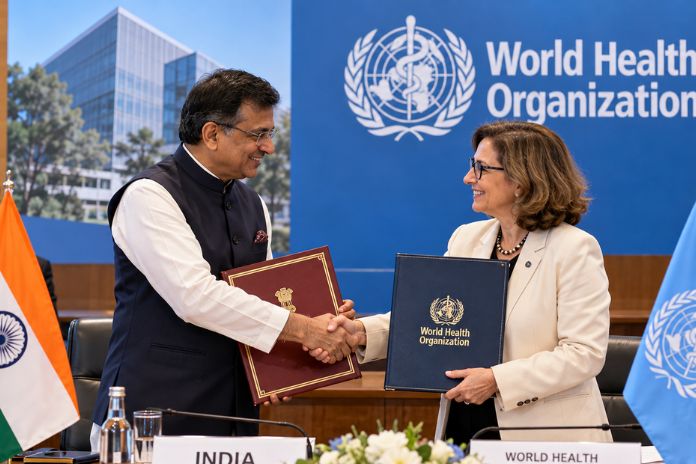
An agreement signed in May 2025 between India’s Ministry of Ayush and the World Health Organization supports work on classifying traditional medicine interventions within international health information systems.
India’s Ministry of Ayush and the World Health Organization (WHO) signed an agreement on 24 May 2025 to support work on a dedicated traditional medicine module under the International Classification of Health Interventions (ICHI). Announced by the Press Information Bureau (PIB) on 25 May 2025, the initiative aims to improve how traditional medicine interventions are described and documented within standardised health information frameworks.
The agreement includes a reported contribution of US$3 million from India to WHO’s work on traditional medicine and ICHI. The announcement was highlighted by Prime Minister Narendra Modi during the 122nd episode of his monthly radio programme, Mann Ki Baat. WHO Director-General Dr Tedros Adhanom Ghebreyesus also welcomed the agreement.
What is the International Classification of Health Interventions?
ICHI is a WHO classification system designed to support the recording, reporting and analysis of health interventions for clinical and statistical purposes. It complements other international health classifications, including the International Classification of Diseases (ICD).
While ICD primarily classifies diseases and related health conditions, ICHI focuses on the interventions carried out by healthcare providers. Standardised classification can help health systems describe services consistently, support clinical documentation and facilitate the analysis of health information across settings.
WHO’s published description of ICHI includes interventions across a broad range of health services, including traditional medicine. The India–WHO agreement announced in May 2025 specifically concerns work on a dedicated traditional medicine module within this framework.
Relevance for Ayurveda and other Ayush systems
The PIB announcement identifies Ayurveda, Yoga, Siddha and Unani among the systems relevant to the proposed work. Examples mentioned include Panchakarma, Yoga therapy, Unani regimens and Siddha procedures.
Using consistent terminology to record interventions could help healthcare institutions and researchers describe services more systematically. It may also support the comparison and analysis of health service information, provided the classification is implemented appropriately and the underlying data are reliable.
For Ayurveda practitioners, researchers, academic institutions and healthcare administrators, the development is relevant to discussions about clinical documentation, health information systems and the representation of traditional medicine in international frameworks.
Potential implications for healthcare documentation and policy
According to the government announcement, the initiative is expected to support improvements in areas such as clinical documentation, hospital management, health research and the recording of Ayush services. The release also identifies transparent billing, fair pricing, insurance-related integration and wider accessibility as potential benefits.
These are intended benefits rather than confirmed outcomes of the agreement. Standardised classification can provide a common way to describe interventions, but it does not, by itself, establish that a treatment is clinically effective or safe. Nor does classification automatically guarantee insurance coverage, reimbursement or acceptance by healthcare systems in individual countries. Such decisions depend on relevant evidence, regulations, financing arrangements and institutional policies.
The development should therefore be understood as a step in health information standardisation and international cooperation, rather than as a blanket endorsement of all traditional medicine treatments.
India–WHO cooperation on traditional medicine
The agreement reflects India’s stated interest in increasing the international visibility of its traditional medicine systems and supporting their documentation within global health frameworks. WHO’s role includes maintaining international classifications that enable consistent recording and analysis of health interventions.
The government release presented the initiative as a means of helping Ayush reach more people through a scientific approach. Its longer-term significance will depend on how the work progresses, how the module is developed and used, and whether standardised information contributes to stronger research, regulation and healthcare decision-making.
For practitioners, researchers, policymakers and institutions working in Ayurveda and other Ayush disciplines, the agreement highlights the growing importance of standardised terminology and reliable health data in discussions about traditional medicine’s place in healthcare systems.
Source: Press Information Bureau, Government of India, 25 May 2025, Release ID 2131164. The announcement describes the agreement and its expected benefits; it does not establish clinical effectiveness for individual treatments.