


Prof. (Dr) Rabinarayan Acharya
Director General, CCRAS
The Union Budget 2026/27 has sent an unambiguous signal. The Ministry of Ayush has received a record allocation of ₹4408.93 crore – a four-fold increase since the ministry was formed in 2014. Within that envelope, the Central Council for Research in Ayurvedic Sciences (CCRAS), the country’s apex body for Ayurvedic research, has been allocated ₹524 crore (Budget estimate 2026/27). These are not mere numbers. They represent a national commitment to building the evidence base, the quality infrastructure, and the scientific partnerships that will carry Ayurveda onto the world stage.
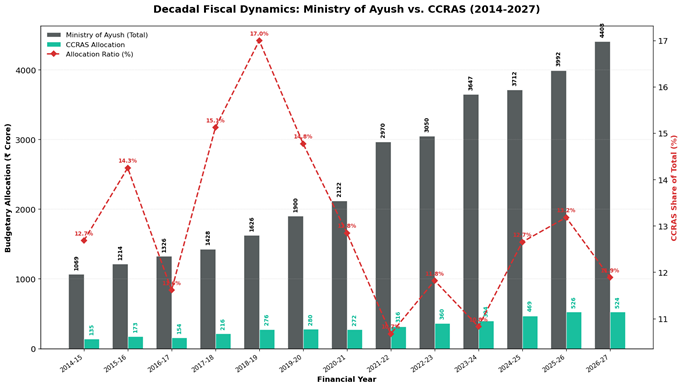
The chart above tells a story of sustained and accelerating commitment. When the Ministry of Ayush was carved out as a separate ministry in November 2014, its first budget stood at ₹1069 crore. Twelve years on, that figure has quadrupled. More significantly, the growth has not been linear – recent years show a sharp upward inflection, reflecting a government that sees Ayurveda not as a welfare item but as a knowledge-based economic sector with serious export potential. For CCRAS, the journey mirrors that of the parent ministry. Starting from ₹135.56 crore, the Council’s budget has grown nearly four-fold to ₹524 crore, enabling it to move from basic documentation to rigorous, multi-site, internationally peer-reviewed research.
The demand for natural, holistic healthcare has never been higher. According to data published by the India Brand Equity Foundation (IBEF) and Ministry of Ayush assessments, the Indian Ayush market grew from just USD 2.85 billion in 2014 to USD 43.3 billion by 2020 – an extraordinary 15-fold increase in one decade. Exports of Ayurvedic and herbal products have also more than doubled, crossing USD 2 billion annually. As per IBEF, ‘The Indian Ayush market is projected to reach USD 200 billion by 2030, reflecting an exponential growth of almost five times over just six years.’
This target aligns perfectly with the World Health Organization’s (WHO) 2025–2034 Global Traditional Medicine Strategy, which has shifted its focus from ‘Traditional Medicine’ (TM) to the broader concept of ‘Traditional, Complementary and Integrative Medicine’ (TCIM). The strategy recognises that traditional healing systems, when backed by scientific evidence and quality standards, can form an essential part of universal health coverage – a mission CCRAS is actively supporting.
- Multidisciplinary research: Breaking silos, CCRAS is moving decisively beyond single-discipline studies. The new budget supports collaborative research with premier national institutions, Council of Scientific and Industrial Research (CSIR), Indian Council of Medical Research (ICMR), Indian Council of Agricultural Research (ICAR), All India Institute of Medical Sciences (AIIMS), Indian Institutes of Technology (IITs), National Institute of Pharmaceutical Education and Research (NIPERs), and other recognised bodies under the Department of Biotechnology (DBT) and the Department of Science and Technology (DST). By bringing together Ayurvedic scientists, molecular biologists, clinicians, and data scientists under one research roof, CCRAS is producing findings that no single discipline could generate alone. This is what modern science calls ‘convergence research’, and Ayurveda is uniquely positioned to lead it.
- Quality science: Accreditation and Standards Research findings are only as credible as the facilities and processes that produce them. CCRAS has, therefore, prioritised the accreditation of its hospitals and laboratories with nationally and internationally recognised bodies. Its facilities carry certifications from the National Accreditation Board for Testing and Calibration Laboratories (NABL), the National Accreditation Board for Hospitals (NABH), and comply with Good Manufacturing Practices (GMP) standards for quality medicine production. This rigorous quality framework means CCRAS data is accepted in international journals, regulatory submissions, and WHO technical consultations.
- Public health: Research that reaches people and science that stays in a laboratory do not save lives. CCRAS has made large-scale public health research a central priority. The Council is conducting multi-site clinical studies on conditions where Ayurveda has a well-established historical background like anaemia, non-communicable diseases (NCDs) such as diabetes, arthritis, cardiovascular conditions, and metabolic disorders. These are the conditions driving India’s growing disease burden, and Ayurveda’s holistic, preventive approach offers genuinely promising solutions that need rigorous clinical evidence.
- Digital and AI integration research for the 21st century: CCRAS runs the NAMASTE Portal and the Ayush Research Portal, which together host over 43,000 research articles, the largest digital repository of Ayurvedic evidence in the world. Platforms such as SAHI, CCRAS-DRAVYA, and Ayurgenomics are integrating AI with traditional medicine knowledge, enabling predictive diagnostics and precision Ayurveda. The WHO has specifically recognised these AI-driven innovations as a model for global traditional medicine.
The Road to a USD 200 Billion Ayush Economy
The Ministry of Ayush’s Vision 2030 is not wishful thinking, it rests on a clear strategic architecture, with CCRAS providing the scientific foundation. Here is how research investment translates into economic opportunity:
Evidence base: Regulatory acceptance, rigorous CCRAS clinical trials, and safety studies enable Ayurvedic medicines to meet the regulatory standards of export markets – the EU, USA, Japan, and Gulf countries. Without peer-reviewed evidence, these markets remain closed. With it, they open.
WHO alignment: CCRAS’s collaboration with the WHO on TCIM strategy and ICD-11 classification positions Ayurveda as a mainstream healthcare system, not an ‘alternative’. This recognition drives insurance coverage, hospital adoption, and government procurement abroad.
CCRAS is strategically advancing research to deliver quality-assured, evidence-based formulations for national and global markets. Standardised ‘coded formulations’ such as AYUSH-64, AYUSH-82, and AYUSH-SG demonstrate scalable, reproducible, and internationally compliant products. Over 40 research products targeting diverse disease conditions are in the pipeline, with several already commercialised.
CCRAS’s collaborative research with these international partners builds trust, raises awareness, and drives demand for Indian Ayurvedic products and services worldwide.
NCD research: India has over 101 million people living with diabetes and is the world’s hypertension capital. CCRAS’s large-scale NCD clinical studies are building the evidence for Ayurvedic interventions in these conditions, unlocking the enormous domestic healthcare market and reducing pressure on the overloaded allopathic system.
The enhanced budget allocation is expected to accelerate intensive research and expand the portfolio of validated products.