


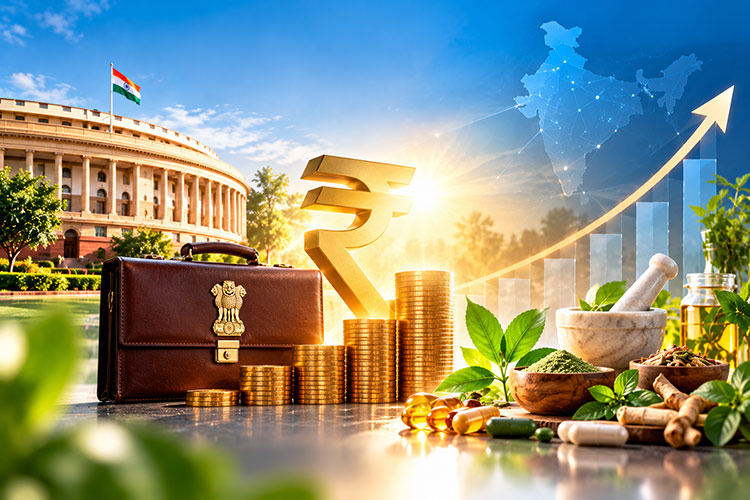
India’s healthcare needs are changing. Alongside treatment for illness, there is growing demand for prevention, rehabilitation and long-term support for people living with chronic conditions. According to healthcare leaders quoted in an ETHealthworld report, the Union Budget 2026–27 could help strengthen this broader approach through its focus on AYUSH, healthcare infrastructure, workforce development and research.
For Ayurveda and the nutraceutical industry, the opportunity is significant—but experts emphasise that sustainable growth must rest on evidence, quality and consistent standards.
Bringing AYUSH into Integrated Healthcare
One of the key proposals highlighted in the report is the creation of five regional medical hubs with dedicated AYUSH centres. These hubs are intended to bring treatment, education and research into a connected ecosystem, while incorporating diagnostics, rehabilitation and post-care services.
This matters because healthcare does not end when a patient leaves a hospital. People managing chronic and lifestyle-related conditions often need continuing support, including follow-up care, rehabilitation and help with daily habits.
Dr Mukesh Batra, Founder-Chairman Emeritus of Dr Batra’s Healthcare, viewed the proposal as a step towards stronger preventive and integrated healthcare, particularly outside metropolitan centres.
Rajiv Vasudevan, Founder, CEO and Managing Director of Apollo AyurVAID, similarly highlighted the need for an integrative response to India’s growing burden of non-communicable diseases. In his assessment, greater attention to Ayurveda and Yoga could strengthen the preventive and lifestyle dimensions of care.
The potential lies in coordinated services rather than treating different systems of medicine as isolated alternatives. Delivering that potential will depend on clear clinical standards, appropriate referrals and effective implementation.
Nutraceutical Growth Needs More Than Demand
The Budget’s wider support for seeds, food processing, micro, small and medium enterprises, and research and development could provide a stronger foundation for the nutraceutical sector, according to Sanjaya Mariwala, Executive Chairman and Managing Director of OmniActive Health Technologies.
Nutraceuticals are broadly understood as products derived from food sources and marketed for potential health benefits. Their development connects agriculture, processing, manufacturing and scientific research.
Mariwala stressed that growing global interest in AYUSH and Ayurveda will endure only when supported by proof, quality and consistency. That observation is especially important for a sector where consumer confidence depends on reliable ingredients, manufacturing standards and credible product claims.
The opportunity, therefore, is not simply to launch more products. It is to build a more dependable ecosystem—from raw materials to finished formulations—with research supporting what businesses promise consumers.
Building the Workforce Behind Better Care
Infrastructure alone cannot deliver better healthcare. Skilled professionals are equally essential.
The report highlights the Budget announcement to add one lakh allied healthcare professionals over five years, through upgrades to existing institutions and the establishment of new ones. Gautam Khanna, CEO of P D Hinduja Hospital and Medical Research Centre, said this could help address workforce gaps in diagnostics, peri-operative care, mental and behavioural health, and rehabilitation.
The government’s target to train 1.5 lakh caregivers also reflects the needs of India’s ageing population. A stronger caregiver workforce could support older adults and help families manage continuing care needs.
For integrated healthcare initiatives, these investments could be particularly valuable: preventive care, rehabilitation and follow-up services all depend on people with the right training.
Research and Medical Travel Add Another Dimension
The Budget’s healthcare ambitions extend to innovation. The ETHealthworld report cites a ₹10,000 crore allocation for the biopharma sector and a proposal to accredit 1,000 Indian clinical trial sites.
These are broader life-sciences measures, not dedicated AYUSH or nutraceutical allocations. However, they point towards an emphasis on strengthening India’s research ecosystem.
The proposed regional medical hubs could also support India’s position as a destination for medical travellers. Dr Issac Mathai, Founder Chairman and Medical Director of SOUKYA International Holistic Health Centre, highlighted the potential of hubs that connect treatment, education and research.
The Real Test Is Implementation
The Union Budget 2026–27 offers a promising direction for a healthcare system that gives greater attention to prevention, continuity of care and coordinated services.
For AYUSH institutions and nutraceutical businesses, the next step is to translate policy momentum into measurable outcomes. That means investing in research, maintaining quality, developing skilled teams and communicating health claims responsibly.
The lasting opportunity is not growth alone, but growth that earns trust.
Source: Adapted from the PTI report published by ETHealthworld on 2 February 2026, “Budget 2026–27: Experts see momentum for AYUSH, nutraceutical ecosystem.”