


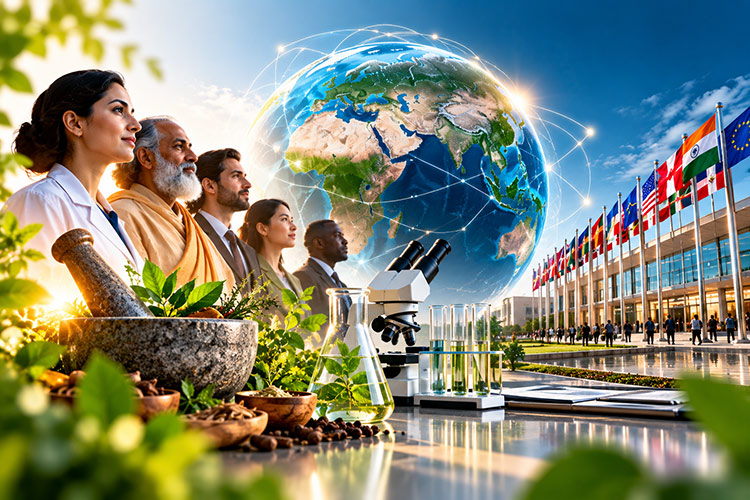
Traditional medicine is gaining greater international attention—but its lasting contribution to healthcare will depend on research, safety and responsible integration.
As healthcare systems confront lifestyle-related illnesses, stress and mental health challenges, the conversation is expanding beyond treating disease to supporting long-term wellbeing. Prevention, healthier daily habits and more coordinated care are becoming increasingly important.
Against this backdrop, India is making a stronger case for AYUSH in global health discussions. At the 3rd International Ayush Conference and Exhibition (IACE 2026) in Dubai, Union Minister of State for Ayush Prataprao Jadhav argued that traditional medicine is moving from the margins towards the centre of international healthcare dialogue.
The significance of that message lies not simply in greater recognition, but in what must come next: turning international interest into credible research, reliable standards and meaningful patient care.
A Global Conversation About Whole-Person Health
According to the Ministry’s statement cited in the ETHealthworld report, the three-day conference brought together participants from 28 countries for scientific discussions, consultations and partnership-building.
Jadhav highlighted Ayurveda, Yoga, Siddha, Unani and Homoeopathy as approaches concerned with physical, mental and social wellbeing. He said AYUSH could contribute to preventive and holistic care through interventions connecting body, mind and environment.
These remarks reflect India’s policy vision for traditional medicine. However, international visibility is not the same as clinical validation. Different systems and interventions have different evidence bases, and claims about their benefits need to be assessed individually.
That distinction is essential if growing interest is to translate into public trust.
From Traditional Experience to Scientific Evidence
One of the conference’s key developments was discussion of a draft international white paper on AYUSH interventions for mind-body health.
The proposed document aims to support three important shifts:
- From experience-based practice towards evidence-based validation.
- From isolated practices towards structured treatment protocols.
- From parallel systems towards integrated healthcare frameworks.
Once finalised, the white paper is expected to serve as a reference for governments, academic institutions and international organisations working in integrative medicine and public health policy.
For now, it remains a draft—not a completed guideline or proof of effectiveness. Its value will depend on the quality of evidence it evaluates and the clarity of its recommendations.
A credible framework should help answer practical questions: Which interventions offer measurable benefits? For which conditions? What are their risks, limitations and possible interactions with other treatments?
Global Acceptance Requires More Than Promotion
Jadhav also emphasised quality assurance, pharmacopeial compliance and international certification as priorities for AYUSH products and services.
These requirements are central to patient safety. Wider availability must be accompanied by confidence in product identity, composition, consistency and manufacturing quality. Likewise, healthcare services need appropriate professional standards and clear accountability.
The minister linked the Dubai discussions to the WHO Global Summit on Traditional Medicine in New Delhi and the Delhi Declaration, highlighting their emphasis on evidence generation, safety and responsible integration.
The direction is clear: global acceptance must be earned through dependable standards, not assumed because a practice has a long history.
Partnerships Must Deliver Practical Results
The conference promoted joint research, academic exchanges, regulatory cooperation, investment partnerships and the expansion of medical value travel and AYUSH services.
Each offers opportunities, but announcements alone are not outcomes. The real test will be whether partnerships produce rigorous studies, stronger training, transparent quality checks and demonstrable improvements in care.
Responsible integration should also preserve access to established diagnosis and treatment. A whole-person approach is most useful when it strengthens appropriate medical care rather than delaying or replacing necessary treatment.
The Next Chapter for AYUSH
The Dubai conference signals growing international engagement with India’s traditional healthcare systems. It also brings a greater responsibility to communicate benefits carefully, acknowledge uncertainty and place patient safety first.
AYUSH’s strongest route to global credibility is not tradition versus modern medicine—it is tradition examined through evidence, supported by quality standards and applied responsibly.
That is how greater visibility can become a meaningful contribution to global health.
Source: Adapted from the PTI report published by ETHealthworld on 19 February 2026, “Ayush no longer at margins but at centre of global health discourse: Prataprao Jadhav.”