


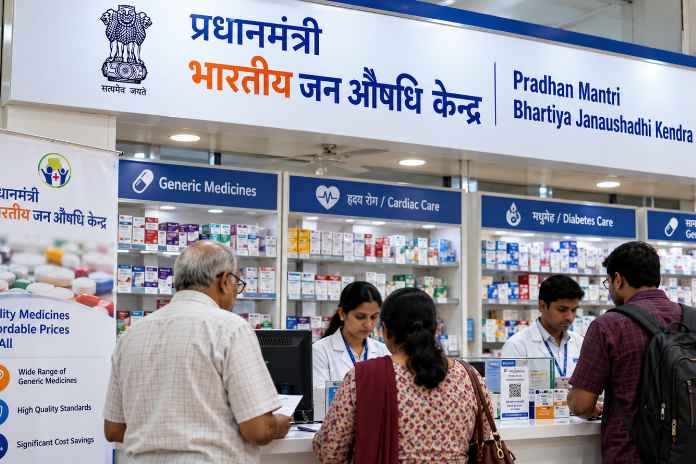
Affordable medicines are an important part of healthcare. But what if people need medicines from different systems of health care and they have difficulty in getting them locally? A parliamentary panel in India has urged quicker action on a proposal to provide AYUSH medicines via the country’s national network of Jan Aushadhi Kendras.
The Department-related Parliamentary Standing Committee on Health and Family Welfare has asked the Ministry of AYUSH to finalise and implement the proposed co-branding initiative within a definite time frame. The recommendation was reported by Medical Dialogues on 4 October 2026, within the framework of a broader discussion on affordable healthcare and accessibility of traditional systems of medicine.
The recommendation is for policy development and not a guarantee that AYUSH medicines are already available in every Jan Aushadhi Kendra.
What is the proposal?
The proposal intends to leverage the Pradhan Mantri Bhartiya Janaushadhi Kendras (commonly known as Jan Aushadhi Kendras) to enhance the visibility and availability of AYUSH medicines.
AYUSH is an umbrella term for Ayurveda, Yoga and Naturopathy, Unani, Siddha and Homoeopathy. These systems have different approaches and practices and the medicines associated with them are subject to relevant regulatory and quality requirements.
Jan Aushadhi Kendras are the government’s initiative to enhance access to affordable generic medicines. The parliamentary committee has recommended that this existing retail network can also be used to help people access suitable, standardised AYUSH pharmaceutical products.
The proposal is based on co-branding – a coordinated approach to the presentation of products or services under more than one institutional or program identity. Details of the exact arrangements including which products would be included, and how the initiative would operate, need to be confirmed in official implementation details.
Why has the parliamentary committee called for action to be accelerated?
According to a report, a review meeting chaired by the Prime Minister held on February 27, 2025 had discussed the possibility of using Jan Aushadhi Kendras to promote AYUSH medicines through suitable co-branding.
But the ministry of AYUSH was reported to have told the committee that it was looking at further action. The committee found this response insufficient and recommended that the proposal be finalised and implemented within a strict time frame.
The policy concern is access, fundamentally. “If the right AYUSH medicines are provided through a good retail network, there could be another option for people to access such products.” The committee thinks this could help make it more broadly available and affordable.
These are the intended benefits of the proposal, not outcomes that have already been proven by a completed rollout.
What else did the committee suggest?
The suggestion for co-branding was one element of a wider bundle of recommendations on AYUSH healthcare services.
1. Providing AYUSH services at the doorstep of the patients
The committee deliberated on availability of AYUSH services in conjunction with the conventional health care facilities like Primary Health Centers (PHCs), Community Health Centers (CHCs) and district hospitals.
Concerns were raised about patchy access between states and regions when expansion is heavily dependent on individual state proposals and projected staffing needs.
The Committee, therefore, recommended stronger coordination between the Ministry of AYUSH and the Ministry of Health and Family Welfare and a baseline policy for co-located AYUSH facilities.
Co-location refers to the delivery of services from different health care systems at the same institution or facility. The practical operation of such services would be important in terms of how they would be staffed, supervised and coordinated.
2. Connecting underserved communities
The report also mentioned outreach approaches adopted by AYUSH institutions and research councils including satellite clinics and other community-level activities.
The committee recommended expanding satellite clinic models to aid in reaching underserved, rural and tribal areas. If they have the right staff, facilities and resources in place, such services could help reduce the distance some people need to travel for healthcare.
3. Enhancing digital access to care
The other recommendation was to integrate eSanjeevani with Hospital Management Information Systems (HMIS) at AYUSH dispensaries, peripheral institutions and clinical units.
eSanjeevani is a telemedicine initiative by the government. HMIS stands for digital systems that are used to manage healthcare information and the operations of a hospital.
Improved digital integration could strengthen healthcare facilities’ capacity to coordinate information and provide services remotely. But the extent of any benefit would depend on implementation, digital connectivity, staffing and appropriate safeguards for patient information.
4. Infrastructure and affordability strengthening
The committee also recommended targeted funding for upgrading bed capacity and diagnostic facilities in smaller AYUSH institutions. It recommended a universally subsidised tariff structure for registration, diagnostics and essential medicines at National Institutes.
These recommendations speak to a larger issue: access to medicines is more than simply availability. This also requires appropriate facilities, trained personnel, reliable diagnostics and clear information on costs.
What does this mean for the public?
The proposed co-branding initiative, if implemented, could offer one more pathway for the people seeking eligible AYUSH medicines. The practical value will depend on what products are included, where they are available, how quality is assured and whether they are made consistently available.
For the public, a few questions will be important:
- Availability: What medicines will be available where?
- Cost: How much will it cost and will there be any subsidies?
- Quality: What standards, testing and regulatory requirements will be imposed on the products?
- Information: Will people receive clear guidance about the products, approved uses and precautions?
- Implementation: When will the scheme start and how will it be monitored?
The committee’s recommendations do not answer these questions themselves. We’ll need more official announcements to know the final arrangements.
It is also important to distinguish between wider availability and medical effectiveness. Just because a product is being sold through a retail network does not mean that it is effective for a particular condition or suitable for every person. “Medicines should be used properly and with professional advice when needed.
Understanding the larger AYUSH policy discourse
The recommendations raise a broader question of policy: how to make healthcare services more accessible, while preserving quality, affordability and appropriate oversight?
This includes strengthening supply of medicines, support for research and health infrastructure, better access to qualified practitioners and accurate communication of evidence for AYUSH systems.
Traditional knowledge and practices may be important areas of study; however, claims regarding the safety or efficacy of a medicine must be assessed based on the evidence concerning the specific product and use. Policy support and retail availability do not constitute scientific evidence that a treatment works.
Patients need reliable product information, clinical advice and an understanding of potential benefits and risks to make informed decisions.
What’s coming next?
The next crucial step is to spell out the co-branding model by the Ministry of AYUSH and the concerned agencies, identify the products that would be eligible, work out the implementation arrangements and communicate the time frame.
Tracking whether the initiative improves actual availability and affordability will be important as well, not just measuring progress by the announcement or launch of the scheme.
The message from the parliamentary committee is clear: a proposal to improve access must move from the drawing board to reality. The extent to which it achieves the stated public benefit will depend on how the policy is implemented and evaluated.
The take-away: This proposal for improving access to AYUSH medicines through Jan Aushadhi Kendras is part of a larger discussion on affordable and accessible health care in India. “While the proposal may create opportunities, the real impact will depend on transparent implementation, product quality, appropriate use and ongoing oversight.”
Disclaimer: The information provided in this article is for general information only and is not meant to replace professional medical advice. “Not all drugs are right for all people or for all conditions just because they are available in a government-related retail program.
Source note: This blog is mainly based on the report of Medical Dialogues dated 4 October 2026 and the parliamentary recommendations as detailed in that report. Kindly note that the proposed co-branding initiative should not be considered as implemented until confirmed in an official update.