


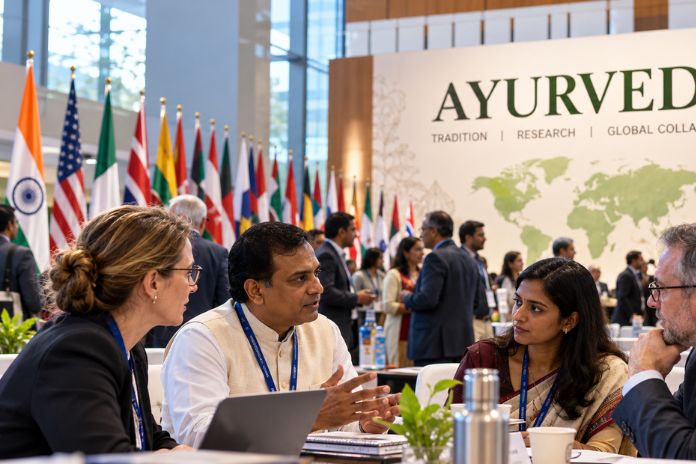
From traditional knowledge and wellness tourism to international standards and digital health platforms, Ayurveda is gaining a wider global presence. But sustainable growth will depend on scientific evidence, quality assurance and responsible healthcare practices.
Introduction: Why is the world looking towards Ayurveda?
Why are people across different countries becoming interested in traditional systems of medicine? For some, the attraction lies in lifestyle and wellbeing. Others are interested in traditional approaches to preventive healthcare, while researchers and policymakers are exploring how traditional medical knowledge can be documented, evaluated and incorporated into contemporary health systems.
Ayurveda, one of India’s longstanding medical traditions, is increasingly part of this international conversation. Its presence now extends beyond traditional clinical settings to academic institutions, wellness centres, policy discussions, digital platforms and medical tourism.
A 2025 article in the Journal of Indian Medical Heritage, titled Global Scenario of Ayurveda: Medico-Historical and Anthropological Perspectives and Health-Seeking Behaviours, examines this changing landscape. Written by Rabinarayan Acharya, the article explores how Ayurveda’s global journey is shaped by historical exchanges, cultural adaptation, government initiatives, international collaborations and efforts to establish common standards.
The central message is that Ayurveda’s international growth presents opportunities, but it also brings responsibilities. Preserving traditional knowledge must go hand in hand with quality, safety, credible research and ethical healthcare.
What did the article explore?
Rather than testing a medicine or evaluating a treatment in a clinical trial, the article offers a broad perspective on Ayurveda’s international development.
It considers three connected questions:
- How has Ayurveda travelled beyond its historical roots in the Indian subcontinent?
- What institutions, policies and collaborations are supporting its international development?
- What needs to be done to strengthen quality, public trust and scientific credibility as its reach expands?
The article brings together historical, anthropological and policy perspectives. Anthropology, in this context, means understanding how people and communities interpret health, illness and healing within their cultural and social environments.
This perspective is important because healthcare choices are not determined by medical evidence alone. Cultural familiarity, affordability, personal beliefs, accessibility and previous experiences can also influence which healthcare systems people choose.
How Ayurveda’s global journey is evolving
1. From historical knowledge exchange to modern wellness practices
The movement of medical knowledge across regions is not new. Trade, travel and scholarly exchanges have historically helped transmit medical ideas and practices between communities.
Today, Ayurveda’s international presence reflects a different but related process: traditional practices are being interpreted within contemporary wellness cultures and healthcare environments.
According to the article, Ayurveda attracts interest in areas such as preventive care, stress management, skincare and lifestyle balance, particularly among some urban populations in Europe, North America, Australia and East Asia.
However, interest in these areas should not be confused with proof that every Ayurvedic intervention is effective for every health condition. Public interest, traditional use and scientific evidence are distinct considerations.
In Europe and other regions, Ayurveda’s development also depends on national laws, professional recognition, practitioner training and public expectations regarding safety and quality.
2. International collaboration and institutional support
India has undertaken initiatives to support the international presence of Ayurveda and other AYUSH systems, which include Ayurveda, Yoga and Naturopathy, Unani, Siddha, Sowa-Rigpa and Homoeopathy.
The article describes the Ministry of Ayush’s International Cooperation Scheme, which supports activities such as academic collaboration, international workshops, educational initiatives and the promotion of AYUSH-related products and services.
It reports several institutional milestones, including:
- 25 country-level memoranda of understanding (MoUs).
- 52 institute-to-institute collaborations.
- 43 AYUSH information cells established across 39 countries.
These figures are reported in the 2025 article and should be understood in the context of the initiatives it describes.
International partnerships can create opportunities for knowledge exchange, training and collaborative research. Their long-term value, however, depends on whether they produce meaningful outcomes, including reliable research, appropriate education and improved standards of practice.
3. Why standardisation matters
One of the important challenges in expanding Ayurveda internationally is ensuring consistency in the quality of medicines, equipment, terminology and professional practices.
Standardisation means establishing agreed requirements or methods so that products and procedures can be assessed against clearly defined criteria.
For herbal medicines, this may involve checking identity, purity, composition and other quality parameters. For equipment and clinical procedures, standards can help establish consistent specifications and operational requirements.
The article highlights the work of the Bureau of Indian Standards (BIS), which has developed standards covering areas such as medicinal plants, Ayurveda-related terminology and Panchakarma equipment.
It reports that 91 BIS standards had been published at the time described, alongside additional documents at different stages of development.
Such standards can support quality assurance and help reduce avoidable variation. Nevertheless, standardisation alone does not establish that a treatment is clinically effective. Product quality, safety and therapeutic effectiveness are related but separate questions, each requiring appropriate assessment.
4. Digital platforms and the preservation of traditional knowledge
Digital technology is creating new opportunities to document, organise and share traditional medical knowledge.
The article discusses the Ayush Grid, a digital health initiative launched by the Ministry of Ayush in 2018. It is intended to support different areas of the AYUSH sector, including healthcare services, education and research, while aligning with India’s wider digital health infrastructure.
Another initiative is the National AYUSH Morbidity and Standardized Terminologies Electronic (NAMASTE) portal. Its purpose includes developing consistent terminology and coding systems for AYUSH-related health information.
The article also highlights the Traditional Knowledge Digital Library (TKDL), developed through collaboration between the Ministry of Ayush and the Council of Scientific and Industrial Research. Established in 2001, the TKDL documents traditional knowledge in searchable formats to help patent offices identify existing knowledge and assess relevant patent claims.
These initiatives serve different purposes, but they share an important objective: making traditional knowledge easier to document, organise and evaluate while helping protect it against inappropriate claims of novelty or ownership.
5. Ayurveda, international health frameworks and medical tourism
The article also discusses India’s collaboration with the World Health Organization (WHO) on international classification systems for traditional medicine.
Standardised terminology and classification can help health systems record information more consistently and improve communication between institutions. However, inclusion in a classification system should not automatically be interpreted as WHO endorsement of the effectiveness of every treatment within that system.
Another development is the establishment of the WHO Global Traditional Medicine Centre in Jamnagar, Gujarat, intended to support work relating to traditional, complementary and integrative medicine.
Medical and wellness tourism is also contributing to Ayurveda’s international visibility. India’s introduction of a separate Ayush visa category facilitates travel for foreign visitors seeking treatment under eligible AYUSH systems.
These developments may support international engagement, education and tourism. They also increase the importance of transparent information, qualified practitioners, appropriate patient safeguards and clear communication about what different treatments can reasonably be expected to achieve.
What does this mean for ordinary people?
For the public, Ayurveda’s growing international presence creates more opportunities to encounter traditional healthcare practices. It also makes informed decision-making increasingly important.
A few principles can help people navigate this changing landscape:
- Look beyond popularity. A treatment’s international popularity does not, by itself, demonstrate its safety or effectiveness.
- Check product quality. Reliable manufacturing, appropriate testing and transparent labelling matter when choosing herbal or traditional medicines.
- Seek qualified care. Practitioners should have appropriate training and work within the relevant legal and professional requirements.
- Understand the evidence. Traditional use, laboratory findings and well-designed clinical trials provide different levels and types of evidence.
- Discuss treatments with healthcare professionals. Some herbal products can cause adverse effects or interact with prescribed medicines. Conventional treatment should not be stopped or delayed without appropriate medical advice.
These principles apply to traditional and modern healthcare alike.
Understanding the Ayurvedic perspective
Ayurveda approaches health through a framework that considers lifestyle, diet, individual characteristics and the relationship between a person and their environment.
The article’s historical and anthropological perspective adds another dimension: Ayurveda is not only a collection of medical concepts and practices, but also a body of knowledge shaped by communities, institutions, cultural exchanges and changing social needs.
Its international development therefore involves more than exporting products or opening wellness centres. It also requires thoughtful engagement with different healthcare systems, cultural expectations, professional standards and contemporary research methods.
For evidence-informed Ayurveda, an important task is to investigate traditional practices rigorously while representing their principles accurately. Traditional explanations can provide valuable research questions, but claims about clinical benefits must be supported by appropriate evidence.
What challenges lie ahead?
The article identifies several priorities for Ayurveda’s sustainable global development.
Reliable evidence: More high-quality research is needed to establish the benefits, risks and appropriate uses of specific interventions.
Quality and safety: Consistent standards, suitable manufacturing practices and effective monitoring are essential to protect the public.
Education and professional practice: Appropriate training and ethical conduct can help build confidence among patients, healthcare professionals and regulators.
Protection of knowledge and natural resources: Digital documentation and intellectual property safeguards should be accompanied by responsible use of medicinal plants and attention to ecological sustainability.
International cooperation: Partnerships should lead to meaningful research, knowledge exchange and improvements in practice, rather than being measured solely by the number of agreements signed.
These priorities also help clarify the limits of the article. It is a broad perspective on Ayurveda’s international development, not a clinical study measuring patient outcomes. It does not establish that international expansion, standardisation initiatives or increased public interest necessarily lead to improved health outcomes.
Practical takeaways
Readers can take away five important messages:
- Ayurveda’s global presence is being shaped by historical connections, cultural adaptation, government initiatives and international partnerships.
- Digital platforms can help preserve traditional knowledge and improve consistency in health terminology.
- Standards for medicines and equipment can support quality assurance, but they do not independently prove therapeutic effectiveness.
- Research, safety monitoring, professional education and transparent communication are essential to public trust.
- Informed healthcare decisions should consider both the available evidence and the potential risks of individual treatments.
Conclusion: Building Ayurveda’s future through evidence and responsibility
The global scenario of Ayurveda reflects a continuing interaction between traditional knowledge and the changing needs of contemporary healthcare. International collaboration, digital documentation, standardisation and wellness tourism are creating new opportunities for its development.
Yet lasting progress will depend on more than visibility or international recognition. It will require rigorous research, reliable quality standards, ethical practice and responsible stewardship of traditional knowledge and natural resources.
For Ayurveda, the way forward lies in preserving its historical and cultural significance while carefully evaluating its contemporary applications. An evidence-informed approach can help ensure that its global development is guided not only by interest and opportunity, but also by accountability, safety and respect for the people who seek care.
Medical disclaimer: This article is for educational purposes only and is not a substitute for professional medical advice, diagnosis or treatment.
Original research source
Acharya R. Global Scenario of Ayurveda: Medico-Historical and Anthropological Perspectives and Health-Seeking Behaviours. Journal of Indian Medical Heritage. 2025;4(Suppl 1)–S3. DOI: 10.4103/jimh.jimh_88_25.