


Ayurveda in Vedic Literature: Exploring the Ancient Roots of India’s Holistic Health Tradition
How did ancient Indian traditions understand health, the human body and the relationship between people and the natural world? The Vedas and classical Ayurvedic texts offer an important starting point for exploring these questions.
A 2024 article, Ayurveda in Vedic Literature: Discovering the Historical Foundations of Holistic Healing, examines the philosophical connections between Vedic literature and Ayurveda. It discusses ideas such as the five elements, the three doshas, medicinal plants, lifestyle practices and the relationship between physical, mental and spiritual well-being.
The article invites readers to explore Ayurveda not only as a traditional system of healthcare but also as a body of knowledge shaped by India’s intellectual, philosophical and medical history. Understanding that history, however, requires distinguishing traditional accounts of Ayurveda’s origins from what historical and textual research can establish.
What did the authors investigate?
The article by Vishesh Kumar Singh and Shashirekha H. K. explores the relationship between the four Vedas—Rigveda, Yajurveda, Samaveda and Atharvaveda—and the ideas that underpin Ayurveda.
The authors discuss how Vedic literature refers to the natural world, plants, well-being and broader philosophical ideas. They also consider how concepts associated with Ayurveda can be understood alongside themes such as Dharma (duty or right conduct), Karma (action and its consequences), yoga and meditation.
The central purpose is to describe the historical and philosophical foundations that the authors associate with Ayurveda. This is a literature-based historical discussion, rather than a clinical trial or an experiment testing whether an Ayurvedic treatment improves a particular health condition. It does not report new patient data or measured treatment outcomes.
This distinction matters: an article examining ancient texts can help explain the development of medical ideas, but it cannot, by itself, establish the clinical effectiveness of a treatment.
What does Vedic literature tell us about health?
The Vedas are among the foundational texts of ancient Indian intellectual and religious traditions. Their contents span hymns, rituals, philosophical ideas and references to the natural world. The article presents Vedic literature as an important source for exploring early ideas related to health and healing.
The Atharvaveda, in particular, is frequently discussed in connection with traditional healing practices and references to plants and remedies. Such material is important to the history of Indian medicine. Yet references to healing in early texts should not automatically be treated as evidence that every principle found in later Ayurvedic medicine was already fully developed in the Vedic period.
Medical systems evolve over time. Ideas may be preserved, reinterpreted, expanded or organised into more systematic frameworks by later scholars and practitioners. Historical understanding therefore benefits from comparing different texts, considering their context and examining how concepts changed across periods.
The five elements: understanding the natural world
One of the concepts discussed in the article is the traditional framework of five elements, known in Ayurveda as Panchamahabhuta.

Prithvi — Earth
Associated traditionally with solidity, structure and stability.

Jala — Water
Associated with fluidity, cohesion and moisture.

Agni — Fire
Associated with transformation and processes such as digestion in Ayurvedic explanations.
Vayu — Air
Associated with movement and activity.

Akasha — Space or ether
Associated with openness and the space in which things exist.
Within Ayurvedic philosophy, these elements provide a conceptual way of understanding the body and the natural environment. They are not identical to the chemical elements recognised by modern science, nor should they be interpreted as a modern biological classification.
The framework is best understood in its traditional philosophical context. Exploring its historical role can help readers understand how Ayurvedic thinkers organised their understanding of nature and human life, without confusing traditional explanations with experimentally established mechanisms.
The three doshas: a traditional framework for understanding the body
Another central concept discussed in the article is Tridosha—the three doshas known as Vata, Pitta and Kapha. In Ayurvedic theory, they are used to describe functional patterns in the body and to guide traditional approaches to health and wellbeing.
- Vata is traditionally associated with movement and bodily activity.
- Pitta is associated with transformation, including digestion and metabolism in Ayurvedic explanations.
- Kapha is associated with structure, stability and lubrication.
Ayurveda uses these concepts to interpret individual differences and understand what it describes as balance or imbalance. They form part of the system’s own theoretical framework; they are not equivalent to three scientifically established biological substances or independently measured physiological forces.
For readers, this distinction is important. Understanding what a traditional concept means within Ayurveda is different from assuming that modern biomedical research has validated every explanation associated with it.
Beyond medicines: lifestyle, yoga and meditation
The article also discusses nutrition, daily habits, physical activity and spiritual practices as part of a broad approach to wellbeing. It connects these themes with concepts such as Dharma, Karma, yoga and meditation.
These topics reflect the article’s emphasis on holistic health: wellbeing is considered in relation to more than physical symptoms alone. The discussion is relevant to the history of health philosophies in India, where ideas about conduct, food, routine and mental discipline have often been considered alongside approaches to bodily health.
However, the historical discussion should not be read as proof that every practice mentioned prevents or treats a particular disease. The health effects of specific activities, diets or treatments need to be assessed using evidence appropriate to the claim being made.
How did classical Ayurvedic texts preserve this knowledge?
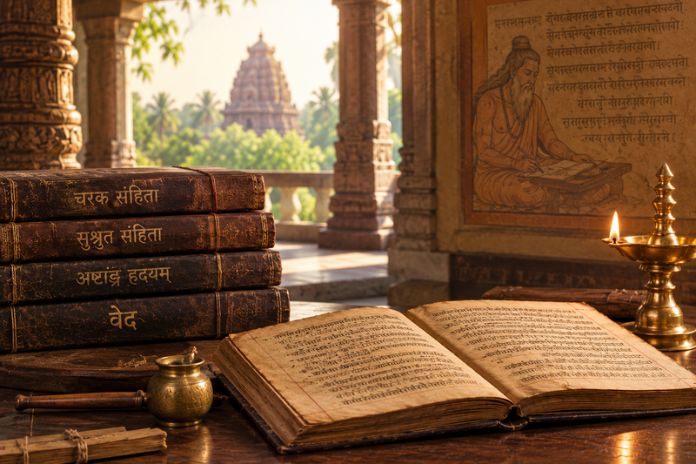
The authors refer to two influential works in the Ayurvedic tradition: the Charaka Samhita and the Sushruta Samhita. The article describes the former in connection with medicine, diet and health, and the latter with surgery and surgical methods.
These texts are important to the history of Ayurveda because they preserve extensive discussions of medical concepts and practices. Their development and transmission also raise historical questions: when were particular passages composed, how were the works revised, and how did later commentators interpret them?
Historians examine such questions by comparing texts and studying their language, structure, references and historical context. The chronology of ancient medical literature is not always straightforward, and a text’s traditional association with an earlier period does not necessarily establish that every part of its surviving form originated then.
A separate historical analysis by Rajesh Kochhar, published in Studies in People’s History in 2014, examines major Ayurvedic texts with the aim of reconstructing the development of Ayurveda as a medical science. This illustrates why the history of Ayurveda benefits from detailed textual and chronological study, rather than relying on broad claims of origin alone.
What does this mean for ordinary readers?
This article offers a starting point for readers interested in India’s medical and intellectual heritage. Its main value lies in introducing traditional concepts and encouraging further exploration of the literature in which they appear.
Readers can take three useful lessons from the discussion:
- Medical traditions have histories. Understanding Ayurveda involves exploring the texts, ideas and practices through which it developed.
- Traditional concepts need context. Terms such as the five elements and the three doshas make sense within Ayurvedic philosophy and should be explained in that context.
- Historical importance and clinical effectiveness are different questions. A concept may be culturally or historically significant without that alone proving a treatment’s safety or effectiveness for a particular condition.
For healthcare professionals, students and researchers, the article can prompt further questions about the relationship between early textual references and later medical systems. For the general public, it offers a reminder to approach traditional knowledge with both cultural respect and careful interpretation.
What should readers keep in mind?
The article is a descriptive discussion of traditional literature and ideas, not a systematic review of clinical trials. It does not report a defined search strategy, formal method for selecting historical sources, clinical comparisons or measured health outcomes in patients.
Its conclusions should therefore be understood as an interpretive overview, not as conclusive proof of the precise origins of every Ayurvedic concept. Some of its broad statements about the Vedas and Ayurveda would benefit from closer examination against primary texts and specialist historical scholarship.
In particular, claims that the entire Ayurvedic system, including all its later theoretical frameworks, was already fully established in the Vedic period require careful qualification. Historical scholarship recognises connections between early Indian literature and later Ayurveda while also examining how the classical medical tradition developed over time.
The article also refers to an “eightfold path of Ayurveda”. This wording needs verification: the familiar eight-limbed path is associated with Ashtanga Yoga, while Ashtanga Ayurveda traditionally refers to the eight branches of Ayurveda. These are related within India’s broader intellectual traditions, but they are not interchangeable terms.
Practical takeaways
- Explore the Vedas and classical Ayurvedic texts as important sources for understanding India’s intellectual and medical heritage.
- Learn the meaning of Ayurvedic concepts in their traditional context before comparing them with modern biomedical terminology.
- Distinguish historical and philosophical discussions from clinical evidence about treatments.
- Look for clear citations to primary texts and specialist historical research when evaluating claims about Ayurveda’s origins.
- For decisions about treating a health condition, seek advice from qualified healthcare professionals and consider reliable evidence about safety and effectiveness.
Conclusion: understanding Ayurveda through history and evidence
Ayurveda in Vedic Literature introduces readers to traditional ideas about the five elements, the three doshas, lifestyle and the relationship between human wellbeing and the natural world. Its contribution is primarily historical and explanatory, rather than clinical.
Exploring Ayurveda’s textual foundations can deepen appreciation of India’s medical heritage. At the same time, careful historical scholarship helps distinguish early references from concepts developed in later texts. A balanced understanding of Ayurveda respects its traditional knowledge while asking clear questions about history, interpretation, safety and evidence.