


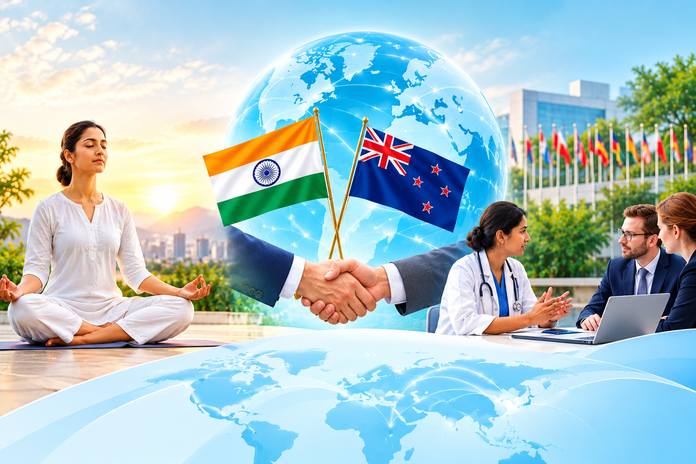
India is increasingly promoting Ayurveda, Yoga and other AYUSH systems in international health and trade diplomacy. Recent deals with Oman, New Zealand and the European Union cover traditional medicine services, professional mobility and market access. As international opportunities increase, experts are also emphasising the value of credible standards, practitioner competence, evidence and patient safety.
AYUSH Imprints on Global Health Diplomacy
Ayurveda and Yoga have long been part of India’s cultural outreach. Their role is now expanding to areas such as healthcare services, medical value travel, education, professional mobility and international trade.
This change is illustrated by recent trade agreements.
The India-Oman Comprehensive Economic Partnership Agreement (CEPA) includes what the Government of India describes as Oman’s first comprehensive commitment on traditional medicine across all modes of supply. The provision aims at creating opportunities for India’s AYUSH and wellness sectors, while strengthening cooperation in traditional healthcare and medical value travel.
The India-New Zealand FTA also has a separate Health and Traditional Medicine Services Annex dealing with Ayurveda, Yoga and other traditional medicine services. The agreement came into force on 20 October 2026.
The India-EU FTA, signed in January 2026, does more on Indian traditional medicine services. “AYUSH practitioners will be able to provide services in EU Member States where there is no specific regulatory framework in place, using professional qualifications obtained in India,” the Department of Commerce said. The deal also provides greater certainty for setting up AYUSH wellness centres and clinics, subject to applicable requirements.
Implications of the Trade Agreements on AYUSH
These agreements do not amount to a global licence for practitioners of Ayurveda or Yoga.
Rather, they establish mechanisms for collaboration and market entry, while professional and regulatory standards are left to the jurisdictions.
The India-Oman CEPA covers provisions in areas such as:
- Licensing and certification processes
- Work experience
- Medical travel
- Capacity building
- Establishment of standards
- Collaborative research
- Indigenous medicine services
The traditional-medicine provision is described by the Government of India as a first-of-its-kind comprehensive commitment by Oman.
The India-New Zealand FTA provides another avenue for Indian traditional medicine services. Its Health and Traditional Medicine Services Annex is intended to promote trade in Ayurveda, Yoga and other traditional medicine services. The deal also creates a pathway for 5,000 visas for skilled Indian workers in selected occupations, such as AYUSH practitioners and Yoga instructors.
Why Credible Standards Matter
Greater international access also poses a more difficult question: how can countries ensure traditional medicine services are appropriately trained, regulated and delivered safely?
The World Health Organization (WHO) has international reference materials for Ayurveda.
The WHO Benchmarks for the Practice of Ayurveda, released in February 2022, established minimum reference standards addressing the quality and safety of Ayurveda practice. The document covers practitioner categories, infrastructure, health interventions, products and medical devices, safety, regulatory and ethical issues, and health-data management.
In 2022, the WHO also published the WHO Benchmarks for Training in Ayurveda. It defines the minimum criteria for Ayurveda training in WHO Member States and provides guidance on competency-based knowledge and skills, training programmes, and safety issues in clinical application and medicinal preparation.
These documents are important reference points but should not be referred to as a worldwide Ayurveda licence or as automatically superseding national regulatory systems.
Yoga Has a Similar Standards Issue
This is not just a conversation about Ayurveda standards.
Yoga is already a significant part of India’s international outreach, but training and professional requirements can differ greatly from country to country. This makes competence, education, accreditation and safe practice increasingly relevant as Yoga services expand internationally.
The larger question is not whether Ayurveda and Yoga are becoming visible internationally. It is whether systems can be developed to make qualifications, competencies, quality and safety understandable to regulators, healthcare institutions and the public, thereby supporting international growth.
India’s Broader AYUSH Global Strategy
International expansion of AYUSH is not limited to trade agreements.
The Ministry of AYUSH has also pursued international cooperation, education and research. Its annual report has highlighted international cooperation and bilateral agreements relating to traditional medicine.
Another important channel is education. The Ministry’s annual report for 2023–24 recorded that 260 students from 32 countries were studying AYUSH systems in Indian institutions under the AYUSH Fellowship Scheme.
India has also launched an AYUSH visa framework for foreign nationals seeking treatment under AYUSH and Indian systems of medicine. These initiatives connect healthcare, education and international cooperation rather than viewing AYUSH solely as a cultural export.
What This Means for Practitioners
International expansion could open up opportunities for Ayurveda practitioners, Yoga teachers and AYUSH institutions in areas such as:
- Professional services
- Wellness and medical tourism
- Training and education
- Research cooperation
- International conferences and knowledge sharing
- Establishment of wellness centres where permitted
- Professional mobility under applicable agreements
However, practitioners should distinguish between market access and professional recognition.
A trade agreement may offer access to the supply of services or movement of professionals, but it does not automatically remove licensing, registration or other requirements in the destination country.
Evidence and Patient Safety Remain Paramount
When traditional medicine services expand internationally, evidence and safety receive greater scrutiny.
The WHO’s Ayurveda benchmarks explicitly address quality assurance, regulation and patient safety. The practice benchmarks are designed to assist national authorities in developing or improving regulatory standards for qualified Ayurveda practice.
For the AYUSH sector, this means international growth will increasingly depend on more than cultural recognition or consumer interest. Clear practitioner qualifications, appropriate training, product quality, safety monitoring, reliable health information and credible research will all contribute to confidence in international settings.
This should not be taken as a judgement that traditional medicine as a whole has been scientifically validated or disproven. Evidence should be considered for the specific intervention, product, indication and research question.
Things to Know About AYUSH’s International Expansion
Anyone examining AYUSH’s international expansion should remember three important distinctions.
Global Visibility Does Not Equal Global Regulatory Recognition
While an agreement between governments may open up opportunities, it does not automatically provide a licence to practise.
WHO Benchmarks Are Reference Standards, Not a Universal Licence
Technical reference points for practice and training have been established through the WHO Ayurveda benchmarks. Responsibility for regulatory systems remains with individual countries.
International Demand Does Not Automatically Equate to Clinical Effectiveness
Claims about individual Ayurvedic treatments, products or health outcomes still need to be supported by appropriate evidence and should not be assumed to be effective simply because of trade agreements or international recognition.
Why This Matters
India’s increasing use of AYUSH in trade agreements and global health diplomacy signals a broader trend in the international positioning of traditional medicine.
The opportunity is significant, but international expansion also brings a higher level of accountability. In increasingly regulated global healthcare environments, Ayurveda and Yoga will need to develop professional competence, quality assurance, evidence, regulation and patient safety alongside market access to function effectively.
Conclusion
India’s international AYUSH strategy is expanding across trade, healthcare services, education and professional mobility. Agreements with Oman, New Zealand and the European Union are examples of the increasing integration of traditional medicine into formal international economic and health frameworks.
The challenge is to ensure that greater international access is accompanied by credible standards, qualified practitioners, appropriate regulation, evidence and patient safety. This will be important for the long-term global development of Ayurveda and other AYUSH systems.