


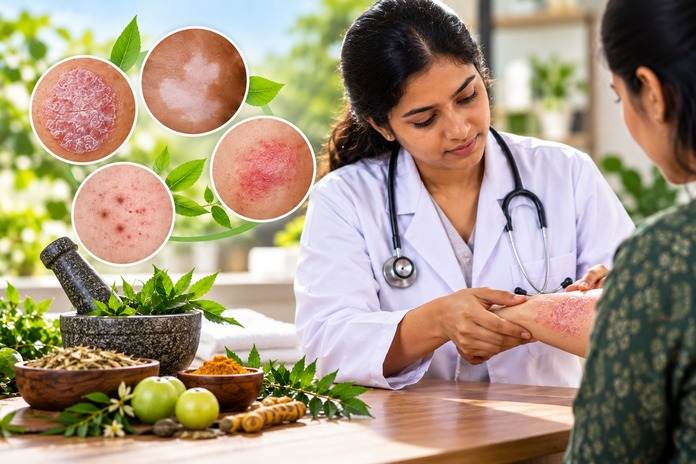
The Ministry of Ayush has released new Standard Treatment Guidelines for managing dermatological disorders across Ayurveda, Siddha, Unani and Homoeopathy. The guidelines aim to promote greater uniformity and quality assurance in the management of common skin conditions while supporting evidence-informed clinical practice.
Published on October 13, 2026, the guidelines cover conditions such as psoriasis, vitiligo, dermatitis and other dermatological disorders. The initiative has been developed by the Ayush Vertical of the Directorate General of Health Services (DGHS), Ministry of Health and Family Welfare.
Guidelines Cover Common Dermatological Conditions
Certain health conditions, including skin disorders, may require long-term care and regular clinical assessment. The newly released guidelines provide system-specific approaches to managing dermatological conditions through Ayurveda, Siddha, Unani and Homoeopathy.
Conditions such as psoriasis, vitiligo and dermatitis are highlighted in the guidelines. The document aims to provide healthcare professionals with a more structured reference for clinical management within their respective AYUSH systems.
The guidelines are also part of the government’s broader efforts to improve standardisation and quality in AYUSH healthcare.
Emphasis on Uniformity and Evidence-Informed Practice
One of the main objectives of Standard Treatment Guidelines is to promote greater consistency in clinical practice.
According to the announcement, the new guidelines combine system-specific clinical approaches with available scientific evidence. Their stated aim is to support safe, effective and comprehensive approaches to managing common dermatological conditions.
A standardised reference may help practitioners assess and manage specific conditions using more clearly defined clinical approaches. It may also support healthcare institutions, educators and researchers.
However, the existence of a guideline does not mean that every treatment it describes is supported by the same level of scientific evidence. Evidence for individual interventions may vary depending on the condition, treatment and available research.
Relevance to Ayurveda and Other AYUSH Systems
The release is significant for the wider AYUSH sector because it places greater emphasis on structured clinical guidance and evidence-informed practice.
Ayurveda, Siddha, Unani and Homoeopathy have their own theoretical frameworks, diagnostic approaches and treatment methodologies. Incorporating these approaches into a formal guideline framework may help promote consistency while retaining the characteristics of each system.
The guidelines may also help researchers and academic institutions identify areas where additional clinical research and evidence generation are needed.
Implications of the Guidelines for Patients
The new guidelines are intended as a professional reference and are not a substitute for individual medical consultation.
Skin conditions can have different causes, and some require a clinical examination before appropriate treatment can be selected. Patients experiencing persistent, worsening or unexplained skin symptoms should seek advice from a suitably qualified healthcare professional rather than relying solely on information found online.
The guidelines also do not guarantee that a particular AYUSH treatment will produce the same outcome for every patient. Treatment decisions should take into account the individual’s condition and clinical assessment.
Importance for Healthcare Professionals and Researchers
AYUSH practitioners, healthcare institutions, educators and researchers are among the groups most directly concerned with the new guidelines.
The document may serve as a reference for practitioners managing dermatological conditions. It may also support teaching in educational institutions and discussions about standardised clinical approaches.
Researchers may use the framework to identify areas for further investigation and evaluate the available evidence relating to specific interventions.
As research into traditional systems of medicine continues to develop, evidence-informed practice remains important.
Toward Greater Standardisation in AYUSH Healthcare
The new dermatology guidelines from the Ministry of Ayush represent an effort to improve consistency and quality across clinical practice in the AYUSH sector.
Their long-term impact will depend on implementation, adoption by healthcare professionals and continued evaluation of the evidence supporting individual approaches. Further research will remain important for determining how different interventions perform for specific dermatological conditions.
For patients and the public, the key message is that the guidelines are intended to support professional healthcare practice, not encourage self-diagnosis or self-treatment.
The release marks another step in the government’s efforts to establish more structured and evidence-informed guidance for Ayurveda, Siddha, Unani and Homoeopathy in managing dermatological disorders.