


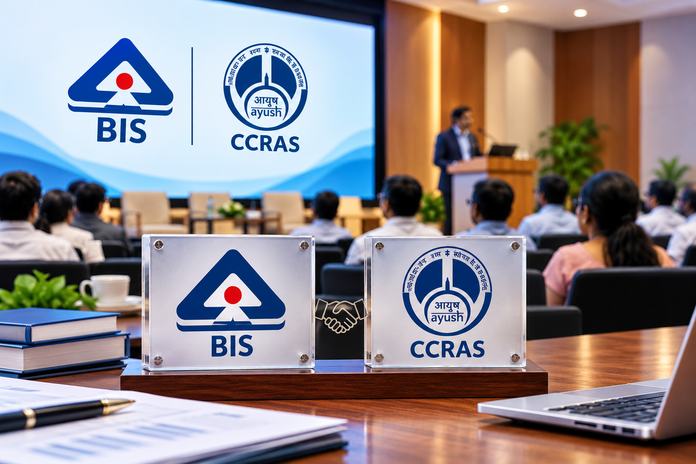
The Bureau of Indian Standards (BIS) organised a sensitisation programme for scientists of the Central Council for Research in Ayurvedic Sciences (CCRAS) at the Central Ayurveda Research Institute (CARI), Bengaluru, on 16 September 2026.
The programme was conducted under the existing Memorandum of Understanding (MoU) between BIS and CCRAS. Its objective was to strengthen understanding of standardisation processes and explore opportunities for collaboration in Ayurvedic sciences.
Standardisation Programme for Ayurveda
The programme aimed to familiarise CCRAS scientists with India’s national standardisation system and identify areas for greater institutional collaboration.
Scientists, researchers and administrators from CCRAS institutes across the country participated in the programme. Discussions focused on quality, safety and the development of standards for Ayurveda, including opportunities to connect Ayurvedic research with formal standardisation frameworks.
The initiative forms part of the ongoing collaboration between BIS and CCRAS under their MoU. Participants also discussed how researchers could contribute more actively to the development of standards in their respective areas of expertise.
BIS Explains the Standards Development Process
During the technical sessions, BIS experts explained India’s standardisation ecosystem and the process of formulating standards.
Ms Neha Yadav, Scientist-E/Director, SCMD, BIS, provided an overview of the scope and objectives of the BIS–CCRAS MoU. She also presented BIS digital initiatives designed to facilitate institutional collaboration.
Ms Shrishti Dixit, Scientist-E and Head (AYUSH), BIS, explained the Indian standardisation ecosystem, the standards formulation process and the functioning of BIS’s technical departments.
The sessions aimed to improve CCRAS scientists’ understanding of standards development and explain how research institutions can participate in the process.
Ayurveda and Yoga International Standardisation Discussed
The programme also covered India’s international standardisation activities relating to Ayurveda and Yoga.
Dr Raghavendra Naik, AYUSH, BIS, highlighted India’s work through the ISO/TC 249/SC 2 Secretariat and discussed the importance of international standardisation activities in Ayurveda and Yoga.
This work is relevant to India’s broader efforts to participate in developing international standards for traditional medicine. However, involvement in international standardisation processes does not automatically mean that a treatment has received international regulatory approval or that its clinical efficacy has been established. Standards development and scientific or regulatory evaluation serve different purposes.
Open House Explores Future Cooperation
The afternoon session featured an open house and group discussion on a roadmap for implementing the BIS–CCRAS MoU.
Participants from both institutions shared perspectives on interdisciplinary research, capacity-building and the integration of Ayurvedic knowledge into formal standards frameworks.
The discussion aimed to identify practical areas for future collaboration between research institutions and standards bodies.
Why Is Standardisation Important for Ayurveda?
Standardisation can help establish consistent approaches to quality, specifications, testing and other technical requirements.
In Ayurveda, appropriate standards can provide a common technical framework for researchers, manufacturers, laboratories and other stakeholders. They can also improve communication between traditional medicine research institutions and national or international standards organisations.
The BIS–CCRAS programme represents an institutional effort to strengthen researchers’ understanding of standardisation and the contribution Ayurvedic research can make to standards development.
However, the programme should not be interpreted as evidence that all Ayurvedic products or therapies have been scientifically validated. Standardisation, quality assessment, safety evaluation and clinical efficacy are distinct areas of assessment.
Key Participants and Institutional Roles
Representatives from BIS and CCRAS came together for the programme.
Key participants identified in the Press Information Bureau (PIB) report included:
- Prof. Rabinarayan Acharya – Director General, CCRAS
- Ms Shrishti Dixit – Scientist-E and Head (AYUSH), BIS
- Ms Neha Yadav – Scientist-E/Director, SCMD, BIS
- Dr Raghavendra Naik – AYUSH, BIS
- Dr T. Maheswar – Additional Director In-charge, CARI, Bengaluru
Prof. Rabinarayan Acharya emphasised the importance of equipping CCRAS scientists with knowledge of standardisation processes so that they could contribute to the development of standards at national and international levels.
What Happens Next?
The programme concluded with discussions on future activities and the need for continued cooperation between research institutions and standards bodies.
Sustained collaboration, interdisciplinary research and capacity-building were identified as important areas for future work.
The event represents a step towards implementing the objectives of the BIS–CCRAS MoU rather than the completion of a new standards framework. Further developments will depend on follow-up activities, technical work and decisions arising from the collaboration.
Conclusion
The BIS–CCRAS sensitisation programme in Bengaluru brought together scientists, researchers and standards experts to discuss the role of standardisation in Ayurvedic sciences.
Through technical sessions and discussions on implementing their MoU, the two institutions explored ways to strengthen research, capacity-building and standards development.
The initiative also highlights India’s participation in national and international standardisation activities relating to Ayurveda and Yoga. It reinforces the importance of technical standards while recognising that standardisation alone does not establish the safety or clinical effectiveness of a treatment.
Source: Press Information Bureau (PIB), Government of India, 22 September 2026.