


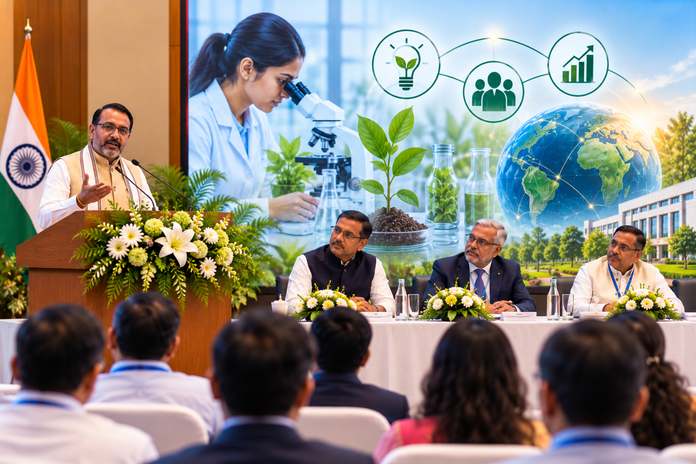
New Delhi: Union Minister of State (Independent Charge) for Ayush Prataprao Jadhav has called on young researchers, startups, entrepreneurs, and industry representatives to play a greater role in taking Ayurveda innovations from research laboratories to the marketplace.
He made the appeal while presiding over the 27th Governing Body meeting of the Central Council for Research in Ayurvedic Sciences (CCRAS) in New Delhi on August 6, 2026.
Jadhav Calls for Greater Focus on Innovation and Technology
Addressing the CCRAS Governing Body, Jadhav said the next phase of Ayurveda’s development should focus on technology, entrepreneurship, and stronger market linkages.
He highlighted scientific validation, innovation, and global outreach as important elements in strengthening Ayurveda while preserving the authenticity and fundamental principles of classical Ayurvedic knowledge.
The Minister urged CCRAS to expand evidence-based research and strengthen cooperation with international organisations. He also highlighted the potential role of emerging technologies, including artificial intelligence (AI), in clinical research, data management, and personalised healthcare.
Encouraging Young Researchers and Startups
Jadhav emphasised the need for young researchers, startups, entrepreneurs, and industry representatives to participate actively in translating Ayurveda research into practical products and services.
He called for a stronger innovation ecosystem supported by:
- Research grants and funding support
- Incubation facilities for emerging startups
- Mentorship for young researchers and entrepreneurs
- Partnerships between research institutions and industry
- Technology-driven innovation
- Stronger connections between research and the marketplace
The Minister also suggested exploring initiatives such as a Youth Research Fund, an Ayurveda Startup Accelerator, and a Global Ayurveda Challenge to encourage young innovators and entrepreneurship in the sector. These were presented as proposed areas for development rather than established operational programmes.
Strengthening Evidence-Based Ayurveda
“The growth of Ayurveda in the future should be supported with scientific excellence, standardisation and innovation,” the Minister said.
He urged CCRAS to strengthen translational research—the process of translating findings from laboratory and clinical research into practical applications—while retaining the foundations of classical Ayurveda.
The approach aims to support the development of evidence-based Ayurveda research and expand its potential international reach.
Scientific evidence generation remains important from both scientific and regulatory perspectives. The announcement does not establish that all Ayurvedic treatments or products have been scientifically validated or accepted within international healthcare systems.
New Research and Digital Initiatives Unveiled
Several research, infrastructure, and digital initiatives were launched during the CCRAS meeting.
Jadhav virtually inaugurated infrastructure projects at CCRAS Regional Ayurveda Research Institutes in Pune, Ranikhet, and Nagpur. These included:
- An extension of the research laboratory and Animal House Building at RARI, Pune
- A guest house and residential building at RARI, Ranikhet
- The foundation ceremony for a new 50-bedded hospital building at RARI, Nagpur
He also launched CCRAS-PARAMPARA, an initiative focused on the systematic documentation, evaluation, and scientific validation of India’s local health traditions, ethnomedical practices, and traditional veterinary knowledge.
Digital Platform to Recognise Ayurveda Research
Another initiative introduced at the meeting was the CCRAS National Research Recognitions Portal.
The platform brings together the following initiatives:
- PRAKASA CCRAS
- CCRAS NAVONMESA
- CCRAS PRABODH 3MT
The platform aims to recognise excellence in postgraduate Ayurveda research, innovation, and scientific communication.
CCRAS also launched Ayur-dict, its first Android application for an Ayurvedic dictionary. The application combines multiple Ayurveda dictionaries into a searchable digital platform.
These initiatives seek to improve access to Ayurveda-related knowledge and support research, academic recognition, and digital innovation.
Ministry Highlights a Research-Based Ayurveda Ecosystem
Ayush Secretary Vaidya Rajesh Kotecha said the Ministry is committed to strengthening a research-driven ecosystem that integrates infrastructure development, digital innovation, and scientific excellence.
According to the Ministry, the initiatives launched during the meeting are intended to strengthen research capacity, promote academic excellence, and improve access to knowledge.
The meeting also reviewed CCRAS’s recent achievements and discussed strategic initiatives to strengthen evidence-based Ayurveda.
What This Means for Ayurveda Startups and Researchers
The emphasis on entrepreneurship and market linkages could create opportunities for researchers and startups developing innovations based on Ayurveda.
The proposed approach may encourage young researchers to move beyond academic research towards product development, intellectual property creation, commercialisation, and industry collaboration.
For startups, stronger connections between research institutions and industry could help address some of the challenges involved in developing research-based Ayurveda products and services.
However, products intended for commercial or clinical use must still meet applicable scientific, quality, safety, and regulatory requirements. The Minister’s remarks and the proposed initiatives do not constitute regulatory approval of any specific Ayurvedic product or treatment.
Linking Research with the Marketplace
The government’s focus forms part of a broader effort to strengthen connections between research, innovation, entrepreneurship, and commercialisation in the Ayush sector.
Earlier in 2026, the Ministry of Ayush and CCRAS invited Ayurveda startups to join the Ayurvedic Sciences Incubation Center (ASIC) at the Central Ayurveda Research Institute in Bengaluru. The programme was intended to provide mentorship, funding guidance, and regulatory assistance to startups.
Together, these initiatives indicate a policy focus on developing an innovation ecosystem around Ayurveda. Individual programmes and proposed initiatives, however, need to be assessed separately according to their formal guidelines and implementation status.
Conclusion
Union Ayush Minister Prataprao Jadhav has urged young researchers, startups, entrepreneurs, and industry representatives to play a greater role in taking Ayurveda research from laboratories to the marketplace.
The appeal came alongside the launch of new CCRAS research, infrastructure, and digital initiatives, including CCRAS-PARAMPARA, the National Research Recognitions Portal, and Ayur-dict.
The government has identified technology, scientific research, entrepreneurship, and innovation as important areas for the future development and international outreach of Ayurveda.