


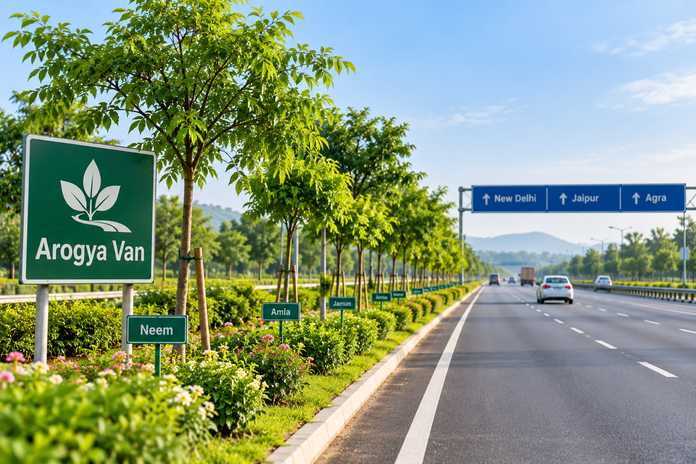
New Delhi: The National Highways Authority of India (NHAI) will develop Arogya Van, a network of thematic medicinal tree plantations on vacant land along National Highways. The initiative aims to increase biodiversity, improve roadside ecosystems, and raise awareness of India’s heritage of traditional medicinal plants.
The initiative was announced by the Ministry of Road Transport and Highways on April 8, 2026, through the Press Information Bureau (PIB). The first phase covers 17 land parcels totalling 62.8 hectares, with approximately 67,462 medicinal trees planned for planting.
Arogya Van to Focus on Medicinal Tree Cultivation
Under the scheme, NHAI will use suitable vacant land along National Highways to establish plantations of medicinal tree species.
In the first phase, approximately 36 species have been identified based on their suitability for different agro-climatic zones. These include Neem, Amla, Imli, Jamun, Lemon, Gular, and Maulsari, among others.
The plantations aim to increase green cover and provide habitats and resources for pollinators, birds, and other small wildlife, helping strengthen ecological resilience along highway corridors.
Phase One to Cover 17 Land Parcels
The first phase of Arogya Van will cover 17 land parcels across several states and regions, including:
- Madhya Pradesh
- Haryana
- Delhi-NCR
- Andhra Pradesh
- Gujarat
- Karnataka
- Odisha
- Tamil Nadu
- Rajasthan
- Maharashtra
- Chhattisgarh
Together, these sites represent more than 62.8 hectares, where approximately 67,462 medicinal trees are planned to be planted.
NHAI has indicated that priority will be given to locations near toll plazas, wayside amenities, interchanges, cloverleaf junctions, and other prominent stretches of National Highways. These locations are expected to improve the visibility of the plantations and create opportunities for public awareness.
Additional Land Identified for Plantation
Beyond the first phase, NHAI has identified approximately 188 hectares of vacant land for plantation during the next monsoon season.
The timing is intended to support plant establishment and long-term survival. Plantation activities will follow Government of India guidelines on landscaping and tree plantation.
The initiative extends conventional highway plantation activities, which have traditionally used native and avenue tree species to increase green cover and support ecological stability.
Raising Awareness About Medicinal Plants
Arogya Van also has an educational and cultural objective.
The plantations are envisaged as living repositories that can raise public awareness of medicinal plants and traditional knowledge systems, according to the Ministry of Road Transport and Highways.
The initiative aligns with broader efforts to promote traditional systems of medicine, including Ayurveda, while contributing to the conservation of indigenous medicinal flora.
By establishing medicinal plantations at prominent locations along major highways, NHAI aims to make information about India’s medicinal plant heritage more accessible to the public.
Developing Greener National Highway Corridors
The project is also expected to contribute to more environmentally friendly highway corridors.
Medicinal trees and other vegetation can provide habitats and resources for pollinators, birds, and other small wildlife. NHAI’s approach combines environmental improvement with public awareness and education.
The initiative therefore connects highway infrastructure development with biodiversity conservation and the promotion of traditional knowledge about medicinal plants.
What the Initiative Means for Ayurveda
For the Ayurveda and AYUSH sectors, Arogya Van offers a public platform for raising awareness of medicinal plants associated with India’s traditional healthcare systems.
However, planting medicinal trees should not be interpreted as scientific verification of specific therapeutic claims about individual plants. The initiative’s stated objectives centre on biodiversity conservation, ecological sustainability, public awareness, and the preservation of medicinal plants.
A Broader Vision for Sustainable Infrastructure
Arogya Van represents an effort to integrate environmental considerations into National Highway development.
Alongside their infrastructure role, NHAI aims to use suitable vacant land to create green spaces with ecological, educational, and cultural value.
The initiative is expected to expand through further plantation activities, with approximately 188 hectares identified for future planting during the monsoon season.
Conclusion
NHAI’s Arogya Van initiative will establish medicinal plant plantations on vacant land along National Highways, beginning with 17 land parcels covering 62.8 hectares.
With approximately 67,462 medicinal trees and nearly 36 identified species planned for the first phase, the project combines biodiversity conservation with public awareness of India’s medicinal plant heritage. It also supports broader efforts to integrate sustainable environmental practices into highway infrastructure and promote awareness of traditional knowledge systems such as Ayurveda.