


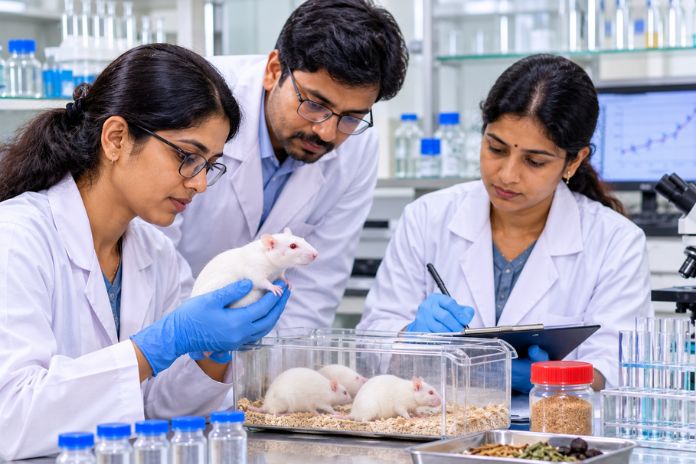
Shwasakuthara Rasa in the Laboratory: What a 90-Day Safety Study Shows
Pre-clinical study of the repeated dose safety of a traditional Ayurvedic herbo-mineral formulation in Wistar albino rats.
Introduction: Are Conventional Formulations Fit for Today’s Safety Evaluations?
Ayurveda has a long tradition of using herbal, mineral and herbo-mineral preparations. But what of the safety of repeated administration of formulations containing mercury, arsenic-bearing minerals and possibly toxic medicinal plants?
This question is of great concern to Shwasakuthara Rasa (SKR), a herbo-mineral formulation of Ayurveda. But its composition makes scientific safety evaluation important, considering that it has been traditionally used in Ayurveda.
A study published in the Journal of Drug Research in Ayurvedic Sciences studied the effect of repeated administration of Shwasakuthara Rasa for 90 days in laboratory rats. The researchers looked at blood parameters, biochemical markers and tissue changes to determine any possible toxic effects.
This study provides preliminary information regarding the safety of the formulation under the experimental conditions used. However, careful interpretation of the findings is needed, because animal studies cannot establish safety in humans.
What did the scientists look into?
In this study subacute oral toxicity of Shwasakuthara Rasa was studied in Wistar albino rats.
Subchronic toxicity is the possible adverse effects of repeated exposure to a substance over a relatively long period.
There are several ingredients of particular toxicological interest in the formulation such as:
- Parada: Mercury
- Manahshila: Arsenic mineral, realgar.
- Vatsanabha: Aconitum chasmanthum Stapf ex Holmes, medicinal plant.
The presence of these ingredients underlines the necessity of systematic assessment of the preparation, dosage, and possible effects on vital organs.
The main purpose was to check whether repeated administration leads to detectable changes in blood composition, biochemical parameters or organ tissues.
How was the study done?
The investigators conducted a 90-day repeated dose oral toxicity study in Wistar albino rats.
Animals were administered varying daily doses of Shwasakuthara Rasa with honey as adjuvant.
The experimental doses were:
- Therapeutic equivalent dose (TED): 22.5 mg/kg body weight.
- 5 x the therapeutic equivalent dose: 112.5 mg/kg.
- 225 mg/kg, ten times the therapeutic equivalent dose.
A further group of recovery animals received the highest dose and were allowed to recover for 30 days.
At the end of the experimental period the researchers measured:
- Haematological parameters: Blood parameters useful to detect possible changes in blood cells and other components of blood.
- Biochemical parameters: Laboratory tests used to assess metabolic activity and the function of organs.
- Histopathological Findings: Microscopic examination of tissues for structural changes or possible organ damage.
This combination of assessments allowed the researchers to look for potential effects that might not be apparent by general observations alone
What did the research say?
The repeated administration of Shwasakuthara Rasa did not cause any significant changes in the haematological and serum biochemical parameters in all the dose groups tested.
But microscopic examination of liver tissue did show some findings which deserve attention.
Slight liver changes at the highest dose
In one rat receiving the highest dose, the researchers saw:
- Unifocal necrosis, meaning a single area of cell death.
- Fatty degeneration: abnormal accumulation of fat in liver cells.
These findings are important because the liver is central in the processing of substances that enter the body.
It also found that the architecture of the liver was normal in animals in the high-dose recovery group after the recovery period. That indicates the observed microscopic changes might have been reversible in the experimental conditions.
What about the overall toxicity evaluation?
The authors concluded that repeated administration for 90 days did not induce any significant toxicological effects related to the treatment in the experimental animals.
They reported a no observed adverse effect level (NOAEL) of 225 mg/kg by oral route.
The NOAEL is the highest dose level at which the investigators did not observe treatment-related adverse effects according to their criteria.
This finding should not be taken as an indication that the formulation is safe. It is the authors’ conclusion within the specific animal experiment and evaluation framework.
What does this mean for the average Joe?
The study contributes to the scientific evaluation of a traditional Ayurvedic formulation, particularly because the ingredients raise concerns about possible toxicity.
Its findings could support the development of evidence-based assessment methods for traditional medicines, and could help researchers to plan further investigations into the safety of the formulation.
But there are some key differences between research on animals and healthcare for humans.
A dose that works in rats is not necessarily safe for people. The effect of a substance on the human body can be influenced by metabolism, absorption, body physiology and individual health conditions .
Therefore, this research does not prove:
- Safety of Shwasakuthara Rasa in human patients.
- Its efficacy in the treatment of respiratory or other diseases.
- The safety of long-term use by humans.
- Safety of various commercial formulations or products prepared by different manufacturing processes.
These results should be viewed as preliminary preclinical safety information, rather than a clinical recommendation.
Perspective from an Ayurvedic Viewpoint
Shwasakuthara Rasa is a part of Rasa shastra Ayurveda, which deals with the preparation and administration of mineral and herbo-mineral preparations.
In the traditional Rasa Shastra, emphasis is placed on the correct processing, purification procedures (Shodhana), preparation methods and dosage considerations.
Such formulations are prepared and used within the framework of these traditional principles.
However, traditional processing procedures and historical use should not replace systematic quality assessment and toxicological evaluation from the modern scientific point of view.
The safety of a herbo-mineral preparation must be evaluated by appropriate testing of its ingredients, composition, consistency in manufacturing, possible contaminants and biological effects.
The present study is of interest as it applies laboratory toxicological techniques to a traditional formulation. But, by itself, it does not prove the efficacy of conventional processing methods, nor does it prove that all preparations of Shwasakuthara Rasa have a similar safety profile.
What would you like readers to learn?
There are some significant limitations in interpreting this research.
- The study was done in animals, not people.
However, the results in Wistar albino rats cannot be extrapolated for human safety recommendations.
2. The evaluation was for a fixed period.
Additional recovery group were examined for repeated dose 90 days and 30 days recovery. It cannot prove safety for years.
3. Changes in liver tissue were observed.
The changes reported are only in one rat in the high dose group and are followed by normal liver architecture in the recovery group. These observations should not be ignored.
4. The results are valid for the preparation tested.
They should not automatically apply to any product sold or prepared under the same formulation name.
- Further clinical research is required.
Human studies, appropriate product standardisation and additional safety assessments are needed before conclusions about human use can be drawn.
Practical takeaways for readers
The research points to a number of important messages:
- Traditional medicines also need systematic scientific safety evaluation. Herbo-mineral preparations should be given attention as some of their constituents have known toxicological concerns.
- Animal safety studies are useful early steps, but cannot replace human clinical trials.
- Product quality, proper preparation and consistency in manufacture are important considerations.
- People should not self-medicate using herbo-mineral drugs or assume traditional use is safe.
- Patients should seek the advice of suitably qualified healthcare professionals before using such preparations, especially in combination with other medicines.
Conclusion: A step toward evidence based Ayurveda
The 90-day safety evaluation of Shwasakuthara Rasa gives useful preliminary information on the effects of repeated administration in Wistar albino rats.
The measured haematological and serum biochemical parameters did not show any significant changes, but minor liver tissue changes were observed in one animal treated with the highest dose. The recovery findings imply that these changes were reversible under the experimental conditions.
The present study is a contribution to scientific evaluation of traditional Ayurvedic herbo-mineral preparations. However, its findings should not be considered as evidence of safety or therapeutic efficacy in humans.
The larger point is important: Preserving traditional knowledge and enhancing scientific evaluation should be complementary. Rigorous research, transparent reporting, quality control and appropriate clinical studies are essential to advance evidence-informed Ayurveda.
Disclaimer: This article is for informational and educational purposes only. This is not a medical advice or a suggestion to use Shwasakuthara Rasa. Seek the advice of a qualified healthcare professional before using any herbo-mineral preparation.



