


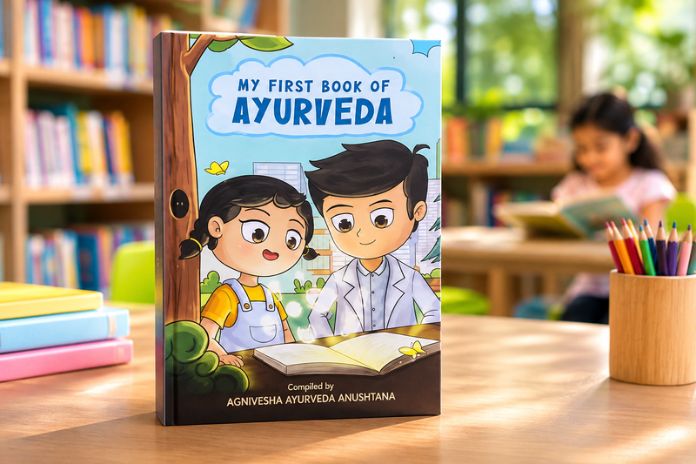
My First Book of Ayurveda: Whole Health for Kids
An interesting educational initiative to introduce children to ayurvedic principles, healthy routines, diet and preventive wellness
Agnivesha Ayurveda Anushtana Initiative
This book is an educational introduction to Ayurveda for a young audience, linking traditional knowledge to daily life. It is aimed at children and adolescents and attempts to demystify the basic principles of ayurveda through relatable explanations, stories and illustrations.
My First Book of Ayurveda: Holistic Health for Children is conceived as part of the Ayurveda School Education Project (2023). It is intended to inspire children to discover India’s traditional system of health knowledge and to be more conscious of healthy lifestyle practices. Parents, teachers and health educators will find it useful because it emphasises diet, daily routines, seasonal living and preventive wellness.
1. Passing on Ayurveda to the Next Generation
Ayurveda is a traditional Indian system of knowledge that considers health in relation to food, lifestyle, daily habits, seasonal changes and individual wellbeing. Early exposure to these ideas will help young students develop an appreciation for the importance of balanced routines and an early interest in traditional knowledge systems of India.
But classical Ayurvedic literature can be challenging for kids because it uses specialised terminology and complex explanations. The book responds to this challenge by presenting selected foundational ideas in a simple, relatable and story-based format.
According to the publisher listing for the book, it is for readers ages 8-18 years. The education system is designed to make Ayurveda reach out to the students, without expecting them to know the subject.
2. An Educational Collaborative
One of the most important features of this publication is its joint development. The book was compiled by Agnivesha Ayurveda Anushtana (AAA) with inputs from a group of 30 Ayurvedic physicians.
The content has been selected through expert focus group discussions under the Ayurveda School Education Project (2023). This collaborative approach is an attempt to find out the Ayurvedic subjects which are relevant to the young students and can be taught in an educational setup.
The book is also claimed to have been reviewed by veteran academic and clinical Ayurvedic practitioners. The illustrations, some of which are contributed by children, are intended to make the subject more engaging and visually accessible.
3. Learning Ayurveda Through Food and Lifestyle
A central educational theme of the book is the connection between daily habits and well-being. Rather than confining the discussion to medical terminology, it introduces practical areas of life through which children can start to understand Ayurvedic thinking.
Some of the main areas of subject matter are:
- Diet and food habits: To raise awareness on food choices and the importance of healthy eating practices.
- Daily routines: Introduce the importance of daily habits and personal care. This can be framed through the Ayurvedic lens of Dinacharya.
- Seasonal Living: An idea relating to Ritucharya, exploring how lifestyle practices can be adapted to the changing seasons.
- Preventive wellness: Training on the importance of developing habits that promote overall wellbeing.
- Basic Ayurvedic principles: Introduction to certain concepts of India’s traditional health system.
These themes can be connected to the everyday experiences of children at home and at school. They can be used by parents and teachers to open up discussions about food, sleep, cleanliness, activity and balanced routines.
4. Why Illustrations and Storytelling Are Important
The way information is presented to children can be just as important as the information itself. Stories and illustrations can help make unfamiliar subjects easier to understand.
The book follows this approach, presenting Ayurvedic ideas in a relatable format. Its illustrations aim to aid young readers in picturing the concepts discussed, while the inclusion of children’s contributions adds a touch of participation and creativity.
This approach might also make the book useful for group reading, classroom activities and discussions organised by schools or Ayurveda practitioners.
5. A Resource for Parents, Teachers and Ayurveda Educators
The book can be used for more than reading. It has a specific audience and educational design that makes it relevant to a number of groups:
- For parents: To introduce Ayurveda to children and discuss healthy everyday habits.
- Schools & Teachers: Assist in educational programs in awareness of traditional Indian knowledge and lifestyle.
- Ayurveda practitioners: A potential resource for school health talks and introductory awareness programs.
- Libraries: Include easily readable books on Ayurveda and Indian traditions of health.
- Young readers: Ignite curiosity for food, routines, seasons and whole-body health.
Its emphasis on basic awareness is especially relevant in an age when children are inundated with health information via digital media. Age-appropriate educational material can stimulate curiosity and help them become critical consumers of health information.
6. Editorial Perspective: Responsible Teaching of Ayurveda
Introducing children to Ayurveda requires responsible communication as well. Traditional ideas should be explained in a manner appropriate to the child’s age, without framing each traditional claim as an established medical fact.
For example, conversations about healthy eating should center on balanced nutrition rather than unnecessary dietary restrictions. Similarly, any references to herbs, medicines or therapeutic procedures should not encourage children to experiment with remedies or to undertake treatment without the guidance of a qualified adult and professional.
The educational nature of the book is an opportunity to introduce Ayurveda as a living tradition of knowledge, while stimulating a thoughtful understanding of health. Its use in schools and families can be especially important when supported by teachers, parents and qualified health professionals.
7. Summary
My First Book On Ayurveda Holistic Health for Children is a collaborative educational effort to introduce Ayurveda to children and adolescents in an easy-to-understand format. Contributed by Ayurvedic physicians, the book developed by Agnivesha Ayurveda Anushtana covers the themes of diet, lifestyle routines, seasonal living and preventive wellness.
It is a potentially useful resource for families, schools, libraries and Ayurveda awareness programs, with its story based presentation and illustrations. But more importantly, it highlights the need for imparting traditional knowledge to the younger generation through an appropriate and responsible education that is age-appropriate.
This publication is a meaningful attempt to bring Ayurveda out of the specialist classrooms and make its basic concepts easily accessible to children. The publication is available to the readers of AyurWorld News.
More Details & Book Information
My First Book of Ayurveda: Title Holistic Health for Kids
- Subtitle on listing provided: Simple Ayurvedic Principles, Diet, Routines & Wellness Practices
- Editor: Dr. Vibhuti S. Rao, Dr. Roopashree S
- Initiative: Agnivesha Ayurveda Anushtana (AAA)
- Contributors: 30 Ayurveda doctors
- Publisher/Imprint: Sahitya Sindhu Prakashan
- Language: English
- Date of publication: 1 July 2024
- P. 106.
- ISBN: 9789394226715
- Libro no: SS_127
- Intended audience: Children and adolescents from 8–18 years old
- Amazon India: View book
- Publisher’s book description: My First Book of Ayurveda – Rashtrotthana Sahitya
- About the organization: Agnivesha Ayurveda Anushthana
Source Link: https://amzn.in/d/0e8tjgub



