


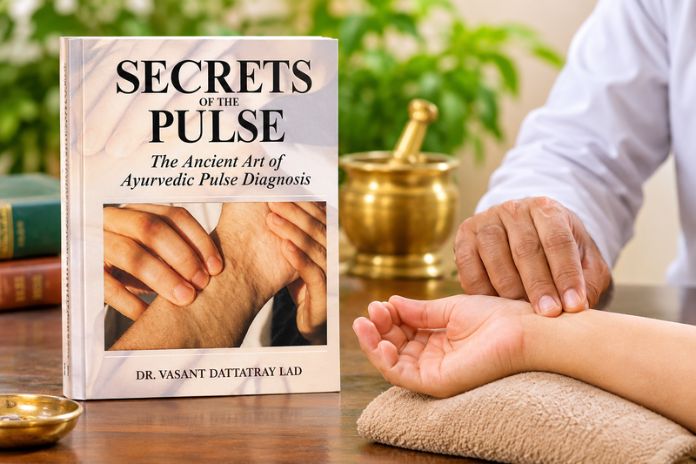
Secrets of the Pulse: Nadi Pariksha and the Ancient Art of Ayurvedic Pulse Diagnosis by Dr. Vasant Lad
Rediscovering the traditional Ayurvedic science of pulse examination, this unique work explores the relationship between Nadi Pariksha, individual constitution, Dosha assessment and the interpretation of health through the subtle characteristics of the radial pulse.
Introduction: Reading Health in the Pulse
The human pulse has long been known to be an important source of information in medical examination. Physicians of many medical traditions have used the pulse to gain knowledge about circulation and physiology. But, in Ayurveda, Nadi Pariksha is a more traditional way to understand a person’s constitution and the functional balance of the Doshas.
Secrets of the Pulse The Ancient Art of Ayurvedic Pulse Diagnosis by internationally recognised Ayurvedic physician and educator Dr Vasant Dattatray Lad looks at this specialised area of Ayurvedic knowledge.
The book introduces the reader to the traditional interpretation of the radial pulse and how it relates to Vata, Pitta and Kapha. It explains methods of examining the different levels of the pulse and their conventional significance regarding the body’s systems, tissues, organs and the individual constitution.
Published first in 1996, and revised and expanded thereafter, the book has become a recognised educational resource for readers interested in Nadi Vijnanam, Ayurvedic diagnosis and traditional approaches to understanding health.
Understanding the Book and Its Main Idea
Secrets of the Pulse is primarily designed to present the theory and practical methods of Ayurvedic pulse diagnosis in a clear and organised fashion.
Nadi Pariksha is an integral part of the examination of the patient in Ayurveda. The traditional way to do this is to feel the qualities of the pulse and interpret them within the framework of the three Doshas.
It is explained in the book that the differences in the pulse characteristics are associated with the different functional patterns of Vata, Pitta and Kapha.
One important feature of the work is its explanation of seven levels of the radial pulse. These levels provide the framework within which the author discusses the traditional Ayurvedic interpretation of different bodily systems and their functional status.
This book introduces the readers to the more detailed and interpretive tradition of Nadi Vijnanam and does not consider pulse examination to be mere measurement of heart rate.
Delving into Important Themes and Ideas
1. Nadi Vijnanam: The Ancient Science of Pulse Diagnosis
The book introduces Nadi Vijnanam as a specialised field of diagnostic knowledge in Ayurveda.The author describes the traditional way of looking at the radial pulse and introduces the importance of developing sensitivity through observation and repeated practice.
The pulse examination is presented as a skill requiring patience, concentration and familiarity with Ayurvedic principles.
The discussion helps readers understand why traditional pulse assessment is more than identifying the rate or rhythm of arterial pulsation.
2. Reading the Pulse to Know Vata, Pitta and Kapha
One of the main themes of the book is the relationship between the pulse and the Tridosha theory.
The three basic functional principles of Ayurveda are Vata, Pitta and Kapha. Traditionally they have been used to understand individual constitution and patterns of physiological imbalance. It describes traditional qualities of pulse associated with these Doshas and explains how their variation is interpreted during examination.
This discussion is very useful for students who want to apply the theory of Tridosha in the practical of Ayurvedic examination.
3. The Seven Levels of Pulse
One of the book’s most unique features is its systematic presentation of seven levels of pulse examination.
The author considers the traditional interpretation of different depths of a pulse and their relation to bodily organs, systems and patterns of functioning. The discussion covers the concepts of Dhatus, Srotas and different physiological functions explained in Ayurveda.
The seven-level framework introduces the reader to the depth and complexity of traditional Ayurvedic pulse interpretation.
It also emphasises that Nadi Pariksha should be understood within the framework of the entire Ayurvedic knowledge and not as an isolated diagnostic procedure.
4. Pulse Examination, Prakriti and Vikriti.
Another important dimension is the relation of pulse assessment to the constitution. Prakriti is the inherent nature of an individual’s constitution and Vikriti is the present state of imbalance or deviation from that constitution. The book discusses the traditional interpretation of pulse characteristics using these concepts.
This outlook is in keeping with the Ayurvedic principle of individualised assessment, where health is viewed in terms of the relationship between constitutional characteristics and fluctuating physiological conditions.
5. Practical Approaches and Interpretation
The book does not only explain the theory but also gives detailed instructions on how to examine and interpret the radial pulse.
Its illustrations and practical descriptions are meant to help the readers to understand the finger placement, pulse perception and the different qualities that are traditionally associated with the Ayurvedic pulse examination.
The work also contains traditional interpretations of various health conditions and body systems.
The revised second edition has been reorganised and expanded with material, explanations and clarifications that developed in response to questions from students and teachers using the book in Ayurvedic educational contexts.
The Author: Dr. Vasant Lad and his Contribution to the Education of Ayurveda
Dr Vasant Dattatray Lad is an internationally known Ayurvedic doctor, teacher and author who has done much to bring the classical knowledge of Ayurveda to students and practitioners around the world.
He completed his Bachelor of Ayurvedic Medicine and Surgery (BAMS) from University of Pune in 1968 and Master of Ayurvedic Science (MASc) from Tilak Ayurved Mahavidyalaya, Pune in 1980.
His professional experience includes the position of Medical Director of the Ayurveda Hospital in Pune and Professor of Clinical Medicine at the Pune University College of Ayurvedic Medicine.
In 1984, he founded The Ayurvedic Institute in the United States, which developed into a major center for Ayurvedic education and training.
Dr Lad has authored several highly influential books on Ayurveda including Ayurveda: The Science of Self-Healing, Textbook of Ayurveda and The Complete Book of Ayurvedic Home Remedies.
His contribution to the education in Ayurveda is not limited to the introduction of traditional concepts. Via clinical teaching, publications and international educational programs, he has helped render specialised areas of Ayurvedic knowledge more accessible to a wider readership.
Secrets of the Pulse presents this teaching method in the form of explanations, practical methods, and detailed illustrations of the traditional wisdom of Nadi Vijnanam.
Importance and Relevance in the Current Ayurvedic Practice
This book will be of special interest to those who wish to increase their knowledge of the traditional diagnostic methods of Ayurveda.
For BAMS students: It gives an introduction to Nadi Pariksha and its relation with Tridosha, Prakriti and Vikriti. It can be used as a supplementary reading for students of Roga Nidana and Vikriti Vijnana.
For Graduate Students and Researchers: The detailed discussion of seven pulse levels, Dhatu assessment and Dosha subtypes provides material for further academic study of Nadi Vijnanam and traditional diagnostic knowledge.
For practising Ayurvedic physicians: The practical explanations and illustrations may help readers to develop familiarity with traditional pulse examination techniques under appropriate clinical guidance.
For Ayurveda teachers and academics: The book can be used as a support in discussions and demonstrations on the classical pulse examination, Ayurvedic terminology and the interpretation of traditional clinical observations.
For the general reader interested in Ayurveda: It is a chance to look at a specialised aspect of traditional Indian medicine. However the technical concepts and practical methods may be more appropriate for readers with some prior knowledge of Ayurveda.
Critical Appraisal: Preservation of an Old Diagnostic Art
One of the book’s most distinctive strengths is its detailed treatment of a specialised area of Ayurvedic knowledge that is not always covered extensively in introductory Ayurveda publications.
The systematic organization, illustrations, and explanations of pulse characteristics endeavour to translate a skill that has been traditionally practice-based into written educational material.
Here the discussion is extended beyond basic pulse examination to include topics such as Prakriti, Vikriti, organ pulses, Dhatu examination, Manas and seasonal effects.
A further useful feature is the revised second edition, with restructured chapters, clarifications and additional explanations based on feedback from students and teachers.
At the same time, Nadi Pariksha has to be read with care. The traditional correlations of pulse qualities with specific organs, diseases or physiological states should not be taken for granted as being scientifically established diagnostic markers.
The book itself wisely cautions the reader that its Ayurvedic information is not to be considered a substitute for standard medical diagnosis or treatment.
The diagnosis of medical conditions still needs modern clinical assessment including correct physical examination and validated investigations. Therefore, Ayurvedic pulse examination should be understood in its traditional educational and clinical context, rather than in isolation to identify or exclude serious diseases.
The book is best understood as a specialised resource for learning about traditional Ayurvedic pulse interpretation, with its practical techniques studied under the supervision of qualified and experienced teachers.
Conclusion: A Look back at the Depths of Nadi Vijnanam
Secrets of the Pulse: The Ancient Art of Ayurvedic Pulse Diagnosis by Dr Vasant Lad is an in-depth introduction to one of Ayurveda’s specialised diagnostic traditions.
The book offers a unique context for the study of traditional Nadi Pariksha by covering the seven levels of pulse, Tridosha, Prakriti and Vikriti, organ pulses, Dhatu evaluation and mental constitution.
Its blend of conceptual explanations, practical techniques and illustrations make it a useful supplementary text for students of Ayurveda, post-graduate scholars, physicians in practice and academicians.
Today, with the resurgence of interest in the fields of education and research in the traditional medical knowledge, the study and documentation of such specialised practices as Nadi Vijnanam is assuming importance.
The enduring educational value of this book lies in its effort to preserve, explain and transmit the ancient art of Ayurvedic pulse examination to a wider international audience.
More Information and Book Details
Specifics details
- Book Title: Secrets of the Pulse: The Ancient Art of Ayurvedic Pulse Diagnosis
- Author: Dr Vasant Dattatray Lad
- Original Publication: 1996
- Second edition: 2006
- Original Publisher: The Ayurvedic Press, Albuquerque, USA
- Language: English
- Subject: Ayurveda, Nadi Pariksha, Ayurvedic Diagnosis
- Second Edition ISBN: 9781883725136
- Second Edition Length: 172 Pages
- Indian Edition Publisher: Motilal Banarsidass Publishing House
- Indian Edition ISBN: 9788120820265
Books and Authors References
- Amazon India – Secrets of the Pulse (Primary Book Link)
- Secrets of the Pulse, 2nd ed. The Ayurvedic Institute.
- Motilal Banarsidass – Secrets of the Pulse.
- Google Books – Secrets of the Pulse.
- Read an excerpt from an authorised book – The Ayurvedic Press edition
SOURCE LINK: https://amzn.in/d/05xIZANO