


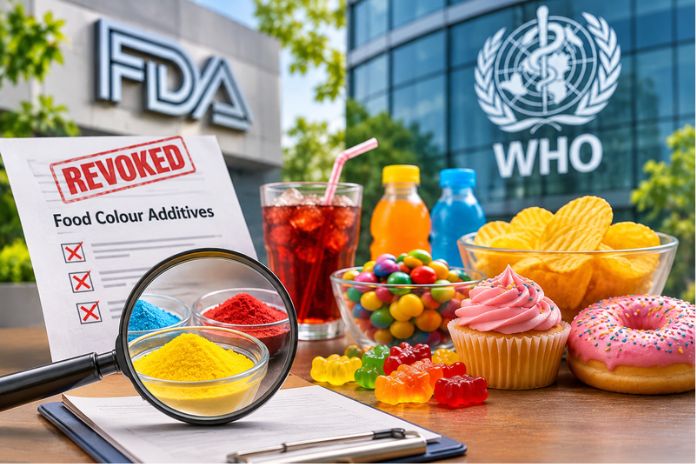
WHO Reviews Food Ingredients as FDA Revokes Food-Colour Authorisations
Internationally, two major regulatory developments in November 2026 have brought food ingredient safety back to the forefront. The United States Food and Drug Administration (FDA) said it will revoke some authorisations for chemicals used to make food colours, while the World Health Organization (WHO) is asking for public feedback on a proposed model for profiling foods that would consider ingredients such as added colours, flavours and sweeteners, as well as nutritional composition.
While these initiatives have different regulatory objectives, they highlight the increasing importance of food safety, ingredient transparency and healthier food environments.
FDA Announces Revocation of Certain Chemical Authorisations
On 9 November 2026, the US FDA announced two regulatory actions regarding substances used in food-colour applications and manufacturing.
The first relates to methylene chloride, a diluent authorised in inks to mark fruit and vegetables. The FDA is revoking this authorisation in response to a petition filed by the Environmental Defence Fund, Breast Cancer Prevention Partners, Center for Environmental Health, Environmental Working Group and Lisa Lefferts.
The petition cited the US Federal Food, Drug, and Cosmetic Act’s Delaney Clause. This provision disallows authorisation of certain food or colour additives found to cause cancer in humans or animals when ingested.
The FDA said it had evidence methylene chloride caused cancer in laboratory animals.
The second action relates to the use of three chemicals as extraction solvents in the manufacture of certain natural colour additives:
- Chloromethane
- Ethylene dichloride
- Trichloroethylene
The colour additives in question are annatto extract, paprika oleoresin and tumeric oleoresin.
This action was taken after a separate petition by the International Association of Colour Manufacturers showed that these particular manufacturing uses had been abandoned by industry.
Crucially, the FDA’s ruling doesn’t mean turmeric, paprika or annatto are banned as food colourants. It removes specified authorisations for chemicals used in some manufacturing processes.
Both sets of revocations will take effect on 11 January 2027.
Food Colour Safety and the Delaney Clause
The Delaney Clause is a section of US food and colour additive legislation which forbids the approval of substances that are shown to cause cancer under the appropriate statutory criteria.
It reflects a precautionary regulatory approach on food additives that are carcinogenic.
Safety assessments of food colours also take into account factors such as intended use, levels of exposure, chemical composition, manufacturing processes and possible impurities.
The FDA evaluates food and colour additives before they may be used and may re-evaluate existing approvals when new evidence or regulatory petitions call for further review.
The latest announcement, however, makes an important distinction between the methylene chloride action on fruit-marking inks (based on the Delaney Clause) and the withdrawal of the three extraction-solvent authorisations (based on evidence that the relevant industrial uses had been abandoned).
WHO Proposes Wider Food Profiling
Coinciding with the FDA announcement, the WHO released a draft document titled Integrated Food Profiling Model for Regulatory Measures on 2 November 2026.
Our proposed model is intended to assist governments in identifying pre-packaged, industrially produced foods that should be consumed in moderation within healthy dietary patterns.
Traditionally, many food-profiling systems have focused mainly on nutritional characteristics such as sugar, sodium and fat.
WHO’s proposed model is more comprehensive by taking into account two dimensions
1. Nutritional Value
The model considers criteria related to:
- Saturated fats
- Trans fatty acids
- Carbs
- Sodium
2. Specified ingredients used for sensory purposes
Also considers:
- Added new colours
- Additional flavours
- Sugar substitutes
Under the proposed approach, a product would be identified if it exceeded one or more of the specified nutrient criteria or contained one or more of the specified ingredients.
The WHO notes that the addition of colours, flavours and sweeteners does not automatically make these ingredients unsafe. They are designed to assist in identifying specific products that have been formulated for industrial use and that might be worthy of consideration for public-health regulatory action.
Why Is WHO Looking at This Model?
Unhealthy dietary patterns are a major risk factor for noncommunicable diseases, including cardiovascular diseases, diabetes and some other chronic diseases.
Governments have a range of policy measures available to promote healthier food environments, including:
- Front-of-pack nutrition labels.
- Restrictions on the marketing of food.
- Fiscal measures (including possible taxation).
- Standards of nutrition for public procurement of food.
- Regulations for advertising and food services.
The WHO model is designed to give governments a consistent way of identifying products that may fall within the scope of such measures.
But the model is still a work in progress. It is not yet a final international regulation or automatic ban on products containing colours, flavours or sweeteners.
The public consultation will be open from 2 November 2026 and will close on 27 November 2026 at 23:59 CET.
WHO has called for comments from governments, researchers, civil-society organisations, industry representatives and other stakeholders before finalising the document.
What Do These Developments Mean for the Food and Nutraceutical Industry?
The FDA and WHO activities could affect future decisions on food formulation, ingredient selection, manufacturing processes and product labelling.
For food-colour manufacturers, the FDA actions mean that from the effective date the affected US-authorised manufacturing processes will need to comply with the revised regulatory requirements.
The potential areas of adjustment for ingredient suppliers and food manufacturers are:
- Review of manufacturing processes and allowed processing solvents.
- Assessment of alternative colour sources and extraction technologies.
- Improved documentation and traceability of ingredients.
- Keeping track of evolving food-labelling requirements.
- Evaluate the nutritional and sensory properties of the final products.
Natural colourants such as turmeric, paprika and annatto are likely to receive further commercial interest as manufacturers consider alternative formulation strategies. But natural origin alone does not mean an ingredient or finished product is safer or nutritionally superior.
Colour stability, purity, consistency, cost and regulatory compliance will continue to be important factors.
The WHO proposal may also have implications beyond the colour industry as it includes flavours and sweeteners in its draft profiling framework.
These developments on the global stage are relevant to India’s food-processing, nutraceutical and ingredient manufacturing sectors.
Food safety, food additives, product standards and labelling are regulated by the Food Safety and Standards Authority of India (FSSAI) under the Food Safety and Standards Act, 2006 and associated regulations.
The food additives permitted to be used and the conditions of use thereof are specified in the Food Safety and Standards (Food Products Standards and Food Additives) Regulations, 2011.
Indian food businesses should not assume that a US FDA decision automatically changes Indian regulations and should continue to comply with the applicable FSSAI requirements.
At the same time, international regulatory developments can guide scientific discussions, ingredient sourcing, manufacturing quality and future policy considerations.
Manufacturers exporting to the United States should be aware of the FDA’s updated authorisations and effective date.
The developments also offer an opportunity to explore the relationship between traditional food ingredients, natural colourants and modern food-safety science.
Familiar sources of natural colour are turmeric, paprika and annatto. In particular, turmeric has a well-established role in Indian culinary and Ayurvedic traditions.
But a natural ingredient must be of appropriate standards of identity, purity, quality and safety when used in commercial food products.
Traditional use does not automatically confirm the safety of all concentrated extracts, processing aids or methods of manufacture.
Manufacturers of Ayurvedic food products, nutraceuticals and herbal formulations should take care of the following points:
- Verification of raw materials.
- Testing for adulterants and contaminants.
- Standardisation of extracts.
- proper processing and storage.
- Adherence to applicable FSSAI requirements.
- Scientific assessment of the safety of the product and its claims.
The combination of traditional ingredients with modern quality-control systems can promote consumer trust and responsible product development.
Why This Regulatory News Matters
The FDA’s measures and the WHO’s suggested food-profiling template address different facets of food regulation. The first is about particular chemical authorisations, while the second aims at developing a wider framework to identify industrially produced foods that should be consumed in moderation.
Together, they point to the need for transparency in ingredient information, evidence-based regulation and continuous evaluation of food products.
“Consumers should consider what foods are made of and the quality of the diet as a whole, rather than judging products on colour or claims of naturalness.
The developments underscore the need for regulatory compliance, scientific evidence and responsible formulation on the part of manufacturers.
Conclusion
What happened in November 2026? FDA and WHO developments are important conversations in global food safety and nutrition policy.
FDA’s revocations are specific to certain uses of some chemicals in colour-related applications. WHO’s draft model has a broader approach to identifying industrially produced foods for moderation.
Neither development should be seen as a blanket ban on natural food colours, or a declaration that added colours, flavours and sweeteners are all unsafe.
For India these developments represent a timely opportunity to raise awareness of food safety, manufacturing standards and scientific evaluation of natural ingredients while guaranteeing compliance with national regulations.
Source Link: Nutraceutical Business Review – FDA colour additive revocations coincide with WHO scrutiny of food ingredients



