


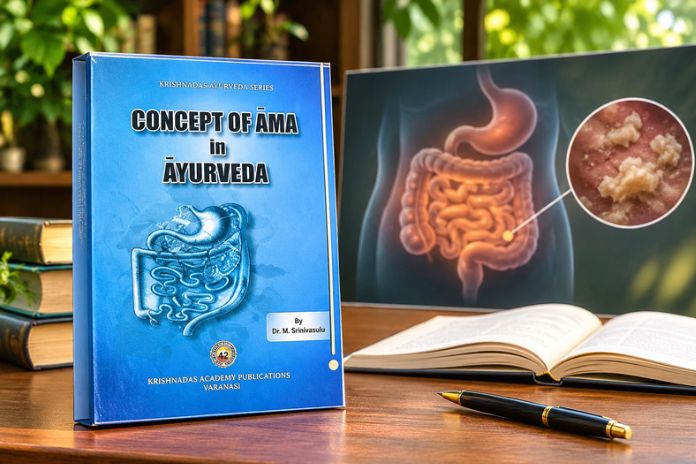
By M. Srinivasulu (Author page on Amazon)
Āma, impaired digestion and disease development: An Ayurvedic perspective and treatment principles
Āma is a key concept in Ayurveda for understanding health, digestion and disease development. Its relation to impaired digestive and metabolic processes, disturbance of body functions and manifestation of different disease conditions is discussed. Its relevance lies in Ayurvedic subjects like Nidāna (pathology), Kāya Chikitsā (internal medicine) and therapeutic decision making.
In “Concept of Āma in Ayurveda”, Prof. Dr. M. Srinivasulu discusses the topic in a systematic manner. The book deals with the nature and formation of Āma, its presence in different levels of digestion and metabolism, identification of Sāma and Nirāma conditions and principles of management. It is a specialist reference for those readers who wish to understand Āma more deeply in the classical Ayurvedic framework.
1. Āma: The Central Concept of Ayurvedic Pathology
Āma is frequently defined in Ayurveda with regards to the improper transformation or incomplete processing of substances that arise when the digestive and metabolic processes of the body are disturbed. It is not a direct synonym for food residue or a directly measurable biomedical toxin. It is a concept in a broader Ayurvedic explanation of physiological imbalance and disease development.
The book opens with a discussion of the foundations of Agni and the nature of Âma. It deals with the meaning of the word, its causes (Nidāna), its formation (Utpatti) and its characteristics (Svarūpa). This provides the conceptual background needed to appreciate the role of Āma in Ayurvedic diagnosis.
The discussion is particularly helpful because it situates Āma in the larger context of Agni, rather than as an isolated concept. According to the Ayurvedic theory, the status of digestive and metabolic function determines the processing of food and nourishment of body tissues. The book also explores how the disruption of these processes is understood to contribute to the formation and progression of Āma.
2. Āma in Different Phases of Digestion and Metabolism
One of the major themes is the analysis of Āma at different levels of transformation. It discusses three important fields in the book:
- Jatharāgni level: Associated with the initial digestive process and the conversion of food in the gastrointestinal tract.
- Level of Bhūtāgni: It is related to the Ayurvedic concept of transformation according to the five elemental principles.
- Dhātvagni level: It is related with metabolism for formation and nourishment of the body tissues i.e. Dhātus.
This is a layered discussion. Important as it associates Āma with different stages of digestion and tissue metabolism. Further, it provides a framework for comprehending the distinction between disturbances of primary digestion and those of subsequent metabolic transformation in Ayurvedic texts.
This section provides students and researchers with an opportunity to study the relationship of Agni, Āma, Dhātu and the functioning of bodily channels (Srotas) in Ayurvedic physiology.
3. Sāma and Nirāma: Knowledge of Disease States
Another important topic is the distinction between Sāma and Nirāma conditions. These terms are useful in Ayurvedic clinical reasoning to describe the presence of features of Āma in disease.
The book deals with the general development of these conditions (Samanya Samprāpti) and their characteristic manifestations (Lakṣaṇa Samprāpti). It also considers the indicators used for the evaluation of a Sāma state.
This subject is practically important because in Ayurvedic assessment it is not matter of merely naming a disease. It also takes into consideration the patient’s presentation, the state of the Doṣas, digestive capacity and other factors that may influence therapeutic decisions. Thus the difference between Sāma and Nirāma is part of a larger clinical framework.
The book’s focus on diagnostic signs and symptoms is a useful resource for readers looking for the application of classical Ayurvedic principles in clinical reasoning.
4. Principles of Management and Therapeutic Uses
The text moves from a conceptual discussion to the general principles of management. It consists of Sāmānya Chikitsā which has a discussion structured around various pathways or categories of diseases and Dravya Yojanā which deals with the principles of selection and application of medicinal substances.
The contents deal with substances acting on level of Jatharāgni, Bhūtāgni and Dhātvagni. Compound formulations (Yogas) are also discussed. Another section deals with the management of particular diseases including Āmavāta.
The book has a coherent academic structure that follows the progression from definition to formation to assessment to management. It assists the readers to understand the relation of concept of Āma with Ayurvedic pathology and therapeutic planning.
The material is to be taken as an exposition of the principles of Ayurveda. This book is not a substitute for individual clinical assessment and the descriptions should not be taken as instructions for self-diagnosis or self-medication.
5. Significance of the Book for Ayurveda Students and Researchers
The concept of Āma in Ayurveda is particularly relevant to:
- BAMS and PG Students: For the study of Āma, Agni, Samprāpti and the Sāma-Nirāma distinction.
- Ayurvedic teachers: As a reference to explain the relationship of digestive function and disease processes in classical Ayurveda.
- Kāya Chikitsā practitioners: To reassess the role of Āma in the principles of Ayurvedic clinical assessment and management.
- Researchers: as a source of finding out traditional ideas that can be studied through well planned research.
- Readers of Ayurvedic Literature: To understand a concept that is repeated in many branches of Ayurveda in a more systematic way.
The subject matter and specialised terminology of this book are better suited to readers who already have some background in Ayurveda rather than beginners.
6. A Bridge Between Classical Concepts and Modern Research
The concept of Āma has continued to be of interest in Ayurvedic scholarship because of its association with digestion, metabolism, tissue nourishment and disease development. Modern investigators might find it useful to study various aspects of this framework including the way in which descriptions of Ayurveda are defined, evaluated and applied in clinical settings.
However, we need to keep it scientifically clear. It is a mistake to equate āma with toxins, metabolic waste, inflammation or any single biomedical substance or process automatically. Such comparisons may serve as research questions, but need well-defined parameters and reliable clinical or experimental evidence.
The strength of Srinivasulu’s work lies in its effort to systematise the Ayurvedic understanding of Āma at different levels of physiology and pathology. It provides a conceptual framework for further academic discussion without shutting down critical evaluation.
7. Editorial Viewpoint: A Reference to Ayurvedic Pathology with Focus
One of the most striking features of this book is its systematic organization. It starts from the meaning and formation of Āma, to the different levels, diagnostic indications, general principles of management and specific applications in diseases. This makes it more than just an introductory text; it is rather a focused reference for understanding the integration of Āma into Ayurvedic clinical thinking.
Its discussion on Āmavāta is also relevant as this condition is a familiar example in Ayurvedic literature of the clinical importance given to Āma. The objective of this subject is to make a link between theoretical principles and discussions of disease-
However, readers are encouraged to distinguish between traditional Ayurvedic explanations and established biomedical mechanisms. This book should be read as a specialist treatise on Ayurvedic theory and practice and not as a modern clinical guideline.
8. Conclusion
Concept of Āma in Ayurveda by Prof. Dr. M. Srinivasulu is a well organised and well structured exploration of one of the important concepts in physiology and pathology in Ayurveda. It is a useful academic reference as it deals with Agni, Āma formation, Jatharāgni, Bhūtāgni, Dhātvagni, Sāma–Nirāma assessment and therapeutic principles.
The book offers a chance for Ayurveda students, teachers, practitioners and researchers to study the understanding of Āma at different levels of digestion, metabolism and disease development. It also encourages further research on classical ayurvedic ideas through meticulous interpretation and scientific study.
More Information and Book Details
- Title: Āma in the Ayurvedic System
- Author: Prof. Dr. M. Srinivasulu
- Series: Banaras Ayurveda Series No. 11
- Publisher: Chowkhamba Sanskrit Series Office Varanasi
- Language: English
- ISBN: 9788170801559
- Amazon: See the book on Amazon India
- Author page: M. Srinivasulu at Amazon
- Publisher Book listing: Chow



