


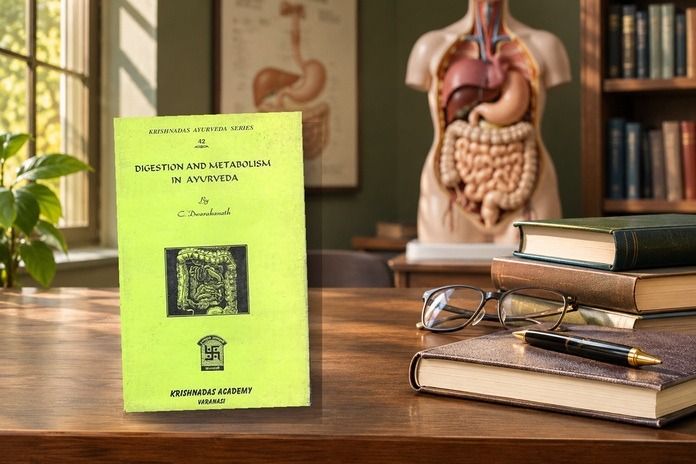
A detailed exploration of Ayurvedic concepts of digestion, nutrition and metabolism through the lens of modern physiology and classical knowledge.
1. Digestion: More than just eating
Digestion is much more than digestion. It is a complicated series of processes that the body uses to eat food, absorb nutrients, change them and get rid of waste. Ayurveda has studied these processes in terms of concepts such as Agni, Pitta, Srotas, Dhatu and Dosha.
In his book ‘Digestion and Metabolism in Ayurveda’, Vd C. Dwarakanath reviews these classical concepts in relation to the physiology and biochemistry of digestion and metabolism. The book provides a thorough academic discussion for those readers who wish to understand Ayurvedic explanations of bodily transformation in relation to the study of human physiology.
This is not a general introduction to Ayurveda, but a work for specialists, especially for students, teachers, researchers and practitioners who have a basic knowledge of Ayurvedic principles.
2. Digestion from the Ayurvedic perspective
The book’s major focus is on the Ayurvedic concept of Agni, which is generally linked to the body’s ability to digest and transform food and other substances. The text describes Pachaka Pitta and different stages of digestion including Avasthapaka and Vipaka.
These concepts provide a traditional frame to the processing of food and to the understanding of its effects in Ayurveda. The book also discusses Pitta in connection with bile and the functions of Kledaka Kapha, Samana Vayu and Apana Vayu in the processes of digestion.
The author treats these ideas with the anatomical and embryological considerations, secretory functions and intestinal digestion. This approach makes the book useful for readers interested in the relationship between classical Ayurvedic physiology and modern biomedical descriptions.
3. The Role of Dhātus: From Digestion to Metabolism
The discussion moves beyond the gastrointestinal process to the wider metabolic activities of the body. Dhatvagni Paka – it is the Ayurvedic concept which is related to the metabolic transformation at the tissue level. It is a major subject.
The book deals with Dhatuvaha Srotas and formation of Prasada (nutritive components) and Mala (waste products). These discussions are essential to understanding the Ayurvedic conceptualisation of the transformation and distribution of nourishment in the body.
It also deals with the importance of Bhutagni Paka and the relationship between the properties of the substances and their transformation. Together these subjects present digestion and metabolism as a single process, not as separate functions of the body.
This larger perspective prepares the readers who are studying Ayurvedic nutrition and physiology to explore the classical texts to understand nourishment, tissue formation and waste elimination.
4. Linking Classical Ayurveda to Modern Science
A distinct feature of the book is its attempt to critically assess Ayurvedic concepts in the light of modern scientific knowledge. The contents are anatomical, embryological, secretory and biochemical views and classical terminology.
This is of academic interest as a comparative approach. It encourages the reader to question traditional explanations, and to consider where conceptual parallels might exist with modern physiology.
However, the comparison of the concepts of Ayurveda with modern biomedical processes should not be taken as evidence that the two systems describe the same mechanisms. Words like Agni, Pitta and Dhatu are part of another theory in Ayurveda. Careful analysis and proper scientific evidence are needed for the interpretation and any possible biomedical correlations.
The book’s value, therefore, is not in its presentation of each traditional explanation as an experimentally established physiological fact, but in its scholarly analysis of these concepts.
5. Who Is This Book For?
The book is a particular aid for:
- Ayurveda Students: For detailed study of AGNI, PITTA, PAKA, DHATU and SROTAS in context of digestion and metabolism.
- Ayurvedic teachers and researchers: As a source of information for academic discussion and further research into classical Ayurvedic physiology.
- Practitioners: To re-examine traditional ideas of digestion, tissue feeding and metabolic transformation.
- Readers interested in comparative physiology: To explore the study of Ayurvedic concepts alongside the modern knowledge of anatomy and physiology.
The technical nature of the subject may be difficult to comprehend in parts by a reader who has not had previous experience with Ayurveda. Some knowledge of the Sanskrit terminology and the principles of Ayurveda will enable the reader to appreciate the content more fully.
6. A Scientific Contribution to the Physiology of Ayurveda
A special merit of Digestion and Metabolism in Ayurveda is its systematic approach to a subject linking several major branches of Ayurvedic knowledge. The discussion of digestion, intestinal processes, metabolic transformation, nourishment and waste formation of tissues provides a broad academic framework to understand the Ayurvedic perspective about the body’s internal processes.
The detailed chapter structure also makes it useful as a reference work rather than a book to be read from cover to cover. Students and researchers can study specific topics in Ayurvedic physiology, Kayachikitsa and related subjects.
At the same time the book is part of a scholarly tradition that studies classical ideas using a comparative way of interpretation. This provides a framework for contemporary research to test specific hypotheses with well-defined methods, measurable outcomes, and reproducible evidence.
7. Publisher’s Point of View: Why This Book Remains Relevant
Digestion and metabolism are still of great interest in the fields of healthcare, nutrition and physiological research. Modern science studies gastrointestinal function , nutrient absorption , energy regulation , tissue metabolism , and the relationship between metabolic processes and general health .
Ayurveda addresses the subjects in its own conceptual vocabulary and theoretical framework. Books like Dwarakanath’s help one to see that framework more deeply.
This book will be especially useful to readers who wish to go beyond the simplified explanations of Agni and who wish to see the classical discussion of digestion and metabolism in a more systematic way. Its comparative perspective makes it a useful starting point for thoughtful academic dialogue between Ayurveda and contemporary biomedicine.
This should be interpreted as an academic work on Ayurvedic concepts and not as a substitute for modern medical textbooks, clinical evaluation, or evidence-based treatment guidelines.
8. Conclusion
Vd C. Dwarakanath , Digestion and Metabolism in Ayurveda. This is a specialised academic work on physiology of Ayurveda . In its discourse on Agni, Pitta, Paka, Bhutagni, Dhatvagni and Dhatuvaha Srotas, it explores the perspective of Ayurveda on the conversion of food, nourishment of body tissues and expulsion of waste.
Its detailed treatment makes it especially useful to students, teachers, practitioners and researchers of Ayurveda interested in the foundations of digestive and metabolic concepts.
This book is a good reference for anyone who wants to explore the Ayurvedic view of digestion and metabolism further, and encourages more research in this field to link ancient knowledge with modern physiological research.
More Information and Book Details
- Title: Ayurvedic digestion and metabolism
- C. Dwarakanath Author
- Publisher: Chowkhamba Krishnadas Academy
- Edition: Second edition, 1997
- Page Count: 361
- Amazon: Find the book on Amazon India
- Author: C. Dwarakanath – Amazon author page
- Book catalogue and publisher info: Krishnadas Ayurveda Series listing
- Contents excerpt: See the contents of the book
[This is the second edition as recorded. Bibliographical details above are for this edition.] Reprints may have a different original publication date, and/or format, please check edition details in the seller’s listing.
Edition: 2nd edition 1997
Language: English
ISBN: 978-81-218-0132-4 (ISBN-10: 81-218-0132-X)
SOURCE LINK: https://amzn.in/d/0huq7I6m