


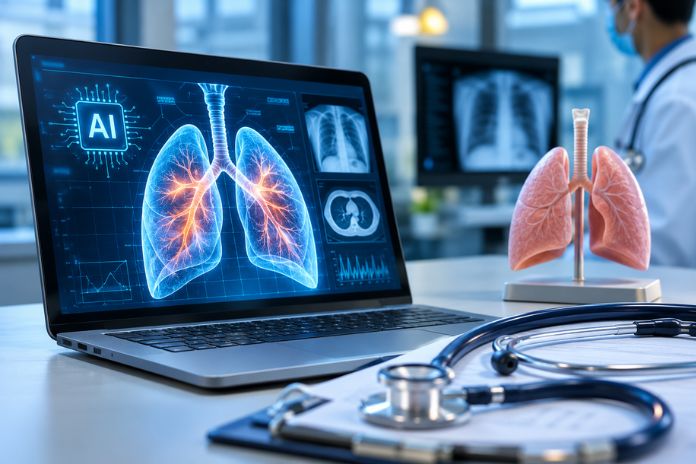
Artificial Intelligence in Respiratory Medicine: Transforming the diagnosis, monitoring and treatment of lung disease with AI
Artificial intelligence is opening up new possibilities in respiratory healthcare, from identifying lung nodules in CT scans to predicting asthma and COPD exacerbations. But can these technologies enhance the accuracy, personalisation and accessibility of lung care?
Millions of people worldwide suffer from respiratory diseases, including asthma and chronic obstructive pulmonary disease (COPD), lung cancer, pneumonia and interstitial lung diseases. Diagnosing and managing these conditions can be challenging because symptoms overlap, disease progression varies among individuals, and clinical decisions may rely on several types of information.
Artificial intelligence (AI) is a promising technology emerging in respiratory medicine. Artificial intelligence (AI) systems could assist healthcare professionals to detect trends, assess disease severity and monitor patients over time on the basis of analysis of medical images, lung function measurements, clinical records and data from wearable devices.
Anuj Yadav, Akash Yadav and Dinesh Kumar Jain in a review titled “AI in the Respiratory System: Recent Trends and Future Prospects” discuss the growing role of AI in pulmonology. Published in May 2026 in the International Journal of Pharmaceutical Sciences and Research, the article addresses applications in lung imaging, pulmonary function testing, management of chronic respiratory disease, critical care, drug discovery, and clinical decision support.
The review suggests a strong possibility that respiratory health care may gradually shift from a model that primarily depends on periodic assessments to a more continuous, data-driven and personalised care model. Still, AI should be seen as a tool that can assist healthcare professionals, not as a substitute for clinical judgement.
What is the importance of artificial intelligence in respiratory medicine?
The respiratory system is constantly exposed to environmental particles, allergens, pollutants and infectious agents. Such exposures may lead to acute and chronic respiratory diseases.
Some diseases, such as COPD, cause progressive changes in lung function. Others like asthma can be intermittent. Imaging may not easily detect early abnormalities in patients with lung cancer and interstitial lung diseases, posing additional diagnostic challenges.
Traditional respiratory assessment may include:
- Clinical history and physical exam.
- X-ray of the chest and computed tomographic (CT) scans.
- Spirometry to test pulmonary function.
- Laboratory work.
- looking at symptoms and response to treatment.
AI is able to go through large piles of this data and find patterns that are hard to reliably find by eyeballing the data itself. Machine learning and deep learning are especially relevant as they can be trained to detect patterns in medical images, sounds and patient time-series data.
1. AI in lung imaging: Helping with earlier, more consistent diagnosis
Medical imaging is one of the most advanced fields of AI application in respiratory medicine.
Detection of lung cancer and pulmonary nodules
A pulmonary nodule is an abnormal area in the lung that can be visualised on a CT scan. Many nodules are harmless, but some may be an early form of lung cancer.
Convolutional Neural Network (CNN) based artificial intelligence systems can evaluate CT images to identify and classify lung nodules. More advanced systems can also assess traits such as:
- Size and shape of nodules.
- Internal texture and density.
- Attributes of the border.
- Variations between scans taken at different times.
The review discusses how AI could help in risk assessment and reduce the need for additional follow-up tests by helping to distinguish nodules that are less likely to be risky from those that need more careful evaluation.
They also discuss radiogenomics, an emerging field that explores whether imaging characteristics can predict the molecular features of tumours. Such approaches may be helpful in future treatment planning, but imaging-based prediction cannot substitute for tissue diagnosis or for validated molecular testing, when clinically needed.
AI for assessment of COPD and asthma
Patterns of airway and lung abnormality differ in COPD and asthma. Quantitative CT analysis with AI assistance may be useful for measuring structural changes, such as emphysema and airway-wall thickening.
Such measurements may contribute to the understanding of disease characteristics and may enable a more detailed assessment of the patient.
The review also examines research on the use of CT images to estimate lung-function measurements, including forced expiratory volume in one second (FEV₁). These applications may ultimately offer additional information in situations where conventional pulmonary function testing is difficult, but should not be regarded as interchangeable with validated lung-function tests.
Interstitial Lung Disease
Interstitial lung diseases (ILDs) are diseases of the lung tissue around the air sacs in the lungs. It can be difficult to diagnose them because HRCT scans may show similar patterns for different conditions.
Artificial intelligence can help identify and quantify imaging patterns, assist in disease classification and track changes over time.
The review emphasises that AI-based measurements may help to standardise the imaging assessment and help clinicians to monitor disease progression. But the final diagnosis and treatment decisions must be based on the interpretation of imaging combined with clinical history, laboratory findings and specialist assessment.
Artificial intelligence for infectious respiratory diseases
The COVID-19 pandemic has spurred research into AI-assisted analysis of chest images. AI tools were examined to estimate the degree of lung involvement and help in assessment of disease severity.
Similar technologies are being targeted at pneumonia and tuberculosis. They may be of particular value in settings where specialist radiology resources are scarce.
An imaging algorithm, by itself, cannot determine the cause of an infection. However, clinical assessment and the appropriate laboratory testing remain essential.
2. AI in pulmonary function tests
Pulmonary function tests are used to assess how well your lungs are working. Spirometry is the most commonly used method to measure airflow, including FEV₁ and forced vital capacity (FVC).
The quality of spirometry depends partly on the patient’s effort and ability to follow instructions. Incorrect technique can affect the reliability of the results.
According to the review, AI-assisted spirometry systems may help assess the quality of a test while it is being performed. They could provide feedback about blowing technique, the speed of exhalation or whether the patient has stopped too early.
Such tools may help technicians obtain more reliable measurements and reduce avoidable testing errors.
AI is also being investigated for analysing respiratory sounds. Algorithms trained on recorded lung sounds may help identify patterns associated with wheezing, crackles and other abnormal sounds.
Smartphone-based cough and breathing-sound analysis is another developing area. These tools could eventually support preliminary screening or remote monitoring, but they are not substitutes for a proper respiratory examination or diagnostic testing.
3. AI for asthma and COPD: Moving towards personalised respiratory care
Asthma and COPD do not affect every patient in the same way. Individuals with the same diagnosis may have different symptoms, underlying disease characteristics and responses to treatment.
AI may help analyse this variation.
Identifying different disease patterns
Machine learning techniques can group patients according to similarities in clinical information, lung-function measurements, imaging and biomarkers.
This process, sometimes called phenotyping, may help identify groups of patients with distinct disease characteristics.
For example, people with asthma may have different inflammatory patterns, while patients with COPD may show varying degrees of emphysema and chronic bronchitis.
Understanding these differences could support more targeted treatment decisions.
Predicting exacerbations
An exacerbation is a sudden worsening of respiratory symptoms, which may require additional treatment or hospital care.
AI models may analyse information such as:
- Changes in daily symptoms.
- Rescue inhaler use.
- Heart rate and respiratory rate.
- Sleep patterns.
- Data from wearable devices.
- Previous exacerbations and clinical history.
By identifying changes from an individual’s usual pattern, predictive systems may help flag a possible deterioration.
The long-term aim is to alert patients and healthcare teams early enough to assess the situation and take appropriate action. Such alerts must be clinically validated, and treatment changes should be made under medical supervision.
Predicting treatment response
Another promising application is the prediction of how a patient may respond to a particular treatment.
The review discusses research into using imaging, clinical information and other patient data to predict responses to cancer immunotherapy and different inhaled medicines used in COPD.
This could contribute to personalised respiratory medicine, in which treatment decisions are informed by an individual’s clinical characteristics rather than relying only on broad disease categories.
However, predictive models need prospective clinical validation before they can be relied upon to select treatment.
4. AI in intensive care and respiratory interventions
AI may also support the management of critically ill patients who require advanced respiratory support.
In intensive care units, patients with severe respiratory failure may need mechanical ventilation. Selecting appropriate ventilator settings requires continuous monitoring and careful clinical judgement.
The review describes potential applications of AI in:
- Analysing patient data to identify signs of deterioration.
- Supporting the optimisation of ventilator parameters.
- Predicting complications and adverse clinical outcomes.
- Assisting robotic bronchoscopy procedures.
- Supporting real-time monitoring of critically ill patients.
Robotic bronchoscopy uses specialised technology to help clinicians navigate airways and reach selected areas of the lungs for examination or sampling. AI-assisted navigation may improve procedural guidance, although the technology remains dependent on specialist supervision.
The longer-term possibility of closed-loop ventilator systems, which automatically adjust selected settings in response to patient data, is also discussed. Such systems require stringent safety testing because inappropriate adjustments can have serious consequences.
5. Digital twins: Creating virtual models of individual patients
One of the more forward-looking concepts discussed in the review is the digital twin.
A digital twin is a computer-based representation of a real-world object or system. In healthcare, the concept involves creating a virtual model of an individual using relevant clinical, physiological, imaging and other data.
In respiratory medicine, a digital twin could potentially incorporate:
- Lung imaging.
- Pulmonary function measurements.
- Clinical history.
- Genetic information.
- Data from wearable sensors.
- Treatment responses over time.
Researchers could use such models to simulate possible disease progression or explore how different treatment strategies might affect an individual.
In the longer term, digital twins may support the development of personalised treatment plans and computer-based simulations of clinical interventions.
However, a digital twin is not a perfect virtual copy of a patient’s lungs or body. Its usefulness depends on the accuracy of the underlying data, the assumptions used in modelling and the ability of the model to predict real clinical outcomes.
6. Generative AI and large language models in respiratory healthcare
Generative AI and large language models (LLMs) are expanding the possibilities of AI beyond image analysis and numerical prediction.
The review identifies several potential applications.
Clinical documentation: AI systems may help convert doctor–patient conversations into structured clinical notes, reducing administrative work.
Medical record summaries: LLMs could summarise lengthy electronic health records and highlight relevant information for healthcare professionals.
Radiology reporting: AI may help prepare draft reports based on chest imaging, allowing radiologists to review and refine the findings.
Clinical decision support: AI assistants may help organise medical information and provide clinicians with relevant information during patient assessment.
These applications could improve workflow efficiency, but generated content may contain errors or omit important details. Clinical records, reports and treatment recommendations must therefore be checked by qualified professionals.
7. AI in respiratory drug discovery
The review also discusses AI’s potential contribution to pharmaceutical research.
Drug discovery is a complex process involving the identification of potential therapeutic targets, screening of compounds, evaluation of biological activity and extensive safety and clinical testing.
AI techniques may help researchers:
- Analyse biological and molecular datasets.
- Identify potential drug targets.
- Screen large numbers of chemical compounds.
- Predict selected molecular properties.
- Support the design and optimisation of candidate molecules.
- Explore possible relationships between patient characteristics and drug response.
Generative models and quantitative structure–activity relationship (QSAR) approaches are among the techniques discussed.
These tools may help researchers prioritise promising candidates, but an AI-generated drug candidate is not automatically safe or effective. Laboratory investigations, preclinical testing and properly conducted clinical trials remain necessary.
8. Challenges and ethical concerns in AI-based respiratory medicine
Despite its potential, AI cannot be adopted responsibly without addressing important technical, clinical and ethical challenges.
Data quality and availability
AI systems require large amounts of reliable, accurately labelled data. Medical datasets may differ in image quality, equipment, reporting practices, patient characteristics and clinical settings.
A model trained in one hospital may not perform equally well in another.
Algorithmic bias
If the data used to develop an AI model do not adequately represent different populations, the system may perform less reliably for some groups.
This could worsen existing healthcare inequalities, particularly when AI tools are introduced without adequate local validation.
The black-box problem
Some deep-learning systems produce predictions without making their reasoning easy to understand.
In healthcare, clinicians need to know not only what an algorithm predicts but also how reliable that prediction is and where it may fail.
Explainable AI (XAI) aims to make model outputs more interpretable. For example, image-based systems may highlight the regions that influenced a prediction. Such visual explanations can be useful, but they do not by themselves prove that the algorithm’s conclusion is correct.
Privacy and data protection
Respiratory AI may use sensitive information from medical records, imaging, genetic testing and wearable devices.
Protecting patient privacy, obtaining appropriate consent and ensuring secure data handling are essential.
Integration into clinical practice
Even a technically accurate AI system may have limited value if it does not fit into existing hospital workflows.
Successful implementation requires compatibility with electronic health records, imaging systems and clinical processes, as well as training for healthcare professionals.
Accountability and patient safety
AI recommendations can influence decisions involving diagnosis, treatment and critical care. Clear responsibility must remain with appropriately qualified healthcare professionals and the institutions deploying these tools.
Independent validation, ongoing performance monitoring and mechanisms for reporting errors are necessary before and after implementation.
What could the future of AI in respiratory medicine look like?
The review anticipates that AI will become increasingly integrated into respiratory healthcare over the coming years. Several developments may shape this transition:
| Emerging technology | Potential future application |
|---|---|
| Generative AI | Drafting clinical notes and radiology reports |
| Digital twins | Simulating individual disease progression and treatment scenarios |
| Wearable sensors | Continuous monitoring of respiratory and physiological parameters |
| Predictive analytics | Identifying patients at risk of exacerbations |
| Robotic AI | Supporting precision-guided bronchoscopy |
| Multimodal AI | Combining imaging, clinical, genetic and sensor data |
| AI-assisted drug discovery | Identifying and evaluating potential therapeutic candidates |
The broader direction is towards a more predictive and personalised model of respiratory healthcare. Rather than depending entirely on occasional hospital visits, future systems may combine clinical assessments with information collected over time.
However, these developments will become meaningful only when they demonstrate reliable performance, patient benefit, safety and practical value in real healthcare settings.
Conclusion: AI could reshape the future of lung healthcare
Artificial intelligence is creating new opportunities in respiratory medicine, from identifying abnormalities in CT scans and improving pulmonary function testing to predicting disease exacerbations and supporting personalised treatment research.
The review by Yadav and colleagues provides an overview of these developments and highlights the potential of deep learning, predictive analytics, digital twins, generative AI and multimodal data integration.
Yet technological progress must be accompanied by responsible implementation. Data quality, algorithmic bias, patient privacy, interpretability, clinical validation and accountability remain essential considerations.
For healthcare professionals, researchers and institutions, the challenge is not simply to adopt AI but to establish where it genuinely improves patient care. Collaboration between clinicians, data scientists, engineers, researchers and policymakers will be central to this process.
The future of respiratory medicine may be increasingly intelligent and personalised, but its foundation must remain reliable scientific evidence, clinical judgement and patient safety.
SEO and publication details
SEO title: AI in Respiratory Medicine: Applications, Benefits and Future Prospects
Suggested URL slug: artificial-intelligence-respiratory-medicine-future-prospects
Meta description: Discover how artificial intelligence is transforming respiratory medicine through lung imaging, COPD monitoring, asthma management, predictive analytics and personalised healthcare.
Primary keyword: Artificial intelligence in respiratory medicine
Secondary keywords:
- AI in pulmonology
- AI in lung disease diagnosis
- Artificial intelligence in COPD
- AI in asthma management
- AI in lung cancer detection
- Digital twins in healthcare
- AI in pulmonary function testing
- Machine learning in respiratory healthcare
- Future of respiratory medicine
Suggested categories: Medical Research; Artificial Intelligence in Healthcare; Respiratory Health; Healthcare Innovation
Suggested tags: Artificial intelligence, respiratory medicine, pulmonology, lung cancer, COPD, asthma, interstitial lung disease, machine learning, deep learning, digital twins, personalised medicine.
Featured image concept: A modern medical illustration showing human lungs at the centre, surrounded by AI-generated CT scan analysis, respiratory monitoring devices, digital health data and a clinician reviewing a diagnostic screen.
Suggested alt text: Artificial intelligence in respiratory medicine showing lung imaging analysis, digital monitoring and AI-supported diagnosis of respiratory diseases.
Article reference
Yadav A, Yadav A, Jain DK. AI in the Respiratory System: Recent Trends and Future Prospects. International Journal of Pharmaceutical Sciences and Research. 2026;17(5):1434–1443.
DOI: 10.13040/IJPSR.0975-8232.17(5).1434-43
Full article: International Journal of Pharmaceutical Sciences and Research
Article type: Review article
Received: 26 December 2025
Accepted: 14 January 2026
Published: 1 May 2026
Affiliation: IPS Academy College of Pharmacy, Indore, Madhya Pradesh, India.
SOURCE LINK: https://ijpsr.com/bft-article/ai-in-the-respiratory-system-recent-trends-and-future-prospects/



