


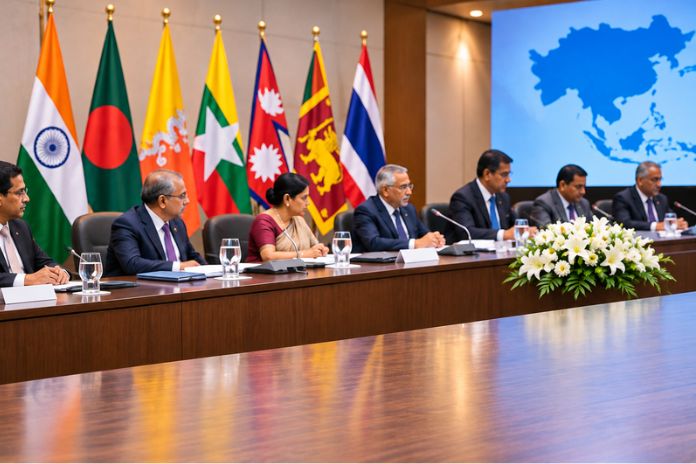
The first BIMSTEC Health Ministers’ Meeting held in Colombo, Sri Lanka, has set a landmark in regional healthcare cooperation, with member countries agreeing to enhance cooperation in public health, traditional medicine, digital healthcare, disease surveillance and pandemic preparedness.
The meeting was attended by the Health Ministers and senior representatives of seven BIMSTEC member countries – Bangladesh, Bhutan, India, Myanmar, Nepal, Sri Lanka and Thailand. The meeting was chaired by Dr. Nalinda Jayatissa, Minister of Health and Mass Media of Sri Lanka and adopted a Joint Ministerial Statement that unanimously reaffirmed the commitment of the countries to accessible, affordable and quality healthcare across the Bay of Bengal region.
Representing India, Union Minister for Health and Family Welfare Shri Jagat Prakash Nadda highlighted the commitment of India to strengthen regional health partnerships through knowledge-sharing, research collaboration, digital innovation and capacity building.
India to set up BIMSTEC Center of Excellence for Traditional Medicine in Jamnagar
One of the most important announcements for the Ayurveda sector was India’s commitment to establish the BIMSTEC Center of Excellence in Traditional Medicine at the Institute of Teaching and Research in Ayurveda (ITRA), Jamnagar, Gujarat. The proposed center is envisaged as a regional platform to promote:
- Joint research and development of traditional medicine.
- Academic exchanges and cooperation between institutions.
- Building capacity and professional training.
- Sharing of knowledge and best practices in traditional medicine.
- Traditional health care: evidence-based approaches.
- Development of quality and safety norms.
- Responsible protection of traditional knowledge.
The initiative is expected to strengthen India’s role in global promotion of Ayurveda and traditional medicine and create opportunities for collaboration between research institutions, universities and healthcare organisations of BIMSTEC countries.
The Joint Ministerial Statement welcomed India’s proposal and noted its capacity to further enhance regional cooperation in traditional medicine. The offer of India to host the next BIMSTEC meeting of the Task Force on Traditional Medicine was also welcomed.
BIMSTEC Public Health Action Plan 2026-2030 Adopted Revised
The participating countries also adopted the Revised BIMSTEC Plan of Action on Public Health (2026-2030) providing a structured roadmap for regional cooperation.
The plan identifies some priority areas as follows:
- Disease surveillance and early warning systems.
- Emergency response and pandemic preparedness.
- Telemedicine and digital healthcare
- Cooperation on traditional medicine.
- Approaches One Health.
- Increase in health workforce.
- Building public health infrastructure.
The countries also discussed the importance of collaborative action against emerging health threats and to enhance resilience in healthcare systems across the region.
Concentrate on Digital Health and Technology
Speaking at the meeting, Shri J.P. Nadda spoke about India’s success in increasing access to healthcare by technology and digital infrastructure.
He also mentioned the example of India’s National Telemedicine Service, eSanjeevani, which has crossed 50 crore teleconsultations. He also highlighted the significance of the Ayushman Bharat Digital Mission (ABDM) as an important initiative to develop an interoperable digital health ecosystem.
India offered to share its technical expertise and best practices in primary health care, digital health systems and public health infrastructure with other BIMSTEC members.
Strengthening India-Sri Lanka Healthcare Partnership
On the sidelines of the meeting India and Sri Lanka exchanged a Memorandum of Understanding for the supply of 100 more fully equipped ambulances for Sri Lanka’s 1990 Suwa Seriya Emergency Ambulance Service.
The initiative includes Indian grant assistance of approximately USD 5.28 million.
India also announced support for 50 Medical Kiosks, or Health ATMs, to enhance primary healthcare delivery in Sri Lanka. These facilities will be expected to provide point of care diagnostic services along with telemedicine facilities.
Shri Nadda also held bilateral talks with Nepal’s Health Minister Neesha Mehta to explore the possibilities of strengthening the health care cooperation between the two countries.
Stress on One Health Approach
The meeting highlighted the need to enhance regional cooperation within the One Health concept, which recognises the interlinkages between human, animal and environmental health.
Shri Nadda stressed the importance of early detection, timely sharing of information and coordinated regional action to prevent disease outbreaks and safeguard public health.
BIMSTEC Health Ministers to Meet Bi-Annually
The Joint Ministerial Statement reiterated the decision to hold BIMSTEC Health Ministers’ Meetings and Senior Officials’ Meetings every two years to ensure continuity of engagement and implementation of agreed priorities.
Thailand’s offer to host the second BIMSTEC Health Ministers’ Meeting in 2028 was also welcomed.
New Opportunities for Ayurveda and Traditional Medicine
The decision to establish a BIMSTEC Center of Excellence in Traditional Medicine at ITRA, Jamnagar, is a significant development for the Ayurveda and traditional medicine ecosystem in India.
The proposed center could act as a platform to enhance international research cooperation, academic exchange, institutional networking and capacity building for the stakeholders of traditional medicine in the region.
The initiative provides an opportunity for Ayurveda universities, research institutions, practitioners and policymakers to strengthen international engagement and promote responsible, evidence-informed approaches to traditional medicine.
The first BIMSTEC Health Ministers’ Meeting has therefore paved the way for a more coordinated regional healthcare framework, taking modern healthcare systems and traditional medicine cooperation onto a more expanded agenda of public health development.