


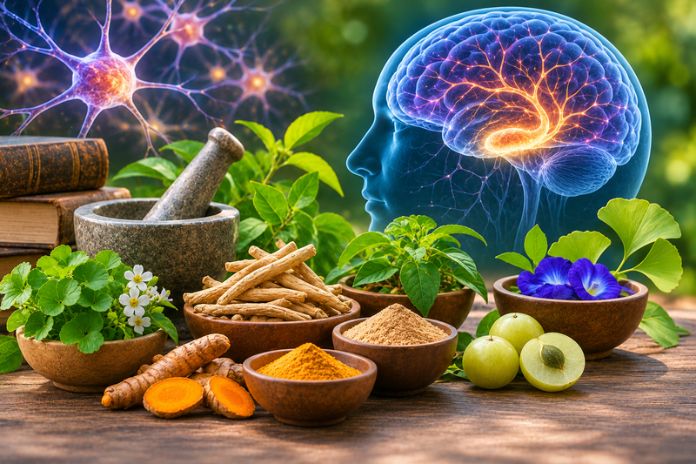
Do Medhya Rasayanas, an Ayurvedic Herb, Promote Neurogenesis, Neuroplasticity and Cognitive Function?
Researchers investigate the ways in which traditional Ayurvedic medicinal plants can affect the brain’s ability to adapt, form neuronal connections and maintain cognitive function during ageing and neurodegenerative conditions.
Introduction
Changes in the structure and function of the brain occur gradually with age. Many older adults experience changes in memory, attention, processing speed and learning. In some people, these changes can progress to more serious conditions including mild cognitive impairment (MCI), Alzheimer’s disease, Parkinson’s disease and other neurodegenerative disorders.
Now more than ever, scientists are interested in finding out how the brain keeps its ability to adapt and re-organise itself through life. In this context two important biological processes are neuroplasticity and neurogenesis .
Neuroplasticity is the brain’s capacity to alter its connections and workings in response to learning, experience, environmental shifts and injury. Neurogenesis is the formation of new neurones from neural stem or progenitor cells.
In the traditional Ayurveda, there is a group of medicinal plants known as Medhya Rasayanas, which are traditionally used to support intellect, memory and mental functions. A number of these plants are currently being investigated for their possible effects on neuronal health, brain-derived neurotrophic factor (BDNF), synaptic plasticity and mechanisms involved in neurogenesis.
A 2026 review in Neurochemistry International, “Ayurvedic Herbs as neurogenesis modulators: Current understanding on their possible therapeutic relevance in enhancing neuroplasticity and cognition in ageing and neurodegeneration,” looks at the emerging scientific evidence.
The review describes possible mechanisms of action by which some Ayurvedic herbs can modulate cognitive resilience and neuroprotection. Importantly, it additionally emphasises the gap between promising experimental findings and the clinical evidence that is required to establish effective treatments for human neurodegenerative diseases.
1. Neuroplasticity: The Brain’s Capacity to Change
The human brain is not a static structure. It changes throughout life with new experiences, learning, environmental stimulation and changing physiological conditions.
This ability is called neuroplasticity.
Neuroplasticity is a combination of a few things:
- Synaptic plasticity: Alterations in the strength and efficiency of communication between neurones.
- Structural plasticity: Changes of the neuronal structure, including dendrites and dendritic spines.
- Neurogenesis: Production of new nerve cells.
- Functional reorganisation: Changes in the involvement of different parts of the brain in particular functions.
These processes are involved in learning, memory, emotion regulation and adaptation to novel situations.
Some aspects of neuroplasticity may become less efficient with age. Oxidative stress, chronic inflammation, metabolic changes, vascular problems, and disruptions in neurotrophic signalling may play a role in declining neuronal function.
Understanding these mechanisms is important for developing approaches that may help to preserve cognitive health in ageing.
2. What is neurogenesis and why is it important?
Neurogenesis is the biological process of producing neurones from neural stem cells and progenitor cells.
The hippocampus is a region of the brain that is crucial for learning and memory, and is particularly pertinent to discussions of adult neurogenesis. One area of the hippocampus that has received a lot of attention in terms of new neurones being formed and integrated is the dentate gyrus.
Neurogenesis is associated with processes linked to:
- Building learning and memory.
- Memory flexibility and discrimination.
- Getting used to new experiences.
- Control of certain emotional reactions.
- Maintenance of hippocampal activity.
Adult hippocampal neurogenesis has been shown to be altered by age and experimental models of neurodegenerative disease .
However, the extent and functional relevance of adult neurogenesis in the ageing human brain is still a matter of scientific debate. Therefore, the results in animal models should not be considered as direct evidence that neurone production or memory is improved in humans.
The review points to neurogenesis as a promising target for research into understanding and treating cognitive decline in ageing.
3. BDNF’s role in brain health
A key mechanism discussed in the review is the role of brain-derived neurotrophic factor (BDNF).
BDNF is a neurotrophin, a type of protein that helps neurones develop, survive and function. It is involved in several processes that are essential for brain flexibility.
These are:
- Helping keep neurones alive.
- Improved growth of dendritic processes.
- Control of synaptic plasticity.
- Supporting the development and strengthening of neuronal connections.
- Neurogenesis modulation in experimental models.
BDNF signalling is therefore relevant to research into learning, memory, stress responses and neurodegenerative conditions.
The review considers the evidence that chronic stress may impair BDNF-related signalling and neuronal plasticity and that some established antidepressants and investigational herbal therapies may act on these pathways.
Several Ayurvedic herbs are being investigated for their potential to support BDNF expression and downstream signalling mechanisms. However, an increase in BDNF seen in animal studies does not prove that a herbal preparation can improve memory or prevent dementia in people.
4. Ayurvedic Medhya Rasayanas investigated for neuroprotective potential
The review focuses on medicinal plants traditionally associated with cognitive support and examines their possible influence on neuroplasticity and neurogenesis.
The important herbs discussed include Brahmi, Mandukaparni (Gotu Kola), Ashwagandha, Shankhapushpi, Guduchi and Yashtimadhu.
4.1 Brahmi (Bacopa monnieri)
Brahmi is one of the best-known Ayurvedic herbs traditionally associated with memory, learning and intellectual function. Its major investigated constituents include bacosides, a group of saponins.
Experimental research has examined the potential effects of Brahmi on:
- Synaptic communication and neuronal signalling.
- Antioxidant defence mechanisms.
- Memory and learning performance.
- BDNF-related pathways.
- Neuronal protection against oxidative and other forms of cellular stress.
Some human clinical studies have investigated Bacopa extracts for memory and cognitive performance. Results are encouraging in selected cognitive measures, but study designs, extract standardisation and treatment durations vary.
The evidence does not establish Brahmi as a treatment for Alzheimer’s disease or other forms of dementia.
4.2 Mandukaparni or Gotu Kola (Centella asiatica)
Centella asiatica, also called Gotu Kola, is traditionally used in Ayurveda for mental wellbeing, memory and rejuvenation.
It contains triterpenoid phytochemicals like asiaticoside and madecassoside.
Possible effects on research has been studied:
- Neuronal anti-oxidant action.
- Inflammation signalling.
- Neuronal architecture and dendritic development.
- Experimental models for learning and memory.
- Protection against cell damage associated with neurodegenerative processes.
Improvements in selected memory-related outcomes have been reported in animal studies. However, more rigorous human studies are needed to assess whether these findings translate to meaningful clinical benefits.
4.3 Ashwagandha (Withania somnifera)
Ashwagandha is classified as a Rasayana herb and has been investigated for its possible effects on stress, neuronal function and cognitive performance.
Among the main constituents studied in experimental research are its withanolides.
The review covers possible mechanisms including:
- Anti-inflammatory and antioxidant effects.
- Altering stress-related biological pathways.
- BDNF-related signalling.
- Neurite survival and synaptic function.
- Cognitive function (in experimental models).
Several human studies have looked at Ashwagandha extracts and memory and cognitive function. However, these studies do not show that Ashwagandha can prevent or treat Alzheimer’s disease or other neurodegenerative disorders.
4.4 Shankhapushpi (Convolvulus pluricaulis and allied botanical sources)
Traditionally Shankhapushpi is used as a Medhya Rasayana and is associated with memory, learning and mental calmness.
The review discusses its potential impact on neuronal signalling, synaptic plasticity, and cognitive function.
Experimental studies have been conducted on its possible effect on .
- Memory and Learning.
- Antioxidant mechanisms
- Pathways for neurotransmitters.
- Synaptic plasticity.
- Neuronal responses to stress
Botanical identification is important. Shankhapushpi is a traditional name which may be applied to different plants in different regional and commercial contexts . The present review concerns Convolvulus pluricaulis and also gives an account of the literature on Evolvulus alsinoides. These species should not be assumed interchangeable.
4.5 Giloy (Tinospora cordifolia)
Guduchi, also known as Giloy, is traditionally utilised in Ayurveda for its general health-promoting properties and is currently being studied for its potential neuroprotective benefits.
Its possible effect on has been the subject of experimental studies:
- Oxidative damage.
- Responses of inflammation.
- Neuronal survival.
- Animal models of learning and memory.
- Molecular pathways related to neurodegenerative processes.
More recent experimental work has investigated possible targets for mechanisms of Alzheimer’s disease. But these are early findings, and do not mean Guduchi is a dementia treatment.
There are reports on the cases of liver injury associated with the use of guduchi, therefore special safety consideration is also needed for guduchi. Its use should not be assumed to be without risk.
4.6 Yashtimadhu (Glycyrrhiza glabra)
Yashtimadhu or liquorice has been used in Ayurveda from ancient times for various health-related purposes. It has glycyrrhizin and other bioactive constituents in its roots.
It has been studied for possible anti-inflammatory, antioxidant and neuroprotective effects.
Yashtimadhu is one such herb, which is being researched for cognitive function and neuronal health, as quoted by the review. But there’s not enough evidence to demonstrate that it actually stimulates meaningful neurogenesis in humans.
Excessive or prolonged intake of liquorice containing glycyrrhizin can lead to high blood pressure, fluid retention and low potassium levels. This is an important safety consideration for those with hypertension, kidney disease, heart disease or on medicines that affect the potassium balance.
5. Ayurvedic herbs and neuroplasticity: how to influence?
In this review, we discuss the multiple biological mechanisms by which selected Ayurvedic herbs may modulate neuronal health. They are not working independently but are inter-connected mechanisms.
5.1 Antioxidant properties
The brain has a high energy demand and is particularly susceptible to oxidative damage. Reactive oxygen species can influence cellular membranes, proteins, DNA and neuronal signalling.
Some plant constituents have been reported to exhibit antioxidant activity under experimental conditions. They might protect neurones from cell damage through modulation of oxidative stress.
But antioxidant activity in a lab experiment doesn’t necessarily translate to protection against cognitive decline in humans.
5.2 Anti-inflammation pathways
Chronic neuroinflammation is believed to drive a number of neurodegenerative diseases and this is now the subject of research.
Experimental studies indicate that some herbal constituents may affect inflammatory mediators and signalling pathways involved in neuronal injury.
There is research interest in the possibility that these effects could contribute to a healthier neuronal environment but clinical confirmation is still required.
5.3 Control of neurotransmitters
Neurotransmitters are chemical messengers that allow communication between neurones.
Acetylcholine, dopamine, serotonin, glutamate and GABA all have a role in different aspects of cognition, mood, movement and memory.
The review comprises studies on the possible effects of Ayurvedic herbs on neurotransmitter related mechanisms. These effects may be the basis for reported changes in learning, memory and stress responses in experimental studies.
5.4 BDNF and neurotrophic signalling
BDNF is a key mediator of neuronal survival, synaptic plasticity and neurogenesis.
Some experimental studies have indicated that some herbal preparations can influence the expression of BDNF and its downstream signalling pathways. These pathways are interesting because they are involved in the formation and strengthening of neuronal connections.
5.5 Gut-brain connection
The gut microbiota communicates with the nervous system through several pathways, including immune signalling, microbial metabolites, hormones and neural connections.
The review discusses the potential role of gut microbial composition and gut–brain signalling in some of the neuroprotective effects of Ayurvedic herbs.
This is a new field of research. The precise role of the gut microbiota in the cognitive effects of individual Ayurvedic herbs remains to be determined.
6. Polyherbal formulations: A traditional approach under the scientific investigation
In Ayurveda, single herbs are not necessarily used, but combinations of medicinal plants are. Such combinations are called polyherbal formulations.
The review discusses the possible neuroprotective relevance of these formulations, as it is recognised that many plant compounds can act on different biological pathways.
The proposed benefits of polyherbal preparations are:
- Working on multiple biological mechanisms.
- Combined Antioxidant and Anti-inflammatory Activity.
- Modulation of different neurotransmitter pathways.
- Possibly supporting complementary pharmacological effects.
But the notion of synergy must be experimentally demonstrated. The fact that a formulation is a combination of herbs does not mean it is better or safer than a single ingredient.
The scientific evaluation of polyherbal preparations is complicated by the variability in their composition, which is attributed to the ingredients, their proportions, processing methods and manufacturing standards.
Future research should examine the pharmacological interactions, active constituents, bioavailability, dosage and safety of these combinations.
7. Relevance to Ageing and Neurodegenerative Diseases
The review discusses the Ayurvedic herbs as possible complementary strategies to address the cognitive alterations associated with ageing and neurodegeneration.
Cognitive impairment, mild
Mild cognitive impairment is a measurable decline in cognitive abilities, such as memory or thinking, that is more than expected for a person’s age but does not necessarily interfere substantially with independent daily functioning.
It sometimes progresses to dementia but not everyone with MCI will go on to develop dementia.
Neurogenesis, BDNF and synaptic plasticity studies may help scientists to understand the biological processes involved in cognitive changes in MCI.
Alzheimer’s Disease
Alzheimer’s disease is a progressive, neurodegenerative disease that causes memory, thinking and other cognitive functions to decline.
Its pathology is the result of several interacting processes including amyloid-beta accumulation, tau abnormalities, neuroinflammation, oxidative stress and neuronal dysfunction .
Experimental evidence is presented that selected Ayurvedic herbs may influence some of these mechanisms.
But there is not enough clinical evidence to prove that these herbs prevent, reverse or treat Alzheimer’s disease.
Parkinson’s disease
Parkinson’s disease is a neurodegenerative disorder that is mainly characterised by the progressive loss of dopamine-producing neurones in specific brain regions.
It can affect movement, but may also include sleep disturbances, mood changes and cognitive difficulties.
Some of the Ayurvedic herbs have shown neuroprotective activity in experimental models of relevance to Parkinson’s disease. These results point to directions for further research but do not suggest clinical effectiveness in persons living with Parkinson’s disease.
Age-related memory loss
Normal ageing may include alterations in processing speed, memory recall and some aspects of attention.
Neuroplasticity research aims to understand how the brain can preserve its functional capacity in the face of such changes.
There is scientific interest in the possibility that selected medicinal plants may influence neuronal resilience, stress responses and synaptic function. But a wider approach is necessary to keep our minds healthy, including physical activity, adequate sleep, balanced nutrition, social engagement and management of cardiovascular risk factors.
8. Safety and responsible use of Ayurvedic neuroprotective herbs
Do not forget to always consider their safety profiles and their potential benefits of medicinal plants.
Some important considerations are:
- Product quality: Botanical authenticity, purity, standardisation and freedom from contamination are key.
- Herb-medicine interactions: Some herbs can interact with medicines used for neurological, cardiovascular, metabolic or psychiatric disorders.
- Individual suitability. Factors like age, underlying medical conditions, liver and kidney function, and other medications being taken can affect safety.
- Long-term use: There is little evidence on the long-term safety of many herbal preparations.
- Polyherbal formulations: The presence of multiple ingredients can make it difficult to identify the cause of an adverse reaction or interaction.
Particular caution is advised with use of guduchi (Tinospora cordifolia) because of reports of liver injury. Caution is also advised with use of yashtimadhu (Glycyrrhiza glabra) because excessive exposure to glycyrrhizin can produce hypertension and low potassium.
People with dementia, Parkinson’s disease, epilepsy or other neurological conditions should talk to their treating clinician before taking herbal supplements. Ayurvedic preparations should not be a substitute for prescribed treatment or delay appropriate neurological assessment.
9. Limitations of the review and directions for future research .
Despite the comprehensive nature of the review, a number of limitations must be acknowledged.
- Pre-clinical evidence predominanceMuch of the evidence for neurogenesis and neuroprotection has been obtained from cell-based experiments and animal models. These findings do not by themselves prove therapeutic efficacy in man.
- Limited clinical validationAlthough there are human studies investigating specific herbs for memory and cognition, there are few rigorous clinical trials proving increased neurogenesis in humans.
- Variability of herbal preparationsDifferent extracts may have different levels of active compounds. Results obtained with one standardised extract cannot be automatically transferred to all commercial or traditional preparations.
- Challenges in the Study of Polyherbal FormulationsMany ingredients can interact and it is hard to understand the contribution of each component and to create reproducible effects.
- Uncertainties on mechanismAlthough BDNF, oxidative stress, inflammation, neurotransmitters and gut–brain signalling have been suggested to be important pathways, more research is needed to understand how these mechanisms operate in humans after herbal treatment.
- Measuring neurogenesis in humans: the problemIt is technically difficult to directly measure the formation and integration of new neurones in the living human brain. Hence, the results from animal experiments should not be interpreted as evidence of a certain herb increasing neurogenesis in humans.
Future research priorities
The authors stress the need for:
- Well-designed randomised controlled trials with adequate power.
- Standardised and authenticated herbal extracts – Botanic.
- Better understanding of active constituents and their mode of action.
- Evaluation of memory, learning, and other cognitive outcomes in a clinical setting.
- Longer term safety monitoring.
- To explore the possible role of selected herbs as adjunct interventions with established treatment.
These are the prerequisites for Ayurvedic herbs to be recommended as evidence-based interventions for cognitive impairment and neurodegenerative diseases.
10. Ayurveda and Modern Neuroscience: Opportunities for Synergy
The concept of Medhya Rasayana is an important traditional framework for comprehending the use of medicinal plants regarding intellect, memory and mental wellbeing.
Modern neuroscience is now able to evaluate these traditional applications in terms of measurable biological processes such as synaptic plasticity, neurotrophic signalling, neuronal survival and neurogenesis.
The 2026 review is an example of how traditional Ayurvedic knowledge can help answer contemporary research questions.
However, scientific integration is more than recognising similarities between traditional descriptions and modern biological mechanisms. It demands reproducible experiments, well characterised preparations, rigorous clinical studies and clear safety evaluation.
An evidence-informed approach can help differentiate promising medicinal plants from interventions already shown to be clinically effective.
Conclusion
The review “Ayurvedic Herbs as neurogenesis modulators” explores new area of research between Ayurveda and neuroscience.
It highlights the potential of select Medhya Rasayana herbs like Brahmi, Gotu Kola, Ashwagandha, Shankhapushpi, Guduchi and Yashtimadhu to impact biological processes associated with neuronal health, neuroplasticity and cognitive function.
We looked at pathways including BDNF signalling, antioxidant and anti-inflammatory mechanisms, neurotransmitter regulation and gut-brain interactions.
These results point to useful directions for future research on cognitive ageing and neurodegenerative conditions. However, the evidence is uneven, with many proposed neurogenic effects supported mainly by preclinical studies.
The review does not demonstrate that Ayurvedic herbs can regenerate neurones in humans, or cure Alzheimer’s disease, Parkinson’s disease or dementia.
Our main contribution in this research is to try to bridge the gap between traditional Ayurvedic knowledge and quantifiable mechanisms in modern neurosciences. Selected medicinal plants may ultimately have a scientifically validated role as complementary approaches to supporting cognitive health through standardisation, rigorous clinical trials and responsible safety evaluation.
Research reference
Vismaya, Lalith Kumar V, Muralidhara M.
Ayurvedic Herbs as neurogenesis modulators: Current understanding of their potential medicinal relevance in enhancing neuroplasticity and cognition in ageing and neurodegeneration.
Neurochemistry International 2026;199:106204. Release date: October 2026. DOI 10.1016/j.neuint.2026.106204
SOURCE LINK: https://www.sciencedirect.com/science/article/abs/pii/S0197018626000951