


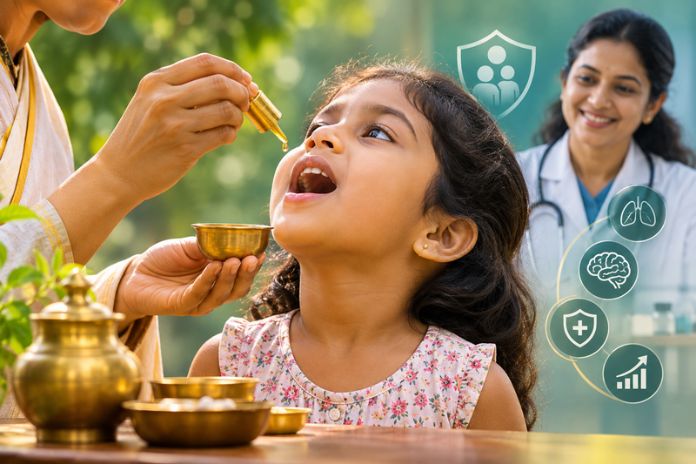
Swarna Bindu Prashana: A bridge between ancient Ayurveda and modern paediatric healthcare – What does science say?
A traditional Ayurvedic paediatric practice using processed gold, honey and ghee has once again attracted the attention of scientists. Researchers are investigating its traditional rationale and potential immunological effects. But, can Swarna Bindu Prashana improve the immunity, memory and overall health of the children? A mini-review in 2026 looks at the evidence available, but also raises important questions around safety, standardisation and clinical effectiveness.
Type of article: Research-based Ayurveda & paediatric healthcare feature | Publication: AyurWorld News
Introduction
The Contemporary Debate on an Ancient Ayurvedic Tradition
Childhood is a critical period for physical growth, brain development and maturation of the immune system. Important priorities for parents and health care professionals include ensuring adequate nutrition, preventing infections and supporting healthy development.
Ayurveda has traditionally described several approaches to paediatric health under Kaumarabhritya, the branch dealing with the care of infants and children. One such practice is Swarna Bindu Prashana (SBP), also called Swarna Prashana or Suvarna Prashana.
The practice is to give a formulation containing Swarna Bhasma (processed gold) which is usually combined with honey (Madhu) and ghee (Ghrita). Some formulations may also contain other Ayurvedic ingredients.
The classical Ayurvedic texts, particularly the Kashyapa Samhita, attribute Swarna Prashana with properties of Medha (intellect), Bala (strength), Agni (digestive and metabolic capacity) and general well-being.
The practice has been revived in recent years by the research in gold-based preparations and nanotechnology. A 2026 mini-review, “Swarna Bindu Prashana: Bridging Ancient Ayurveda and Modern Paediatric Healthcare” reviews the traditional basis, purported biological mechanisms, preliminary research findings and challenges that must be addressed before its role in contemporary paediatric healthcare can be established.
What was covered in the review 2026?
The authors describe:
- Classical Ayurvedic Texts and Uses of Swarna Bindu Prashana.
- The ingredients and recommended use of Swarna Bhasma, ghee and honey.
- Research on the immunomodulatory potential of preparations with gold.
- Potential links between gold nanoparticles and nanomedicine today.
- Hypothesised effects on cognition, inflammation and immune responses.
- Safety, standardisation, quality control and the need for clinical research.
Importantly, this is a mini-review of the literature that already exists and not a new clinical trial. The authors in this publication have not given Swarna Bindu Prashana to children. They conclude that the evidence is limited and heterogenous and that further research is required to establish clinical benefits.
Ayurveda Swarna Bindu Prashana
The classical explanation for Swarna Prashana is connected to the concept of Lehana, which means administration of medicated preparations in the form of lickable or electuary.
The Kashyapa Samhita mentions the use of gold in the care of children and says that the practice has several possible benefits including support for intellect, digestion, physical strength and overall well-being.
In contemporary Ayurveda, formulations could include:
- Swarna Bhasma: A special gold preparation prepared by the traditional pharmaceutical method.
- Ghrita: Clarified butter, traditionally used as a nourishing medium and a vehicle for medicines.
- Madhu: Honey – traditionally mentioned as an ingredient and Anupana or vehicle.
- Medhya herbs: In some formulations, you may find herbs traditionally linked to intellect, memory and cognitive support.
Exact composition, processing methods and dosage may vary between preparations. Thus, the term Swarna Bindu Prashana should not be taken as one uniformly standardised product.
What does research say recently?
Several proposed biological activities are discussed in the review. However, it is important to differentiate findings from traditional literature, lab experiments, animal studies, and human clinical research.
1. Possible immunomodulation activity
Immunomodulation is the ability to modulate the activity of the immune system. It could involve changes in the activity of immune cells, signalling molecules or the co-ordination of immune responses.
The review deals with the interaction of gold-based nanoparticles with immune cells, in particular dendritic cells. These cells are involved in recognition of foreign substances and communication with T lymphocytes important for adaptive immunity.
In experimental nanomedicine gold nanoparticles have been investigated as potential carriers of antigens and other therapeutic agents.
However, laboratory synthesised gold nanoparticles are not automatically equivalent to gold particles present in Swarna Bhasma. They may vary greatly in size, surface properties, chemical composition and biological behaviour.
Hence, the experimental results with modified gold nanoparticles cannot be directly interpreted as evidence of Swarna Bindu Prashana providing enhancement of immunity in children.
2. Possible impact on thinking and memory
Ayurveda in classical texts describes Swarna Prashana as related to Medha that is associated with intellect and cognitive functions.
The 2026 review includes experimental research on gold nanoparticles, neuronal activity, synaptic plasticity, and neurogenesis. These areas are involved in learning and memory.
However, some of the cited research focuses on specialised nanoparticles and experimental models rather than the Swarna Bindu Prashana formulation itself.
Currently there is insufficient good quality clinical evidence to conclude that administering SBP improves children’s intelligence, memory, attention or academic performance.
3. Anti-inflammatory and antioxidant properties
Oxidative stress and inflammation are implicated in many biological processes and diseases. Some experimental studies have been carried out on antioxidant and anti-inflammatory properties of gold-containing preparations.
The review takes these findings as areas of potential science interest.
However, evidence based on isolated compounds, animal experiments or laboratory studies can not prove that a complete formulation has clinically meaningful anti-inflammatory effects in children.
4. Gold nanoparticles and contemporary nanomedicine
Gold nanoparticles are being researched for applications including:
- Drug delivery targeting.
- Imaging diagnostics.
- Vaccine and antigen delivery studies.
- Experimental antimicrobial applications.
- Investigational technologies related to cancer.
These applications evidence the scientific interest of gold-based nanomaterials. However, most are specialist research applications and many are still experimental.
These should not be extrapolated as the proven therapeutic benefits of Swarna Bindu Prashana.
Whate does clinical research in humans show?
The 2026 review speaks of an important study, a randomised controlled clinical trial, published in AYU in 2021.
Swarna Prashana was assessed on 102 healthy infants by clinical trial. The participants were divided into two groups:Swarna Bhasma with honey and ghee was given to intervention group.
The control group was given honey and ghee without Swarna Bhasma.
The intervention was of 4 weeks duration followed by an 8-week observation period. Researchers measured growth-related measurements, blood parameters, biochemical indicators and immunological measures including immunoglobulin G (IgG).
What did they discover?
- Eighty-one infants completed the trial out of 102 enrolled.
- No statistically significant differences in anthropometric measures were found between groups.
- Most blood and biochemical parameters did not show significant between-group differences.
- No statistically significant differences were found between groups in the reported immunological measurements, although some changes were seen in IgG within the individual groups.
- The authors did further analysis that suggested a possible difference in IgG normalisation between the groups.
The study offers preliminary research in humans, but the small sample size, dropouts, limited follow-up and use of a limited range of immune markers mean the results should be interpreted with caution.
Most importantly, changes in an immunological lab marker do not necessarily provide evidence of less infection, greater resistance to disease or better long-term health.
The trial, therefore, does not prove Swarna Prashana to be a useful immune booster in children.
Safety Considerations: Why Quality and Age Are Important
Safety is an issue that requires special attention, as Swarna Bindu Prashana is intended for infants and children who are more likely to be susceptible to inappropriate dosage and contamination.
Swarna Bhasma is a metallic preparation after processing. It has been through traditional purification and incineration procedures which does not automatically mean it is safe.
Important considerations of quality are:
- Check the identity and composition of the preparation.
- Determination of chemical form and particle size.
- Tests for lead, mercury, arsenic and other contaminants.
- Evaluation of lot-to-lot consistency.
- Evaluation of absorption, distribution, metabolism and excretion.
- Suitable studies to assess long-term safety.
An experimental study was conducted in 2017 to evaluate the effect of chronic administration of a Swarna Bindu Prashan preparation in rats for 90 days. No significant adverse changes were observed in the measured parameters at the dose tested.
Animal studies, however, cannot establish long-term safety in infants and children.
Another problem is honey. Do not give honey to infants younger than 12 months of age. It can cause infant botulism, a serious illness caused by toxins produced by the bacteria Clostridium botulinum. This is a well-known recommendation for food safety in children and is particularly relevant to formulations with honey.
Parents should not administer Swarna Bindu Prashana or any other preparation containing gold to infants or children without proper medical guidance. It is not a substitute for routine immunisation, breastfeeding, age appropriate nutrition, prescribed treatment or standard paediatric care.
Challenges and research priorities for the future
The review highlights a number of gaps that need to be addressed before the practice can be confidently evaluated within the current paediatric healthcare context.
- Standardised formulations: A defined composition and reproducible manufacturing process are necessary for meaningful research.
- Sophisticated Analytical Testing: Researchers need to find out the chemical form, particle size, purity and stability of Swarna Bhasma preparations.
- Comprehensive safety evaluation: Studies should include both short- and long-term safety evaluations, including potential accumulation and effects on developing organs.
- Larger clinical trials: Well-designed, adequately powered studies should assess meaningful clinical outcomes and not just laboratory markers.
- Age-specific assessment: Research must consider differences between newborns, infants and older children, including their particular nutritional and physiological needs.
- Clear reporting: Information on formulation, dosage, adverse events, manufacturing standards and research methods should be reported in sufficient detail.
Relevance to Ayurveda & modern paediatric health care
Swarna Bindu Prashana is an interesting area where the traditional paediatric concepts of Ayurveda meet the modern pharmaceutical science and nanotechnology.
For Ayurveda researchers, it opens up opportunities to study traditional formulations by modern analytical methods, pharmacological models and clinical research designs.
The priority of the paediatric healthcare professionals is to distinguish between established indications and preliminary experimental data and benefits demonstrated by reliable human studies.
The responsible approach does not dismiss traditional knowledge but nor does it accept historical use or laboratory findings as sufficient evidence of clinical effectiveness.
Conclusion: Merging traditional knowledge with scientific validation
Swarna Bindu Prashana holds a long-standing position in Ayurvedic discussions on children’s health. Gold has traditionally been associated with immunity, intellect, strength and well-being and has prompted researchers to examine the possible biological properties of preparations containing gold.
The recent mini-review by Sunitha and colleagues in 2026 brings together traditional knowledge, research on Swarna Bhasma and emerging findings from gold nanoparticle science. It also recognises that there is not enough direct clinical evidence to establish the effectiveness of the formulation, the optimal dosage and long-term safety in children.
Standardised preparation, rigorous quality testing, age-appropriate safety studies and well-designed clinical trials are needed to move forward.
The coming together of Ayurveda and modern paediatric healthcare should be guided by respect for traditional knowledge and a firm commitment to child safety and evidence-based practice.
References
Swarna Bindu Prashana: A Link Between Ancient Ayurveda and Modern Paediatric Healthcare. International Journal of Pharmaceutical Sciences and. Research. 2026;17(7):2047–2053. doi: 10.13040/IJPSR.0975-8232.17(7).2047-53



