


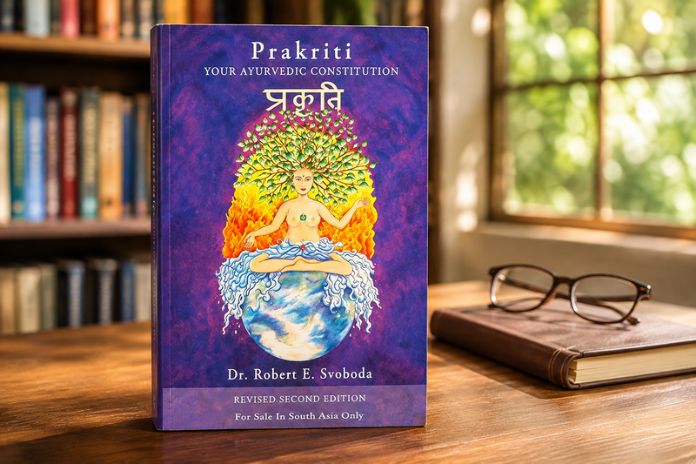
Ayurveda: Discovering Your Unique Constitution with Doshas, Nutrition, Way of Life and Self Wellbeing
Author: Dr. Robert E. Svoboda
Originally published: 1988
New and enlarged edition: 1998
Publisher: Lotus Press (original revised edition) Motilal Banarsidass Publishing House (Indian editions)
1. Ayurveda: The Science of an Individual
How can people react so differently to the same food, climate, lifestyle or daily routine? Ayurvedic thinking on this is encapsulated in the idea of Prakriti or the individual’s inherent constitution.
In Ayurvedic philosophy, Prakriti is understood through the interrelationship of the three Doshas, Vata, Pitta and Kapha. These principles provide the traditional guidelines for the understanding of individual physical traits, inclinations and reactions to the environment.
In Prakriti: Your Ayurvedic Constitution, Dr. Robert E. Svoboda explains this basic concept and how it relates to diet, nutrition, daily routine, health and personal wellbeing. The book is intended to help the reader understand his own constitution and think about how his lifestyle choices can be adapted accordingly.
First published in 1988, the book has been revised and enlarged and is a widely recognised introduction to Ayurvedic constitutional theory.
2. The Three Doshas and Their Relationship to Prakriti
The book is mainly concerned with the relationship between Prakriti and the three Doshas.
- Vata: Traditionally linked to movement, communication, mobility and the functions that control activity in the body.
- Pitta: Associated with transformation, digestion, metabolism and the processing of experiences.
- Kapha: Associated with structure, stability, cohesion, lubrication and nourishment.
According to Ayurveda, every individual has a constitution shaped by a distinctive combination of these principles. One Dosha may be predominant, or two or more may contribute significantly to an individual’s constitution.
The book discusses constitutional characteristics and the influence of Doshas on physical and mental tendencies. This provides readers with an introduction to the Ayurvedic understanding of individual differences.
An important distinction in this context is between Prakriti, the inherent constitution, and Vikriti, the present state of imbalance or disturbance. Understanding this distinction is central to Ayurvedic assessment.
3. Food and Nutrition According to Individual Constitution
The relationship between food and individual constitution is one of the book’s important themes. Ayurveda considers diet not only in terms of nutritional content but also through qualities such as taste (Rasa), heating or cooling effects, digestibility and their relationship with the Doshas.
The book includes dedicated chapters on food and nutrition, discussing how dietary choices may be considered in relation to constitutional characteristics.
This approach introduces readers to the Ayurvedic principle that dietary suitability may differ between individuals. It also provides an opportunity to explore the traditional understanding of the six tastes—sweet, sour, salty, pungent, bitter and astringent—and their relationship with the Doshas.
For contemporary readers, these discussions can encourage greater awareness of eating habits and individual responses to food. However, Ayurvedic dietary recommendations should be seen in the light of modern nutritional science, individual health needs and professional advice.
4. Daily Routines, Lifestyle and Personal Well-Being
It also examines how our daily routines affect our health and balance, not just our eating. Its chapter on routine includes topics such as washing, meditation, massage and exercise.
These themes connect with the Ayurvedic concept of Dinacharya, or daily regimen. Ayurveda gives importance to regular habits, personal hygiene, physical activity, rest and practices supporting mental wellbeing.
The book also explains how lifestyle choices can be understood in terms of an individual’s constitution. It doesn’t prescribe a one-size-fits-all routine, but rather offers the possibility that we might all do better to think about our own tendencies, and adjust habits accordingly.
This is particularly the case in today’s world where irregular schedules, sedentary behaviour, stress and inconsistent eating patterns can all impact on general wellbeing. The Ayurvedic framework provides a traditional perspective on the significance of routine and self-awareness for readers.
5. Disease, Rejuvenation and the wider Scope of Ayurveda
The book goes further than constitutional characteristics and lifestyle. It has chapters on disease & rejuvenation including topics such as Rasayana, seasons & other traditional Ayurvedic practices.
The chapter on disease treats of the relation of constitutional tendencies to departures from health. The chapter on rejuvenation introduces readers to Ayurveda’s Rasayana, which is traditionally connected to nourishment, vitality and healthy ageing.
The later parts also touch on issues that are not covered by a simple constitutional review, for example, the dimensions of yoga and other traditional Indian thought. This expands the book’s philosophical reach beyond just a simple guide to finding one’s Dosha.
Readers should bear in mind that conventional ideas about rejuvenation and therapeutic claims do not necessarily correlate with clinically verified results. Any use of herbs, mineral preparations or treatment procedures require appropriate professional assessment and safety evaluation.
6. Who will benefit from this book?
Prakriti: Your Ayurvedic Constitution could be helpful for:
- General readers: Those looking for an introduction to the Ayurvedic concept of individual constitution.
- Students of Ayurveda: To understand the relationship between Prakriti, Doshas, diet and lifestyle.
- Yoga and wellness teachers: Background reading on traditional approaches to constitution and wellbeing.
- Ayurvedic practitioners: As a reference for the re-visiting of the constitutional concept and its practical application.
- For researchers and teachers: To gain insights into the discussion of traditional Ayurvedic concepts in modern educational and research settings.
The writing is intended for the interested reader in Ayurveda and does not presuppose advanced medical training, but familiarity with basic Ayurvedic terminology will help in following the discussion.
7. About the Author: Dr Robert E. Svoboda
Dr. Robert E. Svoboda is an American author and educator who is best known for his work on Ayurveda and the classical Indian traditions. He has studied Ayurveda formally in India and has also studied and written about Yoga, Jyotish (Vedic astrology) and Tantra.
His books explore the connections between traditional Indian knowledge, health, philosophy and personal development. Prakriti: Your Ayurvedic Constitution This book was his attempt to bring the theory of the Ayurvedic constitution to readers outside of India.
His work has contributed to expanding the international readership for Ayurveda, particularly for those interested in learning about its traditional approach to individual constitution and lifestyle.
8. Editorial View: Relevance of Prakriti in Today’s World
One of the book’s abiding strengths is its focus on individual differences. Modern healthcare and nutrition increasingly recognise that individuals may respond differently to dietary patterns, physical activity and environmental conditions. Ayurveda has its own theoretical framework for individual variation, i.e. Prakriti and Doshas.
The book offers an easy introduction to that framework and encourages readers to think about how food, routine and lifestyle relate to their constitution.
However, Prakriti assessment should not be confused with scientifically validated genetic or medical tests. The three Doshas are concepts of the Ayurvedic theory and the relationships proposed between these modern biological categories need careful research. Readers also should not rely on online quizzes or a book alone for health or treatment decisions.
The book should be considered as an introduction to the philosophy of Ayurveda and the principles of its lifestyle, and with an open but critical mind on its health claims.
9. Summary
Your Ayurvedic Constitution By Dr. Robert E. Svoboda Prakriti is a popular introductory text to one of Ayurveda’s most fundamental concepts. It gives a holistic view of how Ayurveda understands the individual constitution and wellbeing by talking about the three Doshas, constitution, food, nutrition, daily routine, disease and rejuvenation.
Its user-friendly approach makes it relevant to general readers as well as Ayurveda students, practitioners, yoga educators and researchers. The book draws attention to the significance of individual constitution and invites readers to explore the relationship between personal habits, lifestyle and health from the traditional Ayurvedic perspective.
This book is a useful starting point for anyone wanting to study further the foundations of Prakriti and its place within Ayurvedic thinking.
Additional Info & Book Details
- Title: Prakriti: Your Ayurvedic Body Type
- By: Robert E. Svoboda, M.D.
- First published: 1988
- Rev. and enl. 2. ed.: 1998
- First revised edition publisher: Lotus Press
- Publisher Indian: Motilal Banarsidass Publishing House
- Language: en
- Page count: 224 pages (Lotus Press revised edition). Page count varies by Indian edition.
- Lotus Press ISBN: 978-0-9656208-3-3
- Indian edition ISBN: 978-93-91024-43-7 (hardcover listing)
- Amazon India: See book
SOURCE LINK: https://www.sciencedirect.com/science/article/abs/pii/S1342937X26000250



