

CCRAS takes impressive steps to unlock timeless health knowledge to address contemporary health challenges while strengthening India’s leadership in global traditional medicine research.
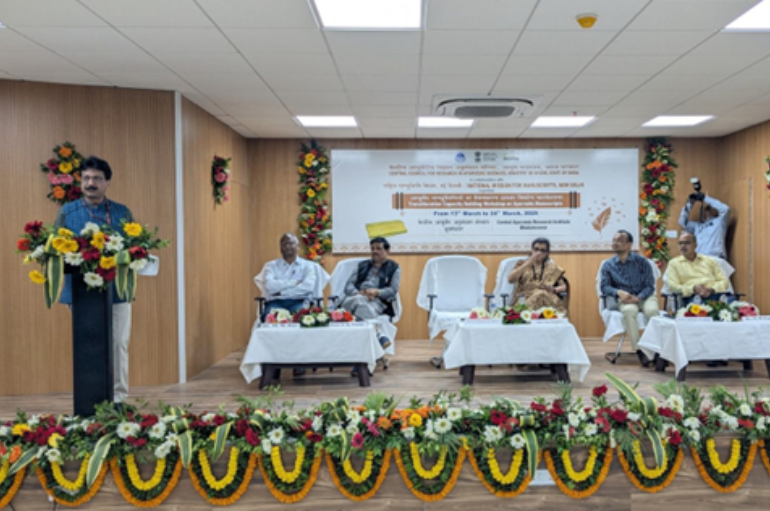
The Central Council for Research in Ayurvedic Sciences (CCRAS), Ministry of Ayush, has successfully conducted two national-level workshops on ‘Transliteration of Rare Ayurvedic Manuscripts’. The CCRAS has carried out these workshops in collaboration with National Mission for Manuscripts (now known as Gyan Bharata Mission – GBM) under Ministry of Culture and the Central Sanskrit University (CSU) under the Ministry of Education. The workshops were aimed at building the capacity of young Ayurveda and Sanskrit scholars to work on traditional manuscripts transliterating over 1600 pages of manuscripts.
The workshops were designed to (a) build a strong resource pool of Ayurvedic and Sanskrit scholars, (b) safeguard India’s tangible Ayurvedic manuscript heritage, (c) foster greater access to rare classical texts for scholars and researchers, and (d) encourage collaborative academic exchange.
According to Prof. Rabinarayan Acharya, Director General, CCRAS,
CCRAS, GBM, and CSU intend to organise more such workshops in the future, training a larger pool of experts from both the fields of Ayurveda and Sanskrit to further transliterate and preserve India’s priceless Ayurvedic manuscript heritage.
Workshop Highlights
To advance the systematic study and preservation of Ayurvedic manuscripts, CCRAS-CARI, Bhubaneswar organized two intensive workshops in 2025.
The first workshop, held in Bhubaneswar brought together 30 scholars under the guidance of 7 eminent resource persons. The focus was on transliteration from Nagari to Devanagari script, covering eight classical texts including Sarvasangraha, Kwathadhikara, Vaidyabhaskarodaya, Kesharanjanam, Yogasudhanidhi, Vrttamanikyamala, Arogyasundara, and Vrttasundara. In just under two weeks, participants successfully transcribed 712 pages of rare manuscripts.
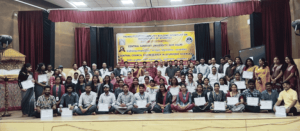
The second workshop, held in Puri, witnessed a much larger participation of 67 scholars guided by 15 experts drawn from across India. The workshop focused on six classical scripts - Medieval Bengali and Gaudi, Grantha, Nagari, Karani/Medieval Odia, Sharada, and Medieval Telugu. A diverse collection of 15 texts, including Vaidyasarvaswa, Sutrasthana, Abhidhanaratnamala, Chikitsanjanam, Aushadhakalpa, Goshastra, Karmavipaka, Ayurvedasaroddhara (Divakara Samhita), Vaidyashastra, Gyanabhaishajyamanjari, Aushadhakumbhasamapana, Charucharya, Indrakshistotra, and Padarthagunapatham, were transcribed, resulting in 888 pages of valuable material.
Together, these two workshops not only enhanced scholars’ expertise in classical scripts but also created a significant repository of transcribed manuscripts, thereby contributing to the Gyan Bharatam Mission and strengthening the foundations of Ayurvedic knowledge preservation.
Future Roadmap
CCRAS, in partnership with GBM and CSU, plans to edit and publish these transcribed texts as separate scholarly volumes. Additionally, the valuable insights from these manuscripts will serve as a foundation for advanced research in various branches of Ayurveda, contributing to innovative healthcare solutions. Building on this momentum, CCRAS, GBM, and CSU intend to organise more such workshops in the future, training a larger pool of experts from both the fields of Ayurveda and Sanskrit to further transliterate and preserve India’s priceless Ayurvedic manuscript heritage.
These initiatives are a crucial step forward in fulfilling the vision of the Gyan Bharata Mission—ensuring the enduring accessibility, preservation, and advancement of India’s traditional knowledge for the benefit of current and future generations.