

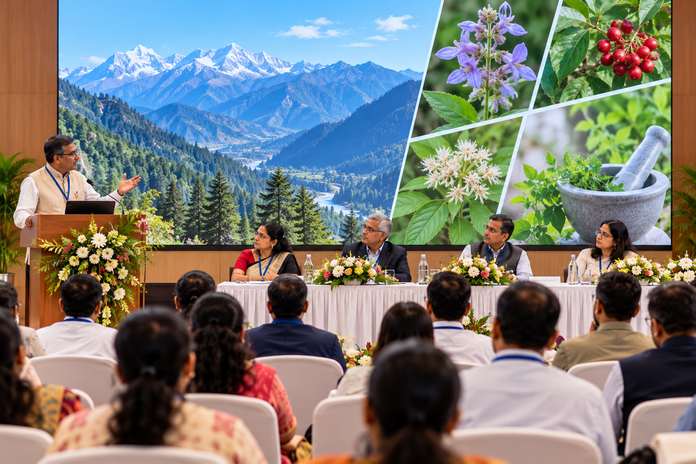
The Central Council for Research in Ayurvedic Sciences (CCRAS), under the Ministry of Ayush, Government of India, organised a two-day national seminar titled “Medicinal Plant Resources of the Western Himalaya: Tradition, Science and Conservation” at the Regional Ayurveda Research Institute (RARI), Mandi, Himachal Pradesh, on October 5–6, 2026.
The seminar focused on medicinal plant diversity, traditional knowledge, scientific research, conservation, and the sustainable utilisation of plant resources in the Western Himalaya.
Focus on Medicinal Plants and Traditional Knowledge
The national seminar brought together themes from Ayurveda, botany, ethnobotany, medicinal plant research, and conservation. According to the CCRAS brochure, the programme was designed to provide an interdisciplinary platform connecting traditional knowledge with contemporary scientific research.
The thematic areas included:
- Plant diversity, taxonomy, and documentation of medicinal plants
- Ethnobotany and traditional healthcare practices
- Traditional knowledge systems and ethnomedicine
- Sustainable use and cultivation of medicinal plants
- Conservation of rare, endangered, and threatened species
- Authentication of raw drugs and quality assurance
- Standardisation of herbal medicines
- Medicinal plants from the Ayurvedic perspective
- Drug discovery and contemporary research opportunities
- Clinical and pharmacological evaluation of traditional claims
The seminar also addressed challenges and future priorities relating to conservation, scientific validation, and sustainable utilisation of medicinal plant resources in the Western Himalaya.
Connecting Ayurveda with Modern Science
An important theme of the seminar was the relationship between traditional knowledge and modern scientific approaches.
The programme included discussions on botanical identification of Ayurvedic medicinal plants, molecular taxonomy, DNA barcoding, biodiversity documentation, and technologies such as geographic information systems (GIS), remote sensing, and biodiversity informatics.
Other thematic areas included ethnodietary practices, traditional foods and nutraceuticals, ethnoveterinary knowledge, cultivation technologies, post-harvest management, and medicinal plant value chains.
The seminar also explored classical Ayurvedic nomenclature, modern plant taxonomy, and Anukta Dravya—plant resources with medicinal properties that are not specifically mentioned in classical Ayurvedic texts. Discussions considered how traditional Ayurvedic concepts could be examined alongside contemporary scientific evidence.
Call for Papers and Research Presentations
The seminar provided a platform for researchers, academicians, scientists, scholars, and students to present work related to the identified thematic areas.
According to the brochure, original abstracts were considered for oral or poster presentations, with full research papers potentially invited from selected contributors.
The two presentation formats were:
- Oral presentations
- Poster presentations
The prescribed poster size was 3 × 6 feet.
Speakers and Organising Committee
Officials and researchers associated with CCRAS and RARI, Mandi, formed the seminar’s organising committee.
The brochure listed the following office-bearers:
- Chief Patron: Prof. Rabinarayan Acharya, Director General, CCRAS
- Patron: Dr. Narayanam Srikanth, Deputy Director General, CCRAS
- Chairperson: Dr. Vineeta Kumar Negi, In-Charge, RARI, Mandi
- Organising Secretary and Coordinator: Dr. Vikas Nariyal, Research Officer (Ayurveda)
- Co-Coordinators: Dr. Kavita Vyas and Dr. Anubha Chandla, Research Officers (Ayurveda)
- Core Organising Committee: Manoj Raturi, Research Officer (Botany), and Dr. Hardeep Singh, Research Assistant (Botany)
The speakers included:
- Dr. S. S. Samant, former Director, ICFRE-HFRI, Shimla
- Dr. Felix Bast, Professor, Central University of Punjab
- Dr. Sumeet Gairola, Professor, University of Delhi
- Dr. Sharad K. Shrivastava, Scientist G, CSIR-NBRI, Lucknow
- Dr. Sanjay K. Uniyal, Scientist G, CSIR-IHBT, Palampur
- Dr. Rashmi Srivastava, Professor, RGGPG Ayurvedic College and Hospital, Paprola
Registration and Participation Details
The seminar brochure listed a registration fee of ₹750, payable through UPI or QR code. The fee included a seminar kit, breakfast, lunch, and tea.
The registration deadline was September 30, 2026, and an on-the-spot registration fee of ₹1,000 was also mentioned.
The organisers stated that registered delegates would receive a list of nearby hotels and guesthouses to help arrange accommodation.
As the seminar took place on October 5–6, 2026, the registration information is historical rather than an indication that registration remains open.
RARI Mandi’s Role in Medicinal Plant Research
The seminar was organised in collaboration with the Regional Ayurveda Research Institute (RARI), Mandi, a CCRAS institution under the Ministry of Ayush.
According to the brochure, RARI focuses on Ayurvedic healthcare, medicinal plant research, and scientific knowledge generation in the Western Himalaya.
Its research activities include botanical, taxonomic, ethnobotanical, and ethnomedicinal studies; field exploration; plant identification; and documentation of traditional plant-use practices.
The institute also maintains a recognised herbarium to support systematic plant identification and research.
Importance of the Seminar
The Western Himalaya has diverse medicinal plant resources relevant to traditional healthcare practices, botanical research, and medicinal plant-based value chains.
Collaboration among Ayurveda researchers, botanists, and other scientific disciplines can support the documentation, identification, and quality assessment of these resources.
Alongside conservation and sustainable use, attention is needed to balance the utilisation of medicinal plants with the protection of rare, endangered, and threatened species.
The seminar aimed to create a platform for discussing how Himalayan medicinal plant resources could be better understood, documented, conserved, and sustainably utilised by bringing traditional knowledge into dialogue with contemporary scientific approaches.
These objectives reflect the organisers’ stated aims and do not establish that specific therapeutic claims discussed during the seminar have been clinically validated.
Conclusion
The CCRAS national seminar on “Medicinal Plant Resources of the Western Himalaya: Tradition, Science and Conservation” brought together themes relating to Ayurveda, medicinal plant science, traditional knowledge, biodiversity conservation, and sustainable resource use.
Held at RARI, Mandi, on October 5–6, 2026, the seminar provided a forum for researchers and scholars to discuss scientific documentation and the responsible utilisation of medicinal plant resources in the Western Himalaya.
The programme highlighted the importance of combining traditional knowledge with scientific research, conservation efforts, and quality assessment to support the responsible study and use of medicinal plants.