


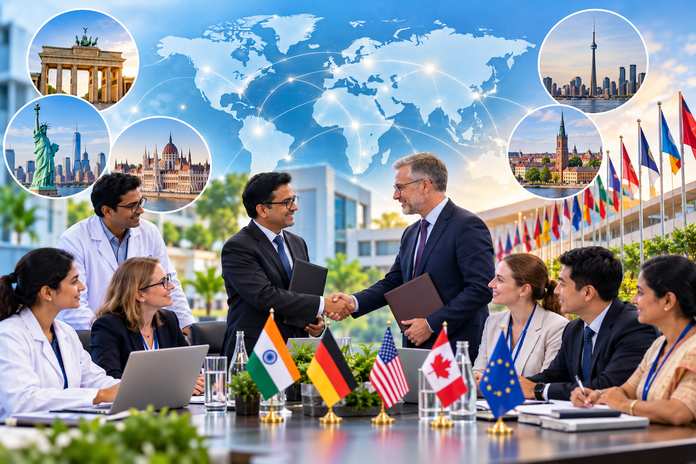
The Central Council for Research in Ayurvedic Sciences (CCRAS), under the Ministry of Ayush, is working to strengthen international engagement and promote Ayurveda through research collaborations, academic partnerships, expert exchanges, and participation in international traditional medicine forums.
The Council’s international activities also focus on evidence-based research and the wider dissemination of authentic information about Ayurveda.
CCRAS Enhances International Cooperation on Ayurveda
To coordinate its international activities, CCRAS established a Section for International Cooperation at its headquarters in New Delhi on August 9, 2016.
The section coordinates collaborative research studies, international deputations, Memoranda of Understanding (MoUs), Ayurveda Academic Chairs, exhibitions, training programmes, international fairs, and the sharing of scientific publications with overseas partners and Ayush Information Cells.
It also assists the Ministry of Ayush in organising international meetings, conferences, and summits on traditional medicine and Ayurveda.
MoUs and Partnerships with Foreign Institutions
According to CCRAS, the Council has signed 20 MoUs and Letters of Intent (LoIs) with foreign countries, universities, and institutions to promote Indian traditional medicine and establish Ayurveda Academic Chairs.
These collaborations cover several areas, including:
- Ayurveda research and development
- Ayurveda Academic Chairs at foreign universities
- Collaborative research involving Ayurveda and cancer
- International academic infrastructure
- Evidence-based research and joint studies
CCRAS has research collaborations with institutions in Germany, the United States, Israel, and Canada. Its Academic Chair collaborations include institutions in Hungary, Thailand, Indonesia, Russia, Slovenia, Latvia, Argentina, Malaysia, Mauritius, Mexico, and Trinidad and Tobago.
Research on Evidence-Based Ayurveda
International cooperation has supported clinical studies and other research projects involving Ayurveda.
One major collaboration involved a multicentre randomised controlled clinical trial with Charité – Universitätsmedizin Berlin, Germany, to investigate the effectiveness and safety of Ayurveda as a whole-system treatment approach for knee osteoarthritis.
The research has been published in peer-reviewed journals. A 2018 paper in Osteoarthritis and Cartilage examined an Ayurvedic treatment approach for knee osteoarthritis.
CCRAS has also undertaken collaborative work with the WHO India Country Office and other international partners in areas such as Ayurveda research methodology, traditional medicine, public health integration, and the standardisation of Ayurveda terminology.
These activities reflect an approach that emphasises scientific investigation and evidence generation alongside the documentation and preservation of traditional knowledge.
Ayurveda Academic Chairs and Global Education
Another area of international cooperation is the establishment of Ayurveda Academic Chairs at universities and institutions abroad.
These partnerships aim to promote academic study, teaching, research, and the wider dissemination of Ayurveda through international higher education institutions.
CCRAS lists active Academic Chair collaborations in Latvia, Mauritius, and Argentina, while partnerships with institutions in several other countries are being developed or pursued.
Such collaborations can create opportunities for teaching, joint research, and the exchange of knowledge between Indian and international institutions.
Participation in International Conferences and Workshops
CCRAS officials and experts participate in international conferences, workshops, and meetings focused on traditional medicine.
Activities highlighted by the Council include participation in:
- The meeting of the WHO International Regulatory Cooperation for Herbal Medicine (IRCH) network in Istanbul
- The Arctic Circle Assembly in Reykjavik, Iceland
- The India–Germany Joint Working Group Meeting on Alternative Medicine in Berlin
- The International AYUSH Conference and Expo 2026 in Dubai
- Other international conferences on Ayurveda research and traditional medicine
These engagements provide platforms for discussions on traditional medicine research, regulation, education, and international cooperation.
CCRAS and the WHO Global Summit on Traditional Medicine
CCRAS served as the nodal agency for the Second WHO Global Summit on Traditional Medicine, held from December 17 to 19, 2025, at Bharat Mandapam in New Delhi.
The summit brought together participants from more than 100 countries, including policymakers, researchers, healthcare professionals, and representatives of international organisations.
Discussions focused on sharing knowledge and best practices and exploring evidence-based approaches to integrating traditional medicine into healthcare systems.
The summit formed part of wider international efforts to strengthen cooperation in traditional medicine research, innovation, and policy development.
Regional Cooperation on Quality Standards
International collaboration has also addressed the quality and manufacturing standards of herbal medicines.
In August 2025, the World Health Organization (WHO) and CCRAS organised a four-day regional workshop on WHO Good Manufacturing Practices (GMP) for Herbal Medicines in Mumbai.
The programme included delegates from India, Bhutan, Thailand, Sri Lanka, and Nepal. According to CCRAS, it featured technical sessions, international experts, and a field visit to a WHO-GMP-certified manufacturing facility.
The workshop aimed to strengthen regional capacity and support greater harmonisation of quality standards for herbal medicines.
Why Global Collaboration Matters for Ayurveda
CCRAS’s growing international engagement creates opportunities to connect Ayurveda with international research, academic, and policy forums.
Areas of potential cooperation include:
- Joint scientific research
- Education and academic exchanges
- Development of research methodologies
- Manufacturing and quality standards
- International knowledge sharing
- Standardisation of terminology
- Wider access to authentic information about Ayurveda
However, international collaboration or the signing of an MoU should not be interpreted as automatic proof of the clinical effectiveness of every Ayurvedic treatment or claim. Scientific evidence must be assessed separately for each intervention, product, or therapy.
India’s International Ayurveda Outreach
CCRAS’s international activities form part of the Ministry of Ayush’s broader efforts to strengthen India’s engagement with traditional medicine worldwide.
The Council’s work includes research collaborations, academic partnerships, participation in international events, and cooperation with organisations such as WHO.
These activities extend beyond promotion to include research, education, regulation, quality standards, and scientific cooperation.
Conclusion
CCRAS is strengthening international cooperation to support Ayurveda research, education, and global knowledge sharing. Through partnerships with foreign institutions, Academic Chairs, collaborative research, international conferences, and engagement with WHO, the Council contributes to India’s broader participation in global traditional medicine discussions.
As international engagement in Ayurveda expands, continued attention to scientific evidence, research quality, academic collaboration, and appropriate standards remains important.