


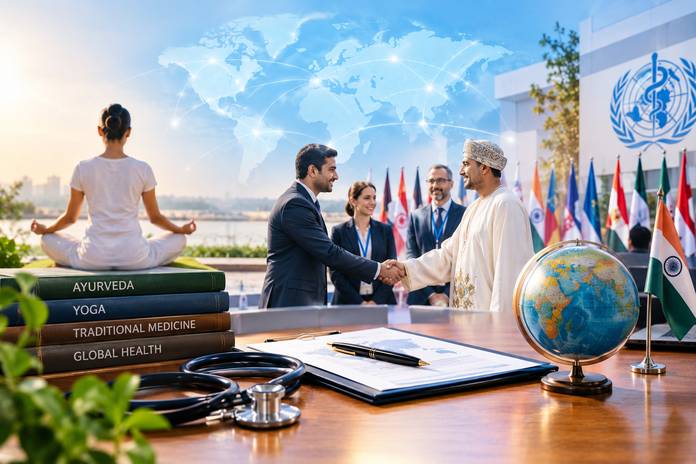
India is increasingly relying on trade agreements, international cooperation and medical-value travel initiatives to extend the global reach of Ayurveda, Yoga and other AYUSH systems. Deals with Oman and New Zealand have clauses on traditional medicine, while India’s wider international strategy is focusing more on standards, practitioner qualifications, evidence and patient safety.
AYUSH in the World Beyond Cultural Diplomacy
India’s traditional medicine systems are becoming a more visible component of the country’s international health and trade engagement.
The change is particularly evident in recent trade deals. The India-Oman Comprehensive Economic Partnership Agreement (CEPA), signed in December 2025, contains a commitment on traditional medicine across all modes of supply. The Government of India describes it as Oman’s first such comprehensive commitment.
The India-New Zealand Free Trade Agreement also has a separate Health and Traditional Medicine Services Annex that covers Ayurveda, Yoga and other traditional medicine services. The agreement was signed in December 2025 and came into effect on 20 October 2026.
These developments pave new avenues for Indian practitioners and wellness-service providers but do not automatically confer on every AYUSH practitioner the right to practise medicine in another country.
What the Recent Trade Deals Offer
CEPA Between India and Oman
The Oman agreement provides a framework for cooperation in health and traditional medicine services.
The Department of Commerce’s Health and Traditional Medicine Services Annex addresses areas such as:
- Licensing and qualification processes
- Recognition of professional experience
- Examinations for digital licensing
- Medical-value tourism
- Capacity building
- Standardisation and harmonisation
- Collaborative research
The agreement also includes broader commitments on services relating to health and medical services.
For India’s AYUSH sector, this means traditional medicine is being discussed in a formal trade setting and not just as part of cultural or diplomatic exchanges.
India-New Zealand FTA
The India-New Zealand deal provides an additional route for the internationalisation of traditional medicine services.
The Government of India has said that New Zealand has, for the first time in its trade agreements, included a dedicated Health and Traditional Medicine Services arrangement with India. The framework covers Ayurveda, Yoga and other traditional medicine services and aims to enhance cooperation in the sector.
The pact also has a 5,000-visa pathway for skilled Indian professionals in designated sectors, including AYUSH practitioners, chefs, music teachers and Yoga instructors.
However, the existence of a trade or mobility provision should not be confused with automatic professional registration. Practitioners must still meet any requirements in the destination country.
The Growing Importance of Credible Standards
As AYUSH enters international markets, the question is not only whether there is demand for Ayurveda or Yoga. Regulators and health systems also need to understand whether practitioners are adequately trained, services are delivered safely and products meet the necessary quality standards.
The WHO has already developed international reference documents for Ayurveda.
The WHO Benchmarks for the Practice of Ayurveda, published in 2022, offer minimum reference criteria relating to the quality and safety of Ayurveda practice. They cover practitioner categories, infrastructure, health interventions, products and devices, safety, regulatory and ethical issues, and health-data management.
WHO also issued the WHO Benchmarks for the Training of Ayurveda in 2022. The document sets out minimum requirements for Ayurveda training, including competency-based knowledge and skills and safety issues related to clinical practice and medicinal preparation.
These are reference frameworks, not a global licence for Ayurveda practitioners.
Yoga Also Faces a Standards Challenge
The debate on international standards is not limited to Ayurveda.
WHO published a technical report on Training in Yoga in December 2025. WHO says there is no global regulatory process governing Yoga training and practice, and requirements therefore vary from country to country. The report provides an evidence-informed reference for competency-based training and aims to help policymakers, education and accreditation bodies, and Yoga providers develop context-appropriate standards.
This reflects a broader challenge: international expansion can open doors, but it also increases the need for consistent approaches to education, competency, quality and safety.
India’s Larger International Strategy for AYUSH
India’s international engagement on AYUSH did not begin with the recent trade agreements.
The Ministry of AYUSH has been working with WHO on traditional and complementary medicine, including a five-year agreement signed in 2023 to support the development of technical documents and evidence-informed approaches in the field.
India has also announced an AYUSH visa for foreign nationals coming for treatment under AYUSH and Indian systems of medicine. The visa category was notified by the Ministry of Home Affairs in 2023, according to the Ministry of AYUSH.
The Ministry has also supported international education. Its report for 2023–24 recorded that 260 students from 32 countries were studying AYUSH systems in Indian institutions under the AYUSH Fellowship Scheme.
Together, these initiatives demonstrate that India’s approach involves several channels: healthcare services, education, research, trade, professional mobility and international cooperation.
Implications for Practitioners and Institutions
Greater international involvement for Ayurveda and Yoga professionals could create new opportunities in education, wellness services, research and professional practice where local regulations permit.
However, practitioners should differentiate between market access and professional recognition.
A trade agreement can provide a route for services and mobility or encourage cooperation. It does not replace the licensing laws of the country where a practitioner wants to work.
For educational institutions, the discussion about international standards also highlights the importance of clearly documented curricula, competencies, training quality and professional credentials.
Why Evidence and Patient Safety Are Important
Ultimately, international recognition will depend on more than diplomatic agreements.
The broader traditional medicine strategy of WHO focuses on quality, safety, appropriate use, evidence and responsible integration into health systems. WHO has also highlighted the need for better methodologies and reliable evidence for traditional and complementary medicine.
For Ayurveda, this means that as it enters more regulated international healthcare environments, research quality, practitioner training, and the quality and safety monitoring of products will remain important.
This is not to say that one model of evidence should be used to evaluate all traditional medicine. It does mean that claims about specific treatments, products or health outcomes need appropriate scientific and regulatory support.
The current developments should not be construed as the creation of a global AYUSH regulatory system.
Three Things for Readers to Remember
- Trade access does not equal a licence to practise.
- WHO benchmarks are reference standards, not universal professional licences.
- The destination country’s regulatory requirements still matter.
For patients considering treatment abroad, the practitioner’s qualifications, product quality, applicable local regulations and appropriate medical advice remain important considerations.
Why This Development Is Important
Recent trade and international cooperation initiatives suggest that AYUSH is increasingly being positioned as part of India’s health-services and international economic strategy.
The next stage will require stronger links between international market access and measurable standards for education, professional competence, research, product quality and patient safety.
As these systems develop alongside expanding international opportunities, India’s traditional medicine sector may be better positioned to engage with regulated global healthcare markets.
Conclusion
The increasing use of AYUSH in India’s international trade and health diplomacy is opening new avenues for Ayurveda, Yoga and other traditional medicine services. Agreements with Oman and New Zealand provide important examples, while WHO benchmarks offer international reference points for Ayurveda practice and training.
This presents an opportunity, but global acceptance will not come simply through diplomatic agreements. Credible standards, appropriate regulation, practitioner competence, evidence and patient safety will remain central to the sector’s long-term international growth.