

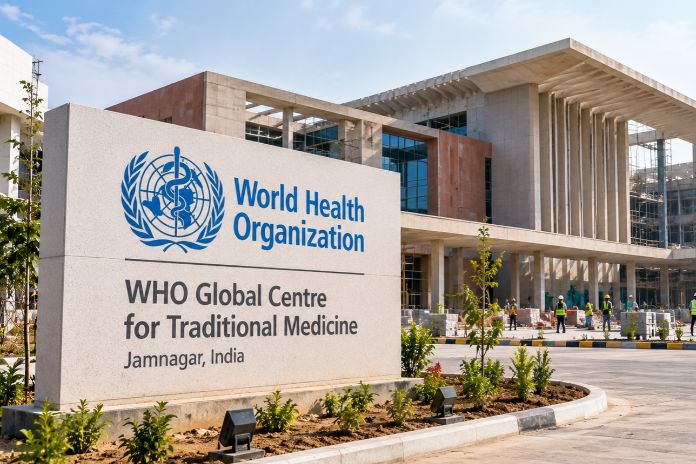
The WHO Global Traditional Medicine Center in Jamnagar, Gujarat, has achieved 79% physical progress and 40% financial progress in infrastructure development as of October 2025, according to a government update released by the Press Information Bureau (PIB) on December 2, 2025. The Center is aimed at enhancing international research and evidence generation and collaboration on traditional medicine.
WHO Global Traditional Medicine Center: What Is It?
The Global Traditional Medicine Center (GTMC) was established in 2022 by the World Health Organization (WHO) with the support of the Government of India. The Center, located in Jamnagar, Gujarat, acts as a global knowledge hub for traditional, complementary and integrative medicine.
Its wider vision is to embed traditional knowledge in constructive dialogue with modern science, supporting evidence-informed healthcare, sustainability and equal access to health services.
The Centre’s work focuses on building scientific evidence, strengthening health systems, promoting biodiversity and equity and encouraging innovation and technology, says WHO.
These priorities are also relevant for Ayurveda and other traditional medical systems as their responsible integration into health care requires reliable information on safety, effectiveness, quality and appropriate use.
Recent Update: Infrastructure Development
According to the PIB release of 2 December 2025, the following infrastructure figures for the Center were reported in Jamnagar:
- Physical progress: 79%
- Financial progress: 40%
- Date of report: October 2025
The physical progress is the progress reported on the infrastructure work and the financial progress is the financial progress reported on the project.
The figures reflect progress as at the relevant reporting date. They should not be read as evidence that the Centre’s infrastructure was fully completed or functional by December 2025.
The release does not give a breakdown of the remaining construction work, components of expenditure or a schedule for completion of the project.
What Is the Purpose of the Center?
The GTMC has a wide international mandate. The government release states that its main purposes are:
1. To Strengthen the Global Position of AYUSH Systems
The Center is aimed at promoting global awareness on India’s AYUSH systems, that is, Ayurveda, Yoga and Naturopathy, Unani, Siddha, Sowa-Rigpa and Homoeopathy.
International engagement can help traditional medical systems to participate in wider discussions around research, healthcare policy, education and standards.
2. Fostering Scientific Research and Evidence
Strengthening the evidence base for traditional medicine is a central priority. This includes improving research methods, identifying gaps in evidence and supporting the collection and analysis of relevant data.
This emphasis suggests the importance of well-designed studies and transparent reporting for assessing traditional interventions for Ayurvedic practitioners, researchers and academic institutions.
WHO also cites as a challenge to the proper integration of traditional medicine into health systems the lack of evidence about the safety and efficacy of traditional medicine products and practices.
3. Establishing Standards and Guidance
The Center seeks to foster the development of norms, standards, guidelines, tools and methodologies in relevant technical areas.
This work can contribute to more consistent approaches to research, quality assessment and responsible use of traditional medicine. However, the PIB release does not announce a new specific regulatory standard or say that all traditional medicine systems have been standardised already.
4. Support for Education and Capacity Building
Training and capacity development is also one of the Centre’s objectives. The envisaged approaches include campus-based, residential and online training, as well as collaboration with the WHO Academy and other strategic partners.
These activities may afford opportunities for knowledge exchange between researchers, healthcare professionals and institutions, provided that the programs and opportunities actually offered allow for this.
5. Connecting Traditional Medicine and Digital Innovation
The government release also notes the proposed development of a Traditional Medicine Informatics Center and collaboration between existing traditional medicine databases, virtual libraries, academic institutions and research organisations.
Better access to organised information can help researchers to find existing evidence, understand the gaps in knowledge and coordinate research more effectively.
Global Engagement and International Collaboration
According to the PIB release, India hosted and is the leading investor of the WHO Global Traditional Medicine Center.
It says India had inked:
- 25 country-to-country Memoranda of Understanding (MoUs)
- 15 Ayush Chair MoUs
- 52 MoUs between institutions
The agreements are intended to boost international collaboration, academic exchange and standardisation efforts. The release does not provide a detailed evaluation of the results of each agreement and so the number of MoUs should not be seen as a measure of their individual impact.
The Center has been a participant in international dialogues on traditional medicine. Along with another, it held the first WHO Traditional Medicine Global Summit in 2023, providing a platform to exchange experiences and discuss scientific evidence.
In 2024, the Center co-sponsored events on traditional medicine, sustainable development and universal health coverage, including a G20 Health Working Group event in Salvador, Brazil, and a high-level panel at the 16th Conference of the Parties to the Convention on Biological Diversity (COP16) in Cali, Colombia.
The release also mentions the creation of a Technical Expert Network to enable regular interaction between WHO headquarters and its regional and country offices.
Five Areas of Work in the Workplan of the Center
The PIB announcement lists five key areas of activity:
- Research and evidence in traditional medicine: Enhancing the quality and accessibility of scientific information.
- Global summits: Backing international dialogue and the exchange of knowledge.
- Universal health coverage, primary health care: Contribution of traditional medicine to health systems.
- Indigenous knowledge and biodiversity: Considering the sustainability, rights and conservation of biodiversity, as well as the recognition of traditional knowledge.
- Digital health applications: The role of electronic devices and information systems in traditional medicine.
Collectively, these areas link research and healthcare policy with education, international collaboration and environmental sustainability.
Why Is This Development Important for Ayurveda?
The Centre’s work is relevant for India’s Ayurveda community as it provides an international institutional platform for discussion, research and collaboration in traditional medicine.
The emphasis on evidence and research methods underscores the need for Ayurveda researchers and academic institutions to evaluate traditional practices using appropriate scientific methods.
The broader focus on quality, safety and rational use serves as a reminder to practitioners that traditional knowledge and clinical decisions should be underpinned by appropriate evidence and responsible professional practice.
International collaboration can help policymakers and health institutions in debates on research priorities, workforce training, standards and the appropriate role of traditional medicine in health systems.
“These are possible areas of relevance, not guaranteed results.” The PIB announcement does not confirm that the Centre’s efforts have already led to demonstrable improvements in patient outcomes or access to healthcare.
What Researchers, Students and Institutions Should Know
According to PIB release, there is no application window, scholarship, recruitment drive, research grant or registration process that forms part of this update.
The official WHO website gives details of the Centre’s research priorities, publications, projects and activities for those who wish to learn more about its work.
Researchers and students should not expect the infrastructure update to automatically bring opportunities, but should consult individual program announcements for details on eligibility, deadlines and application procedures.
Summary
As per the December 2025 update, the Government of India had said that the WHO Global Traditional Medicine Center, Jamnagar, has achieved 79% physical progress and 40% financial progress as of October 2025, in terms of infrastructure.
The Centre’s remit is not only in the area of infrastructure development but also in research and evidence, international collaboration, capacity building, biodiversity and digital innovation. How well these activities support reliable evidence, responsible health care practices and constructive global engagement with traditional medicine will determine their long-term importance.
Source Link: https://www.pib.gov.in/PressReleasePage.aspx?PRID=2209035®=48&lang=2