


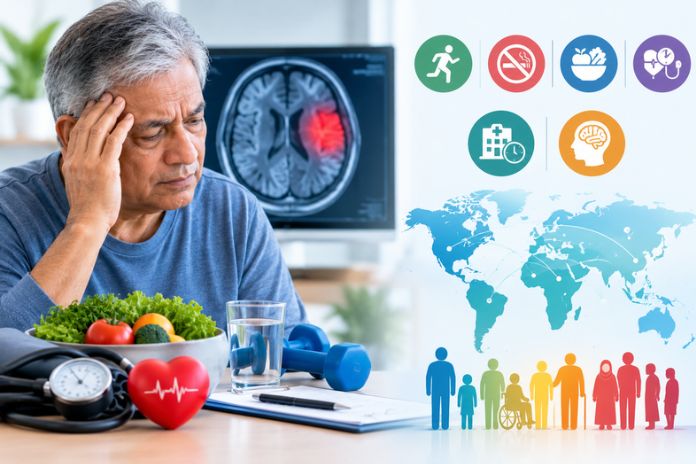
A stroke can change a person’s life in minutes, affecting their movement, speech, memory and independence. But it has a much larger impact on the individual, putting emotional, physical and financial strains on families and health systems. A global fact sheet published by the World Stroke Organization in 2025 highlights the magnitude of this challenge and the urgent need to strengthen prevention, treatment and rehabilitation.
The report shows that stroke is one of the world’s leading causes of death and disability, drawing largely on the Global Burden of Disease 2021 study. It also suggests a troubling trend: despite advances in medical knowledge and treatment options, the total number of people who have had a stroke continues to rise.
What the Researchers Did
The World Stroke Organization: Global Stroke Fact Sheet 2025 collates estimates of stroke incidence, prevalence, deaths, disability and risk factors by country and region. Its findings largely draw from the Global Burden of Disease 2021 study, a major international analysis of health data.
To understand how the global burden of stroke has changed over time and where the burden is highest, the authors looked at changes from 1990 to 2021. This is an evidence summary based on population-level data, not a clinical trial of a particular treatment.
A stroke happens when blood flow to a part of the brain is blocked or when a blood vessel in the brain bursts. When brain cells do not receive the oxygen and nutrients they need, they can be damaged quickly. The effects depend on which part of the brain is affected, how severe the stroke is and how quickly treatment is given.
What Did the World Fact Sheet Reveal?
Every Year, Millions of People Are Affected
According to the fact sheet, in 2021:
- Just under 12 million new strokes occurred worldwide.
- 93.8 million people lived with the effects of a previous stroke.
- More than 7.2 million deaths were due to stroke.
- Stroke contributed to more than 160 million disability-adjusted life-years (DALYs) lost.
DALYs measure the combined years of life lost due to premature death and years lived in less than full health. In essence, they help estimate the cost of disease in terms of healthy life for a population.
The report says stroke is the world’s second-biggest killer and the leading cause of death and disability combined. These estimates underscore the importance of stroke prevention and care as public health priorities.
More Strokes as Time Goes On
The total number of new strokes increased by 70% between 1990 and 2021. Deaths from stroke increased by 44%, DALYs related to stroke increased by 32%, and the number of people living with a history of stroke increased by 86%.
These are increases in the total numbers of cases, deaths and health loss—not necessarily equal increases in each age-adjusted rate. Population growth and ageing are important when understanding long-term trends.
The findings also suggest that stroke remains a problem before old age. In 2021, roughly 53% of new strokes occurred in people under the age of 70. This challenges the perception that stroke is only a concern for older adults.
The Burden Is Disproportionately High in Low-Income Countries
The fact sheet notes that estimates show low- and lower-middle-income countries accounted for around 87% of stroke deaths and 89% of stroke-related DALYs.
This inequality reflects a complex mix of risk factors, access to healthcare, prevention, emergency services and rehabilitation resources. Stroke patients often require urgent diagnosis, specialist treatment and months or years of rehabilitation. Gaps at any stage can lead to worse outcomes.
The report estimated that the global cost of stroke to the economy was over US$890 billion per year, or about 0.66% of global gross domestic product. The impact includes healthcare spending, lost productivity and the long-term consequences of disability.
What Are the Major Risk Factors for Stroke?
The fact sheet categorises stroke risks into three groups: metabolic, environmental and behavioural. It estimates that 69% of metabolic risks, 37% of environmental risks and 35% of behavioural risks contributed to strokes.
These percentages are not mutually exclusive because one stroke may be associated with several risk factors. They should not be added together as if they represent separate groups of patients.
Important modifiable risk factors include:
- High blood pressure
- High blood glucose
- Unhealthy cholesterol levels
- Excess body weight
- Physical inactivity
- Smoking
- Unhealthy dietary patterns
- Air pollution
The importance of each risk factor differs between populations.
High blood pressure is especially important because it can damage blood vessels and increase the risk of both blocked and ruptured vessels. Regular healthcare can help identify and control risk factors that make a stroke less likely.
What Does It Mean for the Average Person?
The report reinforces an important message: stroke prevention is not about one medicine, one lifestyle change or one healthcare visit. It requires individual action and accessible health services.
Practical steps include:
- Monitoring blood pressure and seeking professional advice if it is high.
- Getting appropriate clinical care for diabetes and cholesterol management.
- Avoiding tobacco and reducing exposure to environmental hazards when possible.
- Staying physically active and eating a well-balanced diet.
- Talking to a doctor about personal risk factors, especially when more than one risk factor is present.
Prevention also depends on public health measures, such as affordable primary care, awareness campaigns, effective emergency services and access to rehabilitation.
Recognise Stroke as an Emergency
Signs of stroke include:
- Sudden drooping, weakness or numbness of the face, particularly on one side of the body.
- Trouble talking or understanding speech.
- Sudden vision loss.
- Severe dizziness or a sudden loss of balance.
If you suspect a stroke, call for emergency medical help immediately. Do not wait to see whether the symptoms clear up, and do not try to treat a suspected stroke on your own. The appropriate treatment depends on the type of stroke and how long ago it occurred, so early evaluation is important.
Ayurvedic Perspective Explained
Ayurveda has a long tradition of addressing health, daily routines, diet and rehabilitation. These areas can be relevant to supportive wellbeing and recovery when appropriate for the individual and coordinated with medical care.
However, the Global Stroke Fact Sheet does not assess Ayurvedic medicines, Panchakarma procedures or other Ayurvedic interventions. Therefore, it cannot be used as evidence that a particular Ayurvedic treatment prevents or treats stroke.
People who have had a stroke and are considering complementary approaches should talk with their treatment team. Some herbal products can interact with prescribed medicines or affect the risk of bleeding. This is especially important for people taking antiplatelet or anticoagulant drugs.
Complementary care must never replace evidence-based stroke prevention and rehabilitation or delay emergency treatment.
An evidence-informed approach respects traditional knowledge while requiring particular treatments to be tested for safety and effectiveness.
What Should Readers Keep in Mind?
The fact sheet synthesises estimates from a large global disease-burden study. Such estimates are useful for comparing trends and planning health services. They depend on the quality and availability of data and on statistical modelling. The results are not simply a count of every stroke in the world.
The data cover the years 1990 to 2021; they should not be taken as exact figures for 2025 or 2026. Population-level associations do not prove that every individual stroke was caused by a particular risk factor.
The main value of the report is its demonstration of the scale and distribution of the problem. It identifies groups and places that bear a disproportionate burden and helps inform decisions about prevention, emergency care and rehabilitation.
Conclusion: Prevention and Timely Care Should Remain Priorities
The World Stroke Organization’s 2025 fact sheet highlights a sobering public health challenge. Stroke remains a leading cause of millions of deaths and significant long-term disability, and the burden is not evenly distributed, with lower-income countries bearing the brunt.
To reduce this impact, better prevention, recognition of warning signs, rapid emergency treatment and sustained rehabilitation are needed. For individuals, managing modifiable risk factors and obtaining prompt medical care can make a difference. Equal access to care remains a key issue for health systems.
Medical disclaimer: This article is for educational purposes only and is not intended to substitute for professional medical advice, diagnosis or treatment. If you think someone has had a stroke, treat it as a medical emergency.
Source link: https://pmc.ncbi.nlm.nih.gov/articles/PMC11786524/