


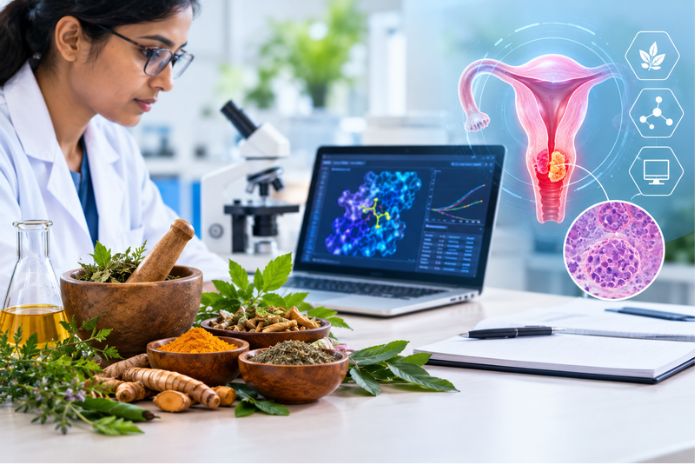
Could compounds found in familiar plants provide clues to new avenues for cervical cancer research? A 2025 study in Molecular Biology Research Communications addressed this question using bioinformatics, a field where biology, computer science, and data analysis intersect.
The researchers looked at compounds in Ayurvedic herbs and used computer-based techniques to predict how some might interact with proteins and biological pathways involved in cervical cancer. Their analysis revealed a number of compounds for further investigation.
The results provide potential pathways for lab work and future drug development. But this was a computational study, not a clinical trial. It does not imply that Ayurvedic herbs can prevent, treat or cure cervical cancer in human beings.
What did the researchers study?
Cervical cancer is a cancer that starts in the cells of the cervix (the lower part of the uterus). The disease is mainly caused by persistent infection with high-risk human papillomavirus (HPV). HPV vaccination, screening and timely treatment of precancerous changes remain essential for prevention.
The researchers investigated whether compounds found in medicinal plants could interact with proteins and pathways related to cancer biology in the study Computational analysis of Ayurvedic herbs to explore their potential role as anti-cervical cancer agents.
Instead of giving patients herbs or trying out a treatment in a hospital, the researchers collected data from published scientific literature and chemical and biological databases. Then they used computational tools to narrow down a long list of plant compounds to those that looked promising for further investigation.
That’s a tactic sometimes employed in the initial phases of drug development. It may help researchers decide which candidates to test first, but the predictions made by computers need to be confirmed by experiments.
What did the researchers discover?
From Medicinal Plants toward Candidate Compounds
The researchers first identified 46 herbs previously associated with anti-cervical cancer activity in scientific literature. They gathered information on the plants’ bioactive compounds – naturally occurring substances that may have biological effects.
A total of 604 compound entries corresponding to 481 unique compounds were identified. In the drug-likeness screening stage, 134 out of 450 compounds evaluated met the computational criteria selected for the study.
‘Drug-likeness’ is a term used to describe the chemical properties that may make a compound a good candidate for a pharmaceutical. The researchers explored predicted properties associated with absorption, distribution, metabolism, excretion and toxicity. Such computer tests can help narrow a list of candidates, but they do not prove that a substance is safe or effective in humans.
The team then looked at predicted interactions between the shortlisted compounds, human proteins and cancer-related biological pathways.
Four compounds were singled out for attention
The researchers flagged four compounds as especially promising candidates for further research:
- Apigenin: A flavonoid of plant origin that occurs in several plants including some identified in the study.
- 6-chloroapigenin: The researchers’ analysis revealed a compound related to apigenin but chemically distinct.
- Allicin: A compound containing sulphur that is found in garlic.
- Matairesinol: A plant lignan found in a number of plant foods.
The computational analysis suggested that these compounds may interact with several proteins involved in cancer pathways including pathways associated with cell growth and survival. Based on this analysis, these compounds were selected.
The paper also listed plants such as Camellia sinensis (green tea), Equisetum arvense (field horsetail) and Rosmarinus officinalis (rosemary) among the herbs relevant to its analysis.
These results are research candidates, not proven therapies. The study did not demonstrate that consumption of these plants, herbal supplements or Ayurvedic formulations would deliver the same compounds at effective concentrations to human cervix or tumour tissue.
How does computer-based research benefit cancer science?
Cancer is a complex web of proteins and signalling pathways that affect how cells grow, divide, repair damage or die. Computational methods allow researchers to predict what compounds might interact with these systems.
In this study, the team used multiple databases to predict compound-protein relationships and explored how the predicted protein targets were related to human biological pathways. They focused on targets that appear in cancer related pathways and identified promising compounds based on pre-defined criteria.
This process can help researchers discover which substances should be examined more closely. For example, a candidate predicted to interact with proteins involved in cell growth may be worth testing in the lab to see whether it actually does alter the behaviour of cancer cells.
But predicted interaction is not evidence that the interaction takes place inside a living organism. It may act differently in lab experiments, may not get to the relevant tissue in sufficient quantities or may affect healthy cells as well as cancer cells.
The next steps in research would therefore be experimental testing of the candidates, evaluation of their effect on cancer and normal cells, investigation of dosage and toxicity and whether any promising results can be reproduced.
Get a feel for the Ayurvedic perspective
Ayurveda is a traditional Indian system of health which includes the use of medicinal plants and preparations derived from plants. Plants used in traditional medicine can be examined for their chemistry, and this can be the starting point for modern scientific research.
However, the study’s computational methods do not confirm all of the traditional uses of the plants studied. There is also no evidence that the isolated compounds act in the same way when taken as part of a whole herb or a multi-component Ayurvedic preparation.
The researchers looked at individual bioactive compounds and how they predicted molecular interactions. This is different to assessing a full Ayurvedic treatment which can involve many ingredients and other aspects of care.
An evidence-based approach can accommodate traditional knowledge by asking specific, testable questions about chemical composition, biological activity, safety and clinical outcomes.
What do readers need to know?
The main limitation is the nature of the study. It was a computer analysis of information from scientific literature and databases. It didn’t test an Ayurvedic treatment in people, and the paper doesn’t show clinical benefit for cervical cancer patients.
Other unknowns include:
- Need for confirmation of predictions: Computer models and databases can indicate possible interactions, but experimental studies are needed to confirm them.
- Drug-likeness is not safety: Predictive chemical properties are not a surrogate for toxicology studies or clinical safety assessment.
- A compound does not equate to a herbal product: The amount, preparation, absorption and interactions of compounds in a real product may differ from the assumptions used in computational analysis.
- Laboratory work doesn’t mean patient benefit: Compounds that work on cancer cells in the lab may not turn into safe and effective medicines.
- More studies needed: Before any claims of treatment can be justified, laboratory studies, appropriate preclinical testing, and well-designed clinical trials would be required.
Thus, the results should be considered a first step in a line of investigation, rather than evidence that an Ayurvedic herb can treat cervical cancer.
What does this mean for the common people?
For readers, the study is a model of how traditional medicinal plants can be studied by modern scientific tools. It might help direct researchers on which plant compounds to study next, but it does not alter current recommendations for the prevention and treatment of cervical cancer.
“The World Health Organization emphasises the importance of HPV vaccination, cervical screening and timely diagnosis and treatment,” These measures continue to be the mainstay of reducing the burden of cervical cancer.
Patients undergoing assessment or treatment for cervical cancer should discuss treatment decisions with qualified health care professionals. Herbal products and supplements can have side effects or interact with medicines and so should be disclosed to the treating team. They are not intended to replace or delay recommended screening, diagnostic evaluation or cancer treatment.
Takeaways for practice
The study identified potential plant compounds by using computer analysis, rather than human treatment trials. Apigenin, 6-chloroapigenin, allicin and matairesinol were selected for further investigation.
- Predicted interaction with cancer-related proteins are leads, not proof of therapeutic efficacy.
- Further laboratory, safety and clinical research is needed before any medical benefits can be established.
- HPV vaccination, recommended screening and timely medical care are important for prevention and management of cervical cancer.
Conclusion: A promising research direction, not a proven treatment
The 2025 computational study presents a systematic approach for studying compounds present in Ayurvedic related plants and for identification of potential candidates for future cervical cancer research. This is not to say that the herbs themselves treat cancer. Its value is in helping scientists prioritise questions for experimental testing.
Carefully interpreted findings that are rigorously tested can open useful avenues for discovery when traditional plant knowledge is brought into modern research. These findings are an early scientific clue for now, and proven cervical cancer prevention and treatment remain crucial.
Medical disclaimer: This article is solely for educational purposes and should not be taken as professional medical advice, diagnosis or treatment.
Source link: https://pmc.ncbi.nlm.nih.gov/articles/PMC11865937/