


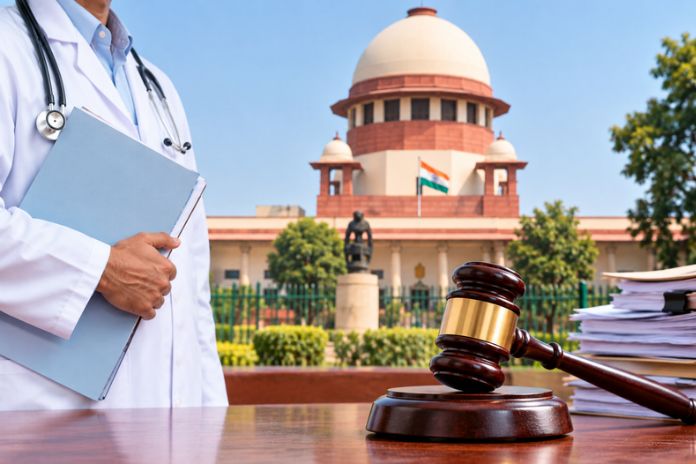
The Court has directed the Rajasthan government to comply with its earlier judgments relating to the retirement benefits of an AYUSH doctor, keeping its appeal pending. The bigger question of parity between AYUSH and allopathic doctors remains unanswered.
NEW DELHI, 28 October 2026: The Supreme Court of India has directed the Rajasthan government to implement previous judicial orders on the retirement benefits of an AYUSH doctor before it goes ahead with its appeal on the matter. The issue pertains to the retirement age of government AYUSH doctors in Rajasthan, which has not been raised to 62 years despite the state raising the retirement age of allopathic doctors from 60 to 62 years.
A bench led by Chief Justice of India Surya Kant and Justices Joymalya Bagchi and V. Mohana said that the pending of a separate reference before a larger bench on the larger issue of service parity does not relieve the state government of its obligation to comply with the existing judgments in the individual case.
The Court kept the State’s appeal pending, asking it to implement the earlier orders before returning to argue its case.
Background: The Dispute Over the Retirement Age of AYUSH Doctors
The row started after Rajasthan increased the retirement age of allopathic doctors from 60 years to 62 years with effect from March 31, 2016. The measure was introduced to deal with the state’s shortage of medical practitioners.
However, the retirement age of government doctors practising Ayurveda and other AYUSH systems remained 60 years.
AYUSH doctors contested the differential treatment, stating that the difference in retirement age was discriminatory. The High Court of Rajasthan accepted their contention and held that eligible AYUSH doctors whose retirement was falling after 31.03.2016 should be taken to have continued in service till the age of 62 years.
Later, the state government challenged the High Court’s decision in the Supreme Court.
In September 2024, the Supreme Court declined to stay the directions of the High Court and directed the state to pay the pending salaries to the reinstated AYUSH doctors within a week.
The latest proceedings are regarding the implementation of earlier judicial directions and retirement benefits of a doctor.
Supreme Court: Pending Reference No Excuse for Non-Compliance
The bench on October 28, during the hearing, had noted the State’s submission that the larger issue of parity between AYUSH and allopathic doctors was already to be considered by a larger bench of the Supreme Court.
The state was seeking the chance to appeal so the legal question could be examined in more detail.
The bench, however, noted that the pending reference cannot be used to circumvent compliance with earlier judgments applicable to the doctor concerned.
Justice Joymalya Bagchi said the state should first pay its existing liabilities. Justice V. Mohana also observed that the later judgment cannot be used to get around earlier directions to comply.
The Court observed that the other doctors of the same batch have already been extended the benefits and the proceedings for remaining payment are still pending before the High Court.
The bench observed that the state should comply with the earlier directions before advancing arguments in the pending appeal.
State Ordered to Pay Benefits Pending Appeal of Case
The Rajasthan government, through Additional Solicitor General Vikramjeet Banerjee, said it was ready to make the payment and sought hearing of its appeal.
The court directed the state to comply with the earlier judgments, but without prejudice to the right of the state to recover the amount from the employees if the state wins the subsequent proceedings.
The bench kept the appeal pending and asked the state to come back after complying with the directions.
The proceedings were also held against the backdrop of contempt proceedings pending before the Rajasthan High Court concerning compliance of earlier orders.
“The latest is on the immediate question of putting the existing judgments into effect.” This does not in itself resolve the larger legal controversy as to whether AYUSH doctors are entitled to the same age of retirement and service conditions as allopathic doctors.
Larger Bench to Hear Parity Plea of AYUSH and Allopathic Doctors
The broader issue of service conditions for AYUSH and allopathic doctors continues to impact government healthcare systems.
The Supreme Court on October 17, 2025, referred to a larger bench the issue whether doctors practising indigenous systems of medicine including Ayurveda, Unani and Homoeopathy should be treated on par with allopathic doctors for determining service conditions, retirement age and pay scales.
The Supreme Court, in the interim, made arrangements that states and authorities can let eligible AYUSH practitioners continue in service till the age of retirement applicable to MBBS doctors, under conditions stated in its order, while waiting for a decision from the larger bench.
These arrangements also provide for payment of salary and allowances during the extended period depending on the eventual outcome of the proceedings.
The bigger legal issue is thus different from the immediate duty of the Rajasthan government to comply with the judgments relating to the doctor in the present case.