


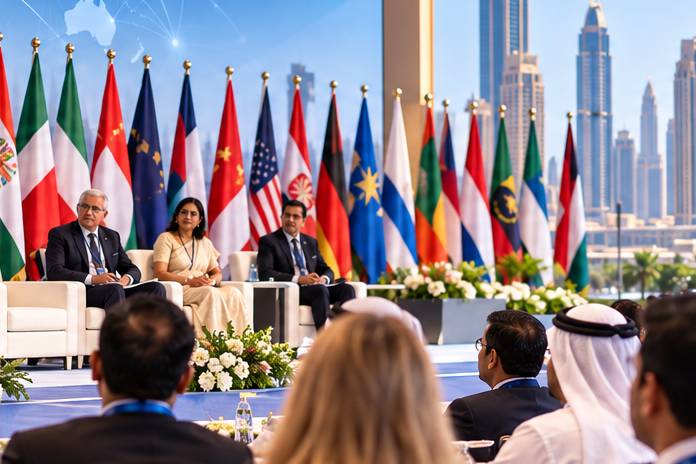
India highlighted the growing international significance of AYUSH systems at the 3rd International Ayush Conference & Exhibition (IACE 2026) held in Dubai. Prataprao Jadhav, Union Minister of State (Independent Charge), Ministry of Ayush, emphasised the importance of international cooperation in traditional medicine, evidence-based research, regulatory standards and integrated healthcare.
The three-day conference brought together participants from 28 countries, including policymakers, researchers, healthcare professionals, industry representatives and international delegates. Discussions focused on the role of traditional and integrative healthcare systems in preventive health, research and public health.
India Highlights the Global Significance of AYUSH
Addressing the International Ayush Conference & Exhibition 2026, Union Minister Prataprao Jadhav stated that AYUSH is increasingly becoming part of the global healthcare discussion rather than remaining on its periphery.
AYUSH stands for Ayurveda, Yoga and Naturopathy, Unani, Siddha and Homoeopathy. These systems have distinct foundations, practices and approaches but are brought together under India’s national AYUSH framework.
The conference aimed to strengthen international cooperation and encourage discussions on the contribution of traditional medicine to preventive healthcare, scientific research and public health.
Participants from 28 Countries Join International Discussions
The three-day conference in Dubai attracted participants from approximately 28 countries for consultations, scientific discussions and partnership-building activities.
The discussions covered several areas relevant to the international development of AYUSH:
- Collaborative research programmes.
- Academic exchanges between institutions.
- Regulatory cooperation and harmonisation.
- Investment and international partnerships.
- International certification and quality assurance.
- Medical value travel and AYUSH services.
These discussions highlighted the importance of international cooperation in developing research frameworks and quality standards for traditional medicine.
However, participation in a conference does not mean that the participating countries have adopted common regulations or entered into formal agreements. Any resulting partnerships or policy commitments would need separate official confirmation.
Draft International White Paper on AYUSH and Mind-Body Health Discussed
One of the developments highlighted by the Ministry of Ayush was the discussion on a draft international White Paper on AYUSH interventions for mind-body health.
A White Paper generally presents information, analysis or recommendations on a particular subject. The proposed document is intended to contribute to international discussions on the role of AYUSH interventions in mind-body health.
The draft seeks to encourage a shift:
- From practice-based experience towards evidence-based verification.
- From isolated practices towards structured treatment protocols.
- From separate healthcare approaches towards more integrated healthcare frameworks.
Once finalised, the document may serve as a reference for governments, academic institutions and international organisations working in integrative medicine and public health policy.
The Ministry described the document as a draft under discussion. It should therefore not be considered an adopted international guideline or a completed policy framework.
Research and Evidence Remain Important for Global Acceptance
Strengthening scientific research and evidence generation in traditional medicine was a major theme of the conference.
During his address, Jadhav emphasised the importance of quality assurance, pharmacopeial compliance and international certification for the wider acceptance of AYUSH products and services.
Pharmacopeial standards are official quality specifications used to assess the identity, purity and quality of substances and products. Compliance with relevant standards is important for manufacturing consistency and regulatory confidence.
Stronger research and quality-control mechanisms can help Ayurveda institutions and manufacturers demonstrate that their products and services meet applicable requirements.
For international acceptance, transparent evidence concerning safety and effectiveness remains essential. Clinical effectiveness should not be assumed solely on the basis of traditional use, cultural relevance or market popularity.
International Collaboration and Traditional Medicine Diplomacy
The Minister also referred to the WHO Global Summit on Traditional Medicine held in New Delhi and the Delhi Declaration, which highlighted international cooperation in evidence generation, safety standards and the responsible integration of traditional medicine.
The Dubai conference continued these broader international discussions.
Areas of potential cooperation included:
- Research partnerships.
- Academic and institutional exchanges.
- Regulatory collaboration.
- Investment opportunities.
- Medical value travel and AYUSH services.
Medical value travel refers to people travelling to another country to receive healthcare services. International promotion of AYUSH services may create opportunities for Indian institutions and healthcare providers, provided that the services meet applicable safety, quality and regulatory requirements.
Significance for Ayurveda and the AYUSH Sector
The conference is significant because it brought traditional medicine into wider international discussions on healthcare, research and public health cooperation.
International academic exchanges and collaborative research may provide opportunities for Ayurveda institutions and researchers to share knowledge and strengthen scientific engagement.
Discussions on quality assurance, pharmacopeial compliance and certification also underline the importance of meeting appropriate standards when manufacturers seek access to international markets.
Regulatory cooperation and evidence-based frameworks remain important considerations for policymakers exploring the responsible integration of traditional medicine into healthcare systems.
These are potential areas of development arising from the discussions. The conference announcement alone does not establish that specific research agreements, regulatory changes or commercial partnerships have already been implemented.
What Healthcare Professionals and Institutions Should Know
The conference announcement does not specify a new application process, registration deadline or regulatory requirement for practitioners, institutions or manufacturers.
Those interested in the developments can:
- Follow the Ministry of Ayush for official announcements on international cooperation.
- Check participating academic and research institutions for confirmed collaboration announcements.
- Ensure that AYUSH products comply with the relevant pharmacopeial and regulatory standards.
- Distinguish draft recommendations from formally adopted international guidelines.
- Evaluate health-related claims using appropriate scientific evidence.
Conclusion
The 3rd International Ayush Conference & Exhibition 2026 in Dubai highlighted India’s efforts to strengthen the global presence of AYUSH through research, quality standards and international cooperation.
With participants from 28 countries, the three-day event provided a platform for discussions on traditional medicine, integrated healthcare and a draft White Paper on mind-body health.
Translating these discussions into meaningful outcomes will require continued evidence generation, responsible regulation and sustained international partnerships.
Editorial note: The article describes the conference discussions and proposals as reported in the supplied material. The draft White Paper should not be presented as an adopted international guideline, and potential collaborations should not be described as completed agreements without official confirmation.



