


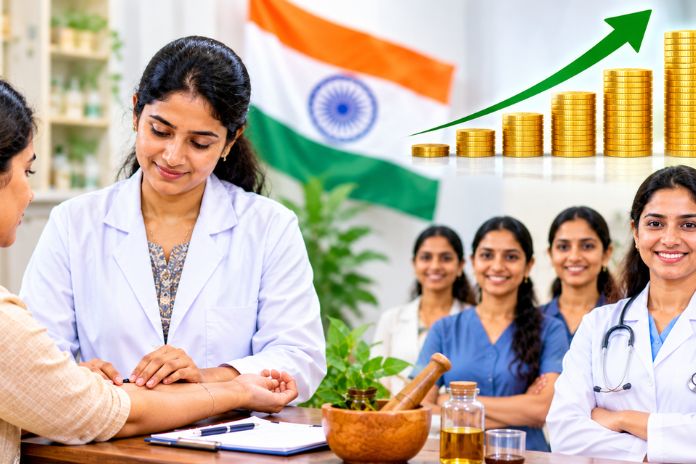
According to the estimates of a FITM-RIS study, the AYUSH services economy supported 1.76 million livelihoods in FY 2024–25, with women accounting for the majority of workers in several organised service segments.
New Delhi: According to a study by the Forum on Indian Traditional Medicine (FITM) at the Research and Information System for Developing Countries (RIS), the AYUSH services sector in India was estimated to be valued at $36.92 billion in fiscal year 2024–25. In addition to its economic contribution, the sector contributes an estimated 1.76 million jobs, representing 43% of the total workforce.
Ministry of Ayush, Government of India released an infographic on contribution of women to AYUSH services sector. It notes that women make up more than half of the workers in a range of industries, including spas, schools, day-care centers and hospitals.
The findings add an important employment dimension to the AYUSH Services Sector Study, which assesses the economic value, workforce, service establishments and international growth potential of the sector.
The report was formally released at the 11th Ayurveda Day celebrations in Nagpur on 23rd September, 2026.
Ayush services economy sees strong growth
The AYUSH services sector is expected to touch US$36.92 billion in FY 2024-25, growing at a CAGR of 16.91% from FY 2022-23 to FY 2024-25, according to the FITM-RIS study.
The assessment is based on a nationally scaled survey of 15,914 establishments covering all the six AYUSH systems – Ayurveda, Yoga and Naturopathy, Unani, Siddha, Sowa-Rigpa and Homoeopathy.
The paper presents an economic assessment of a diversified services ecosystem which includes clinics, hospitals, day-care centers, educational institutions and wellness establishments.
The findings aim to strengthen the evidence base for policy planning, investment, infrastructure development and future growth of AYUSH services in India.
Women Constitute 43% of the AYUSH Workforce
The Ministry of Ayush infographic shows the contribution of women to the sector, highlighting that 43% of the total AYUSH services workforce is women.
Several organised service segments have more than 50% of women’s participation, which reflects their strong presence in healthcare delivery, education and wellness-related activities.
The infographic depicts women’s shares of the workforce in selected segments as follows:
| AYUSH services segment | Women’s share of workforce |
|---|---|
| Spas delivering AYUSH-based services | 61.2% |
| Educational institutions | 58.2% |
| Day-care centers | 57.0% |
| Hospitals | 53.1% |
| Overall AYUSH services workforce | 43% |
These figures demonstrate the significance of women’s participation in the sector’s services delivery and institutional functioning.
The results also suggest that the women’s contribution is not limited to the clinical practice, but it is extended to the educational and wellness settings. Workforce development and professional capacity building are therefore relevant considerations for the sector’s future growth, as they exist across these environments.
The infographic and study findings offer a useful baseline for understanding gender representation in AYUSH services. But the proportion of the workforce alone does not determine whether women and men have equal access to leadership positions, pay, job security or career advancement. A further exploration of these aspects would contribute to building a more holistic picture of gender equity in the sector.
Ayurveda remains the largest single system
Of the estimated total revenue of the AYUSH services sector, Ayurveda accounted for almost 48%, or about US$17.73 billion.
Its share is also representative of the easy access to Ayurveda-related clinical services and wellness offerings in the traditional healthcare ecosystem in India.
The system-wise assessment, undertaken in the report, gives a basis to understand the relative economic contribution of different AYUSH systems and where further infrastructure, research and professional development may be needed.
Revenue driven by clinics and day-care centers
Clinics and day-care centers accounted for more than 71% of the sector’s estimated total revenue.
The findings emphasise the significance of clinical establishments in the AYUSH services economy. They also emphasise the need to improve the quality of services, infrastructure, professional training and regulatory compliance at establishments of all sizes.
Local and standalone clinics were important employment providers with more than one million livelihoods concentrated in them, the study noted.
Wellness Services Show Strong Growth
The AYUSH based wellness segment, which comprises of yoga centers, spas and resorts providing AYUSH related services, recorded a CAGR of 21.29% during the study period.
The report also said that yoga centers had registered about 75 per cent growth in revenue in two years.
The Ministry’s infographic brings a workforce dimension to this expansion, revealing that women represent 61.2% of the workforce at spas covered by the reported segment classification.
The figures illustrate the intersection of wellness services, employment and women’s participation. However, it is important to separate the evidence of clinical effectiveness of individual wellness practices from the evidence of their impact on economic growth and workforce representation.
AYUSH Services Earn US$1.77 Billion from Medical Value Travel
The study estimated the revenue from medical value travel (MVT) generated by AYUSH services at US$1.77 billion in FY 2024-25.
Medical value travel means travelling to obtain healthcare or associated services. In the AYUSH context, this could mean international visitors looking for traditional healthcare services or structured wellness programs in India.
International patients are estimated to account for around 5% of patient volumes but generate roughly 15–25% of hospital-segment revenues, according to the report.
It adds that the average patient stay for AYUSH therapeutic programs such as Panchakarma and residential Yoga is between five and 11 days.
The results open possibilities for international outreach, as long as service providers maintain proper professional standards, open communication and adherence to relevant regulations.
The study also highlights digital visibility and quality accreditation as factors that help attract international patients. Conversely, facilities with a dedicated functional website were 3.6 times more likely to attract international patients, and the presence of recognised accreditation such as NABH or ISO was associated with the odds being doubled.
These are reported associations and should not be interpreted to mean that websites or accreditation alone cause an increase in international patients.



