


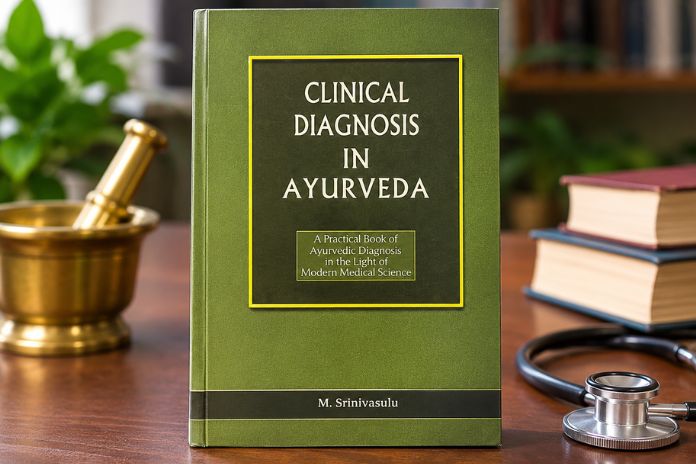
Clinical Diagnosis in Ayurveda Dr M. Srinivasulu’s Practical Approach to Integrating Classical Ayurvedic Examination with Modern Medical Science
Combining traditional Ayurvedic diagnostic principles with modern clinical assessment, this comprehensive textbook is an important resource for students, practitioners and academicians of Ayurveda who wish to strengthen their understanding of clinical diagnosis.
Introduction: Improving the Art and Science of Ayurvedic Diagnosis
Correct diagnosis is the foundation of effective health care. Before prescribing a treatment, a physician should first understand the condition of the patient, the underlying factors that contribute to the illness, and the nature and progression of disease.
Diagnosis in Ayurveda is not based on symptoms. This needs a knowledge of Dosha, Dhatu, Mala, Agni, Srotas and the individual constitution of the patient. The traditional methods of examination provide a systematic basis for assessing the patient’s physical and functional state.
In today’s clinical practice, the amalgamation of these conventional methods with appropriate modern medical investigations can help the healthcare professionals to develop a more holistic understanding of clinical conditions.
This important aspect of Ayurvedic education and clinical practice is covered in the book Clinical Diagnosis in Ayurveda: A Practical Book of Ayurvedic Diagnosis in the Light of Modern Medical Science by Prof. Dr M. Srinivasulu, published by Chaukhamba Sanskrit Pratishthan.
The classical methods of patient examination in Ayurveda are discussed along with the relevant modern clinical parameters and laboratory investigations. It is particularly relevant for students and practitioners who want to improve their diagnostic skills, as it puts emphasis on systematic examination and clinical reasoning.
Understanding the Book and Its Main Purpose
The main aim of the book is to provide a practical approach to Ayurvedic clinical diagnosis with an interface with modern medical science.
To diagnose according to Ayurveda, one must have an in-depth knowledge of the relationship between Dosha and Dushya, the state of Agni, the presence of Ama and the functional status of the body’s Srotas .
The author emphasises the need to use these basic concepts in the examination of a patient and not only the symptoms described.
The book is divided into three main sections with 23 chapters. They include general examination with systemic examination, assessment of Tridosha and evaluation of Manas combined.
A particularly useful feature is the attempt to link classical examination procedures with current clinical assessment and laboratory investigation.
Major Themes and Clinical Contributions Explored
1. General Examination and Classical Ayurvedic Methods of patient’s Assessment
The first part has seven chapters and deals with general examination and clinical case taking.
It discusses three main classical approaches:-
- Panchendriya Pariksha: Examination by five sensory organs.
- Ashtavidha Pariksha: It is the eight fold method of examination of patient.
- Dashavidha Pariksha: The ten-fold examination system mentioned in the Ayurvedic literature.
These methods provide a structured way to gather information on the patient’s condition.
For example Ashtavidha Pariksha consists of Nadi (pulse), Mutra (urine), Mala (stool), Jihva (tongue), Shabda (voice), Sparsha (touch), Drik (eyes) and Akriti (general appearance).
The discussion emphasises the importance of observing different clinical characteristics and understanding them in the wider Ayurvedic diagnostic framework.
2. Systemic Examination by Trayodasha Srotas Pariksha
The second section of 14 chapters deals with systemic examination on concept of Trayodasha Srotas Pariksha described by Acharya Charaka.
Srotas are the channels through which different substances and functional process are thought to be operated in the body. The study of these systems is important in Ayurveda as disturbances in Srotas are believed to be associated with the development and progression of disease. In this context the book discusses systematic clinical assessment and helps the readers to understand how different bodily systems can be examined in relation to Ayurvedic principles.
This section is especially useful to the student and practitioner who wishes to relate classical descriptions to practical clinical observations. The book also emphasises the importance of laboratory investigations in various clinical conditions and provides an opportunity to understand the role of modern diagnostic information to complement Ayurvedic assessment.
3. Study of Tridosha and Manas
The third section deals with two important aspects of Ayurvedic clinical examination Tridosha and Manas.The study of Vata, Pitta and Kapha lies at the core of the understanding of the nature of physiological imbalance in Ayurveda. The clinical features of Tridosha and their importance in the assessment of patient have been discussed.
The section on Manas is particularly noteworthy for going beyond the physical examination.
It considers eight aspects of mental functioning as described in the classical framework of Charaka:-
- Manas – Mind
- Buddhi – Intellect
- Samjna-Jnana – Identification and knowledge
- Smriti – Remembrance
- Shila – Nature or character
- Bhakti – Attachment or tendency
- Cheshta – Labour and behaviour
- Achara – Patterns of conduct and behaviour
This approach reflects Ayurveda’s holistic view of the individual, where the mental and physical dimensions are seen as interrelated aspects of health.
Prof. Dr. M. Srinivasulu and His Contribution to Clinical Education in Ayurveda
Prof. Dr M. Srinivasulu is a seasoned Ayurvedic practitioner, academician, researcher and clinical teacher. He has spent his professional career closely associated with Ayurvedic teaching and clinical practice.
He is a rank holder from Osmania University, having pursued his undergraduate and post graduate studies in Ayurveda. Later he did his doctoral research work on hyperlipidaemia in National Institute of Ayurveda, Jaipur.
His professional experience includes work in tribal, rural, suburban and urban health care settings. He had worked in the Government of Andhra Pradesh for nearly three decades and had held various positions like Medical Officer, Inspecting Medical Officer, Lecturer, Assistant Professor and Professor.
He is retired as Professor and Head of the Department of Panchakarma, Government Ayurvedic College, Hyderabad.Apart from his teaching and clinical responsibilities, his academic interests include concept of Ama and related disorders, physiological Ayurveda concepts, Rasa-Rakta Dhatu assessment and Prakriti related research.
His experience in clinical practice, research and postgraduate education is an important basis for the practical orientation of Clinical Diagnosis in Ayurveda.
Contemporary Relevance and Importance in Ayurvedic Practice
The book meets an important need in Ayurvedic education: the development of the capacity to translate theoretical knowledge into systematic clinical assessment.
For BAMS students: The book provides a systematic introduction to classical examination methods and their application in clinical practice. It can make the students aware of the practical relevance of Panchendriya, Ashtavidha and Dashavidha Pariksha.
For Post Graduate Students: It provides scope for further investigation of the Srotas, Tridosha and Manas examination and their clinical interpretation in the light of Ayurvedic diagnostic principles.
For the practicing Ayurvedic physician: The systematic approach to examination of patients and case-taking may serve as a useful reference to reinforce clinical reasoning and structure the assessment of patients.
Teaching material for Ayurveda academicians: The book can be used to teach clinical examination and demonstrate the relevance of classical Ayurvedic principles within the framework of modern medical assessment.
For researchers: Its discussion on laboratory investigations along with Ayurvedic clinical parameters offers a scope to explore interdisciplinary approaches to diagnosis and clinical research.
Critical Appraisal:
Bridging the Gap between Classical Knowledge and Clinical Application
Practical orientation is one of the chief strengths of Clinical Diagnosis in Ayurveda.
The book does not confine itself to the theoretical explanation of the concepts of Ayurvedic diagnosis but strives to show how these can be utilised in the actual examination of the patient.
This book is divided into three sections which logically progress from a general examination to a systemic examination and then to the examination of Tridosha and Manas.
The detailed discussion on Trayodasha Srotas Pariksha is particularly relevant for students and clinicians interested in learning systemic examination in terms of classical Ayurvedic concepts.
Another important addition is the inclusion of modern clinical parameters and laboratory investigations. This makes the readers think about the complementary role of the contemporary diagnostic tools, without losing the conceptual basis of the Ayurvedic assessment .
The author’s clinical and teaching experience also provides a context for the practical nature of the work.
But the book ought to be seen as a teaching aid and not a substitute for current clinical guidelines, validated diagnostic protocols or professional medical judgement. Ayurvedic examination methods and modern diagnostic investigations are based on different ideas and their integration requires proper interpretation.
Diagnostic findings should be interpreted according to relevant evidence-based standards in current clinical practice and urgent or potentially life-threatening conditions should be promptly evaluated through appropriate medical services.
Overall the strength of the book is in its attempt to make classical Ayurvedic diagnostic knowledge more systematic, clinically relevant and accessible to learners and practitioners.
Conclusion: Fortify the base of clinical diagnosis in Ayurveda
The book Clinical Diagnosis in Ayurveda by Prof. Dr M. Srinivasulu is an important academic and practical resource for those who want to apply Ayurvedic diagnostic principles in clinical practice.
The book integrates Panchendriya Pariksha, Ashtavidha Pariksha, Dashavidha Pariksha, Trayodasha Srotas Pariksha and the evaluation of Tridosha and Manas to provide a complete framework to understand patient assessment in Ayurveda.
Its discussion on modern clinical parameters and laboratory investigations further adds to its relevance in modern Ayurvedic education.
The book offers useful material for undergraduate and post-graduate Ayurveda students, practising physicians, teachers and clinical researchers to develop a more structured understanding of diagnosis.
Ultimately, the work underscores an important aspect of Ayurvedic practice, namely that sound clinical understanding starts with careful observation, systematic examination and the ability to interpret findings within an appropriate medical framework.
More Information & Book Details
| Details | Particulars |
|---|---|
| Book Title: | Clinical Diagnosis in Ayurveda: A Practical Book of Ayurvedic Diagnosis in the Light of Modern Medical Science |
| Author | Prof. Dr M. Srinivasulu |
| Publisher | Chaukhamba Sanskrit Pratishthan |
| Language | English |
| First published in | 2011 |
| Edition | 2018 Edition |
| ISBN – Hardback | 978-81-7084-472-3 |
| ISBN – Paperback | 9788170844730 |
| Pages | 612 pages (2018 edition) |
| Illustrations | 58 colour illusts. |
| Subject | Ayurvedic Clinical Diagnosis, Patient Examination, Modern Medical Science |
References to Books and Authors
- Clinical Diagnosis in Ayurveda. Om Publications.
- Clinical Diagnosis in Ayurveda – Motilal Banarsidass.
- Chaukhamba Sanskrit Pratishthan – List of Books
- Information about author and bibliography – Readers End.
- Amazon India – Clinical Diagnosis in Ayurveda (Main book
ASOURCE LINK: https://amzn.in/d/03yULfBZ