


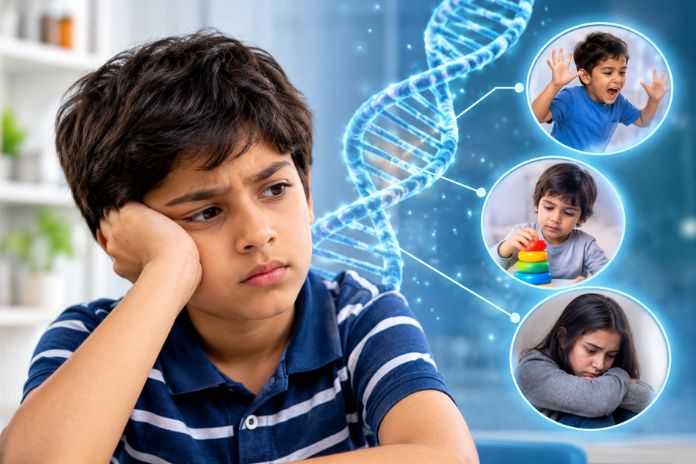
Why do some kids have trouble making friends or learning, and why do emotional and social problems seem to get worse for some kids during the teen years or as adults? Genetics may be part of the story, but it does not necessarily have the same impact at every point in life.
A study in the journal Molecular Psychiatry in 2026 examined how genes that predispose people to attention-deficit/hyperactivity disorder (ADHD), autism spectrum disorder (ASD) and depression influence social and functional outcomes from childhood to young adulthood. These associations may differ depending on the age of the individual and the outcome studied, the findings suggest.
The research sheds light on the relationship between genetics and development. It also shows why mental health and developmental needs should be understood when considering a person’s changing life circumstances.
What was the focus of the researchers’ study?
The study, Investigating the associations between neurodevelopmental and psychiatric genetic liability and adverse social and functional outcomes across childhood, adolescence and young-adulthood, looked at whether genetic predispositions to certain mental and neurodevelopmental conditions were linked to difficulties in everyday life.
The researchers looked at six conditions:
- Attention deficit/hyperactivity disorder (ADHD)
- Autism spectrum disorder (ASD)
- Despondency
- Anxiety
- Schizophrenic
- Manic depressive illness
They looked at associations with four areas of functioning: peer relationships, suicidal thoughts or behaviours, educational attainment and employment.
The study used data from the Avon Longitudinal Study of Parents and Children (ALSPAC), a population-based study that follows participants from childhood. The analysis involved 8,591 unrelated participants who had usable genetic data.
The researchers looked at outcomes at three developmental stages, including childhood (10-13 years), adolescence (16 years) and young adulthood (24-25 years).
How did researchers measure genetic predisposition?
The study employed a method called a polygenic score (PGS).
Each of these genetic differences may contribute a little to specific traits / conditions . A persons genetic characteristics are made up of many genetic differences . A polygenic score is a way of combining information across many common genetic differences to predict a person’s inherited statistical risk for a specific condition.
Importantly, having a higher polygenic score does not mean a person has a condition or will develop one. It is not a diagnosis and it does not explain all of the genetic or environmental effects on health.
The researchers then used the scores to investigate how genetic predispositions relate to different social and functional outcomes at different ages.
What did the research find?
Researchers saw different patterns for autism, ADHD and depression.
Genetic scores for ADHD were associated across development
ADHD polygenic scores were associated with a number of outcomes across childhood, adolescence and young adulthood.
For each standard-deviation increase in the ADHD genetic score, there was an association with:
- 13% higher chances of peer problems as a child.
- 21% more likely to experience peer problems during adolescence.
- 14% greater risk of peer problems in young adulthood.
The study also found associations with lower educational achievement in childhood and adolescence and with not being in education, employment or training (NEET) in young adulthood.
In this analysis, however, the association between ADHD genetic scores and suicidality was observed in childhood and was not robustly evident in adolescence or young adulthood.
Autism-related genetic scores showed a different pattern
In childhood, higher autism-related genetic scores were linked to a greater likelihood of peer problems and suicidality.
The researchers also found, in their analysis, a link to higher educational attainment after controlling for the other genetic scores. Caution is advisable in interpreting this result: it was not clearly evident when considering the autism score alone.
So that’s why genetic findings can be complicated. Statistical association can also change when researchers consider shared genetic influences between conditions.
Genetic scores related to depression gained prominence later
For depression-related genetic scores, the pattern was different from that for ADHD.
Peer problems were linked to the depression score in childhood. In adolescence, it was linked to increased odds of suicidality and lower educational attainment.
The researchers found associations with peer problems, suicidality and being NEET (not in education, employment or training) in young adulthood.
For instance, a standard-deviation increase in the depression genetic score was associated with 42% higher odds of suicidality in young adulthood.
These are not predictions about what will happen to an individual, but statistical associations. They do not show that genetic predisposition directly leads to these outcomes.
What does this mean for everyday people?
The findings support one important message: developmental and mental health needs can change over the course of a lifetime.
A child may have problems paying attention, learning or making friends. Adolescent years may highlight academic pressures, changing relationships and emotional challenges. In adulthood, education, employment and social participation may become more important for wellbeing.
The authors suggest that genetic predispositions associated with different conditions may be differentially associated with such experiences in different age groups.
But genes are only part of a much larger puzzle. Family circumstances, education, social support, physical health, life experiences and access to adequate health care can impact a person’s development and wellbeing.
The findings should not be used to identify children or adults who are likely to have particular difficulties, on the basis of their genetic profile.
Understanding the research in a wider health context
ADHD, autism and depression are distinct conditions, though there may be some overlap in features and challenges.
ADHD is characterised by persistent patterns of inattention and/or hyperactivity and impulsivity. Autism is a neurodevelopmental condition characterised by differences in social communication and interaction and restricted or repetitive patterns of behaviour or interests. Depression is a mental health condition that can affect your mood, thinking, energy levels and how you function in everyday life.
To understand the relationship between these conditions and social outcomes, both shared and distinct influences must be considered.
The study examined statistical relationships using genetic scores. It did not test an Ayurvedic therapy or appraise an Ayurvedic diagnostic framework or prove the efficacy of any traditional medicine or treatment.
It is relevant to evidence-informed healthcare in encouraging a wider understanding of development, mental health and individual differences, not in proving an Ayurvedic explanation of these findings.
What is the takeaway for readers?
While the study is longitudinal and has a large number of participants, there are some important limitations.
First, the investigators looked at associations at different developmental stages, rather than directly modelling how genetic associations changed within an individual over time.
Second, the measures used to assess the outcome were not the same at each age. This makes childhood, adolescence and adulthood harder to compare directly. Suicidality was also measured differently across stages, and the adolescent measure may have included some self-harm without suicidal intent.
Third, polygenic scores capture the cumulative effect of many common genetic variants and therefore do not represent the full range of genetic influences, including the contribution of rare genetic variants.
The study also found little strong evidence of associations between the genetic scores for anxiety, schizophrenia and bipolar disorder and the outcomes examined. That doesn’t mean these conditions aren’t influenced genetically or don’t affect day-to-day functioning.
Finally, the research was observational. It cannot prove that genetic predisposition leads directly to problems with friendships, education, employment or mental health.
Lessons learned
- Genetic predispositions can be related to different social and functional outcomes at different life stages.
- Genetic scores for ADHD were associated with peer and educational or employment outcomes across the three developmental stages that we examined.
- Genetic scores for depression showed more prominent associations with some outcomes from adolescence onwards.
- Polygenic scores are a research tool, not diagnostic tests or predictions for individuals.
- Children and adults should be assessed on the basis of their actual needs, experiences and clinical presentation.
- The continued importance of supportive environments, appropriate assessment and access to professional care.
Conclusion: Looking at development from a lifetime perspective
The 2026 Molecular Psychiatry study illustrates how genetic associations with social and functional outcomes can differ in childhood and adolescence compared to young adulthood. ADHD, autism, and depression revealed different patterns, demonstrating the complexity of human development.
The findings do not imply that genes determine a person’s future. Rather, they add to the evidence that mental health and everyday functioning are shaped by multiple interacting factors.
A better understanding of these relationships may help researchers and healthcare professionals to explore developmental needs across the lifespan and to support people with greater sensitivity to individual circumstances.
Medical disclaimer: This article is solely for educational purposes and does not constitute medical advice, diagnosis or treatment. A genetic score does not diagnose ADHD, autism or depression. If you or someone you know is in crisis or need support, please contact a mental health professional or dial 911.
SOURCE LINK: https://www.news-medical.net/news/20261005/Genetic-links-to-ADHD-autism-and-depression-changed-with-age.aspx



