


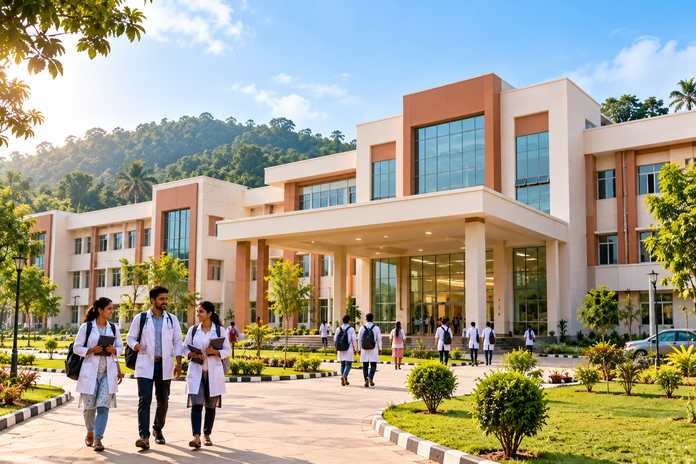
Tripura Chief Minister Manik Saha announced on October 6, 2026, that the National Commission for Indian System of Medicine (NCISM) had approved a new government Ayurvedic medical college and hospital at Tepania in Gomati district.
The proposed institution, Tripura Government Ayurvedic Medical College and Hospital, will have an annual intake capacity of 60 students for its undergraduate Ayurveda programme. The development is expected to strengthen Ayurveda education and healthcare infrastructure in Tripura and expand opportunities for students interested in the discipline.
Tepania to Get New Government Ayurveda College
The proposed college and hospital will be located at Tepania in Gomati district, Tripura.
According to the announcement, the institution will offer undergraduate education in Ayurveda with 60 seats annually. It is intended to combine medical education with Ayurvedic healthcare services for the people of the state.
The approval marks an important regulatory step towards establishing a new government institution dedicated to Ayurveda education and clinical care in Tripura.
However, the announcement does not specify when the college and hospital are expected to become fully operational.
NCISM Grants Regulatory Approval
The National Commission for Indian System of Medicine is the statutory regulatory body responsible for regulating education and professional practice in Indian systems of medicine, including Ayurveda.
Regulatory permission is a key requirement for institutions seeking to offer recognised medical education in these systems. NCISM maintains information on Ayurveda colleges permitted to operate for different academic years, subject to applicable regulatory requirements.
The approval for the proposed Tripura institution represents a formal regulatory development. However, further details about its infrastructure, academic arrangements and operational readiness will be necessary before admissions can begin.
60 Seats Planned for Undergraduate Ayurveda Education
The proposed college will accommodate 60 undergraduate students annually.
The institution could expand access to Ayurveda education in Northeast India by providing students from Tripura and neighbouring states with another option for pursuing undergraduate studies in the discipline.
As a government institution, it may also help strengthen the connection between Ayurveda education and public healthcare delivery. The scale of its eventual contribution will depend on infrastructure development, faculty recruitment, clinical facilities and compliance with applicable regulatory standards.
Hospital Planned Alongside the College
A hospital will form part of the proposed institution. According to the government announcement, the facility is intended to improve access to Ayurvedic healthcare services in Tripura.
Once operational, the hospital could provide clinical services under Ayurveda while also serving as a teaching facility for students.
Details about the hospital’s departments, outpatient services, inpatient capacity, staffing and opening date have not been specified in the announcement. The regulatory approval should therefore not be interpreted as confirmation that hospital services are already available.
Why Ayurveda Education Matters in Tripura
The proposed government Ayurvedic medical college could strengthen the state’s educational infrastructure and create additional opportunities for students pursuing careers in Ayurveda.
An attached teaching hospital could support supervised clinical training and contribute to the delivery of Ayurvedic healthcare services.
The development also reflects broader efforts to expand institutional capacity for Indian systems of medicine beyond established centres in other parts of the country.
The institution’s long-term impact will depend on its ability to develop the required academic and clinical infrastructure, recruit qualified faculty, establish appropriate institutional arrangements and meet NCISM requirements.
What Students Need to Know
Students interested in pursuing undergraduate Ayurveda education at the proposed institution should note that regulatory approval does not automatically mean admissions are open.
Prospective applicants should wait for official notifications confirming:
- The commencement of the academic programme.
- The number of seats available for the relevant academic year.
- Eligibility criteria and applicable NEET requirements.
- The counselling process and responsible admission authority.
- Institutional affiliation and other required academic arrangements.
- Tuition fees and other applicable charges.
- The official admission notification and counselling portal.
Students should rely on official communications from the institution and the relevant counselling authorities for confirmed admission details.
Potential Benefits for Patients
The proposed hospital could eventually improve access to government-supported Ayurvedic healthcare in Tripura.
However, patients will need to wait for official information about the hospital’s opening date, clinical departments, outpatient registration, inpatient facilities and available services.
The approval represents a step towards establishing a new healthcare and education facility; it does not establish that all planned services are immediately available.
Wider Implications for Northeast India
The proposed institution could contribute to the development of Ayurveda education and healthcare infrastructure across Northeast India.
Once operational, a government medical college may create opportunities for teaching faculty, healthcare professionals, administrative personnel and other staff. Its associated hospital could also support clinical education and patient care.
The institution’s long-term contribution will depend on the successful development of its academic, clinical and research infrastructure, as well as compliance with applicable NCISM standards.
Conclusion
The approval of a 60-seat government Ayurvedic medical college and hospital at Tepania in Gomati district marks a significant development for Ayurveda education in Tripura.
Announced by Chief Minister Manik Saha on October 6, 2026, the development is expected to expand undergraduate education opportunities and support the future delivery of Ayurvedic healthcare services in the state.
Further official announcements will be needed to clarify the institution’s development timeline, infrastructure, faculty recruitment, academic arrangements, admission process and commencement of hospital services.