


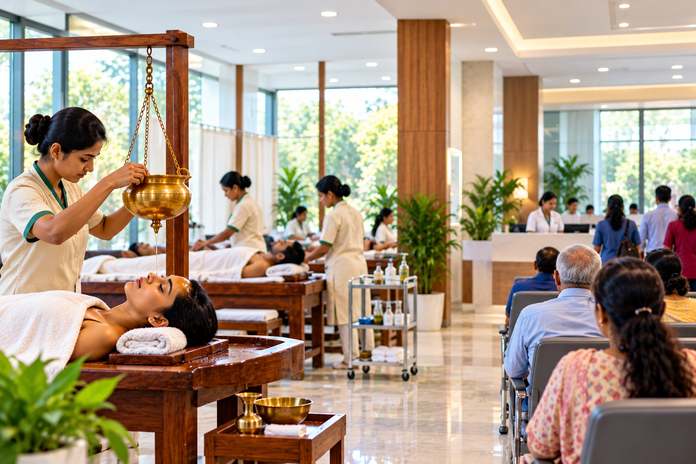
The National Institute of Ayurveda (NIA) in Jaipur is reportedly experiencing high demand for Panchakarma treatment, with patients facing potential waiting periods for inpatient admission. The situation highlights the growing demand for specialised Ayurvedic inpatient care at one of India’s prominent government Ayurveda institutions.
Demand for Panchakarma Care Rises
Panchakarma comprises a set of specialised Ayurvedic procedures performed under professional supervision. NIA Jaipur provides Panchakarma services to both outpatients and inpatients.
Earlier reports have highlighted strong demand for these services, with patients travelling from different parts of India to seek treatment. Those requiring inpatient care may face waiting periods because of high demand and limited bed availability.
As Panchakarma treatment may require several days or weeks of supervised care, depending on the individual treatment plan, inpatient capacity can affect how many patients the department can accommodate.
Panchakarma Services at NIA Jaipur
The National Institute of Ayurveda is an autonomous institution under the Ministry of Ayush, Government of India. It is located at Jorawar Singh Gate, Amer Road, Jaipur, Rajasthan.
The institute’s hospital provides outpatient and inpatient services across several clinical departments, including Panchakarma. Its facilities include general inpatient beds, private wards, laboratories, operation theatres, emergency care and diagnostic services.
According to information published by the institute, its main hospital has 280 general beds, alongside private-ward facilities. The institute also reports substantial patient attendance across its outpatient and inpatient departments.
The department-wise infrastructure information on the institute’s website lists 60 beds for the Panchakarma department. This figure differs from historical reports about the department’s capacity and should be distinguished from the hospital’s overall bed count.
Earlier Reports Highlight Long Waiting Periods
Earlier media coverage has documented high demand for Panchakarma treatment at NIA Jaipur.
A September 2023 report stated that the Panchakarma centre then had 48 beds and that occupancy could exceed its nominal capacity. The report also noted that patients from different parts of the country had travelled to the institute, with some reportedly waiting weeks for admission.
The report highlighted how treatment lasting several days or weeks can limit patient turnover when the number of beds is fixed.
These historical figures should not be interpreted as the institute’s current capacity. The department-wise information currently published by NIA lists 60 beds for Panchakarma.
Free Treatment and Patient Access
NIA provides a range of healthcare services at subsidised rates or free of cost, subject to the applicable rules and eligibility criteria.
According to the institute’s published patient-care information, general patients are required to pay a nominal registration fee. Certain categories, including senior citizens, freedom fighters, Below Poverty Line (BPL) cardholders, NIA staff and students, are exempt from registration charges.
The institute also states that laboratory investigations and Panchakarma procedures provided to admitted patients are free of cost.
Patients seeking inpatient treatment must first undergo consultation with the appropriate consultant. Following clinical assessment, they can proceed to the inpatient registration or reception counter and complete the admission formalities as advised.
Bed availability remains an important factor in determining when eligible patients can begin inpatient treatment.
Patients Travel to NIA from Across India
Demand for Panchakarma at NIA is not limited to residents of Jaipur. Earlier reports have documented patients travelling from other parts of Rajasthan and states such as Telangana and Madhya Pradesh to seek treatment.
As a government Ayurveda institution combining clinical services, education and research, NIA is an important destination for patients seeking specialised Ayurvedic care.
The reported demand also highlights the importance of adequate infrastructure, clinical staffing and inpatient capacity to support patient access.
NIA Expands Its Patient-Care Infrastructure
The institute has been developing its facilities to accommodate patient demand and expand its healthcare services.
In August 2025, the Ministry of Ayush announced plans to develop NIA Jaipur as a Global Centre of Excellence for Ayurveda. The ministry also stated that the institute was catering to more than 400,000 outpatients and over 25,000 inpatients annually.
Government information has also highlighted plans to expand the institute’s hospital services. A Lok Sabha document describes the hospital as NABH-accredited, with speciality clinics, a Panchakarma unit, a central laboratory and operation theatres. It also refers to the construction of a multi-storey building to support further expansion.
In January 2026, the Chief Secretary of Rajasthan visited NIA Jaipur to review its outpatient, inpatient and Panchakarma services. During the visit, the institute’s leadership sought support for additional land in Jaipur to expand healthcare services.
What Patients Should Know Before Visiting NIA
Patients planning to undergo Panchakarma treatment at NIA should take the following steps:
- Complete the required registration and consultation process.
- Obtain a clinical assessment from the appropriate NIA consultant.
- Follow the admission procedure prescribed by the institute.
- Confirm current bed availability before making travel arrangements.
- Check the latest outpatient department and Panchakarma schedules through official NIA channels.
- Carry relevant medical records, previous prescriptions and investigation reports.
- Confirm applicable charges and eligibility for free or subsidised services.
The availability of Panchakarma treatment does not guarantee immediate inpatient admission. Patients should also undergo an appropriate clinical assessment to determine whether the procedures are suitable for their individual circumstances.
Why Is This Development Important?
The situation at NIA Jaipur reflects a broader challenge facing specialised public healthcare services: even when treatment is available at low cost or free of charge, demand can place pressure on existing infrastructure.
For Ayurveda institutions, improving access involves more than expanding treatment availability. It also requires adequate clinical staffing, infrastructure, quality systems and appropriate patient-care protocols.
The ongoing infrastructure development at NIA indicates efforts to strengthen its capacity. The longer-term challenge will be to balance rising demand with safe, organised and evidence-informed care while minimising unnecessary delays for patients.
Conclusion
The reported demand for Panchakarma at the National Institute of Ayurveda in Jaipur highlights the pressure that specialised inpatient services can face when patient demand is high and treatment requires extended supervision.
NIA continues to play an important role in Ayurveda treatment, education and research. Its infrastructure expansion is intended to strengthen healthcare capacity, while adequate staffing, bed availability and efficient admission processes will remain important for improving patient access.
Patients planning to seek inpatient Panchakarma treatment should confirm the latest admission requirements, schedules and bed availability directly with the institute.