


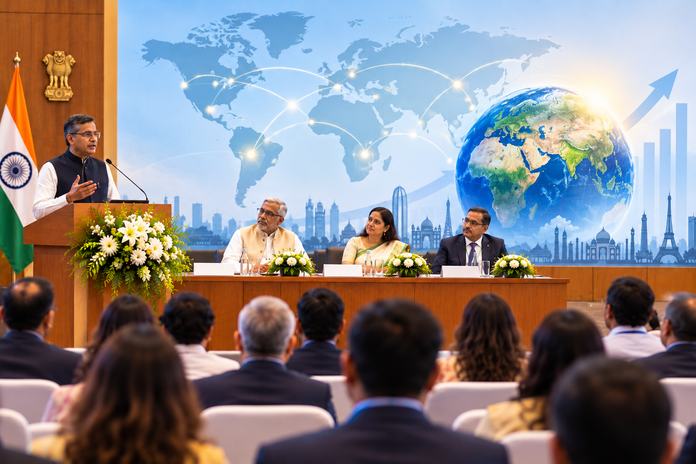
New Delhi: NITI Aayog has released a Strategic Roadmap for Making Ayurveda Global, outlining a long-term strategy to expand Ayurveda’s international presence through research, education, professional mobility, regulatory alignment, exports and healthcare services.
Published on 2 July 2026, the roadmap sets out short-, medium- and long-term priorities extending to 2047. Its objectives include strengthening India’s position in global traditional medicine and improving the international acceptance, quality and accessibility of Ayurveda.
Plan for the Global Expansion of Ayurveda
The NITI Aayog roadmap identifies several areas that could support Ayurveda’s international expansion, including practitioner recognition, research collaboration, education, product quality, international regulation and medical value travel.
The proposed approach is divided into three phases:
- Short term: Until 2029.
- Medium term: Until 2035.
- Long term: Until 2047.
The report highlights the need for coordinated action by government institutions, research organisations, educational institutions, healthcare providers and industry.
Proposal for a Global Ayurveda Practitioner Registry
One of the key recommendations is to establish a Global Register of Ayurveda Practitioners in collaboration with the National Commission for Indian System of Medicine (NCISM).
According to the report, India has more than 355,000 Ayurvedic practitioners, approximately 95% of whom are based in the country. Limited recognition and licensing mechanisms in other countries are identified as barriers to greater international professional mobility.
The proposed global register would aim to support the recognition of professional qualifications and continuing education. The roadmap sets indicative targets of 10,000 registered practitioners by 2029 and 50,000 by 2047.
The report also recommends exploring mutual recognition arrangements with other countries to facilitate the international mobility of qualified Ayurveda practitioners.
Greater Focus on International Ayurveda Research
The roadmap places research and evidence generation at the centre of Ayurveda’s proposed global expansion.
The report states that around 70 countries are conducting research related to Ayurveda, indicating opportunities for further collaboration between Indian institutions and international research organisations.
Its recommendations include:
- Increasing international clinical research.
- Developing patient registries.
- Strengthening real-world evidence.
- Improving safety reporting.
- Encouraging international research collaborations.
These measures are intended to strengthen the evidence base and support greater engagement between Ayurveda researchers and the international scientific community.
International Education and Training
The roadmap envisages strengthening Ayurveda education for international students, healthcare professionals and researchers.
Recommendations include developing modular educational programmes that introduce international learners to areas such as Ayurvedic nutrition, preventive healthcare and selected aspects of Ayurvedic practice.
The report also suggests exploring joint or dual-degree programmes with overseas universities and establishing International Ayurveda Centres of Excellence in selected countries.
Other proposals include strengthening the Ayush Chair initiative and developing international alumni networks to support Ayurveda education and collaboration worldwide.
Regulatory Harmonisation Identified as a Key Challenge
Differences between national regulatory systems are identified as a major challenge to Ayurveda’s international expansion.
The classification of Ayurvedic products varies between countries according to their intended use, ingredients and available evidence. The roadmap therefore calls for deeper regulatory engagement and better alignment with international standards.
It also encourages export-oriented manufacturers to follow internationally recognised quality and manufacturing standards, including WHO Good Manufacturing Practices (WHO-GMP) where applicable.
Another proposal is to develop an export-oriented Ayurvedic Pharmacopoeia package with clearer specifications covering identity, purity, potency and contaminant limits.
Driving the Expansion of Ayurveda Products and Services
The roadmap recommends moving beyond the export of raw medicinal herbs towards a stronger international presence for value-added Ayurvedic products and services.
Potential areas identified include:
- Value-added Ayurvedic preparations.
- International Ayurveda healthcare centres.
- Medical value travel.
- Health and wellness services.
- Overseas finishing and packaging facilities.
- Ayurvedic manufacturing for export.
- Compliance with relevant international quality standards.
The roadmap also links Ayurveda’s internationalisation with India’s medical value travel initiatives and the Ayush Visa framework.
Proposed Implementation and Mission Steering Group
The report recommends establishing a high-level Mission Steering Group, chaired by the Union Minister of Ayush, to coordinate activities related to Ayurveda’s internationalisation.
The proposed mechanism would bring together relevant ministries and stakeholders working across health, commerce, tourism and external affairs. It would also involve representatives from academia, research institutions and industry.
The roadmap further proposes a Global Ayurveda Forum as a platform to support coordination and implementation.
These are recommendations in the roadmap; their establishment and operation would depend on subsequent decisions and implementation by the relevant authorities.
Potential Impact on the Ayurveda Sector
The proposed measures could have implications for Ayurvedic practitioners, students, researchers, educational institutions, healthcare providers and manufacturers.
Improved international credentialing and recognition processes could potentially facilitate professional mobility. Students and researchers might gain access to more international education and research opportunities, while manufacturers could benefit from expanded overseas markets, subject to applicable regulatory and quality requirements.
However, the recommendations should not be interpreted as policies that have already been implemented. Initiatives such as international practitioner registration, mutual recognition agreements and overseas centres would require further decisions, approvals and implementation by the relevant authorities.
India’s Long-Term Vision for Ayurveda
The Strategic Roadmap for Making Ayurveda Global presents a long-term policy framework for strengthening Ayurveda’s international visibility through research, education, regulation, professional development, trade and healthcare services.
With milestones extending to 2047, the roadmap aims to move beyond promotion by placing greater emphasis on evidence generation, quality standards, professional recognition and regulatory compatibility.
The extent to which the roadmap improves international acceptance and creates new opportunities for Ayurveda will depend on how its recommendations are implemented and evaluated over time.