


Case Report: Agnikarma for Migraine Pain Relief Is Fast, But More Research Needed
A severe migraine attack can derail your daily life, making it hard to do simple things like work, read, or rest. Although there are many things modern medicine can do to help manage migraine, researchers are always looking for new ways to treat migraine. Interestingly, in a 2024 case report published in the Journal of Ayurveda and Integrative Medicine, a woman with a severe migraine attack rapidly experienced relief from the pain after an Ayurvedic procedure, Agnikarma.
The finding is significant, especially since the patient had been in pain for 3 days . But it’s important to understand what the report actually shows—and why one patient’s experience can’t prove a treatment’s effectiveness for everyone.
What did the researchers take a look at?
Praveen Balakrishnan, Emy S Surendran and Lisha S Raj authored the report titled An immediate pain relief with Agnikarma therapy for acute episode of migraine headache-a case report.
The authors presented the clinical management of a 58-year-old woman with a history of migraine for approximately 10 years. She complained of a very severe throbbing headache on the right side of the head, particularly at the temple and behind the right ear.
The headache had been with her for three days, and the painkillers she had taken had done nothing to relieve it.
Her pain was evaluated by the researchers using two scales: the Visual Analogue Scale (VAS) which measures the strength of pain perceived and the Global Assessment of Migraine Severity (GAMS) Scale.
Her first scores were 10 in VAS and 8 in GAMS (severe episode).
What is Agnikarma?
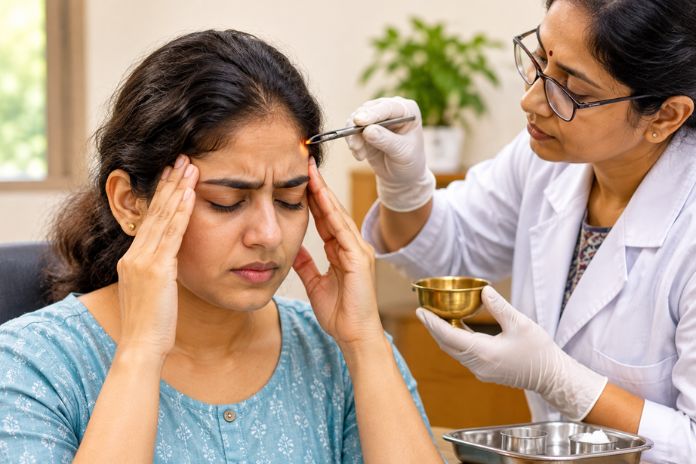
Agnikarma is a para-surgical procedure of Ayurveda, in which controlled heat is applied to a selected area of the body by a specialised instrument.
It is explained in Ayurveda as a therapeutic intervention with Agni (heat or fire). Classical Ayurvedic practice discusses it and its use, especially in the management of certain painful conditions.
In this case, the clinical team applied Agnikarma at the right temple of the patient corresponding to the area where she had maximum pain.
Trained practitioners performed the procedure in a clinical setting. Not to be confused with home treatment with heated objects or attempts to apply heat or cauterisation yourself.
What did we learn in the study?
The most notable observation was the rapid decrease in reported pain by the patient after the procedure.
The case report stated that her severe headache began to reduce within about two minutes of Agnikarma application. Her VAS pain score decreased from 10 to 0 and her GAMS score decreased from 8 to 1 in 5 minutes.
The procedure was tolerated without major discomfort, according to the authors. The patient complained of mild burning sensation at the site of application and blackish skin discolouration developed at the treated area. In 41 days the discoloration disappeared.
In this single case no other adverse effects were reported.
These findings suggest that the intervention led to a significant short-term benefit to the patient. But the study does not prove that Agnikarma alone was responsible for the improvement, or that other people with migraine would have similar results.
What might this mean for people with migraines?
This case raises an interesting question for future clinical research : can properly administered Agnikarma play a role in the management of some acute migraine attacks?
People suffering from recurrent migraine are naturally interested in the possibility of alternative treatment approaches. This report, however, is only a first clinical observation and cannot be taken as evidence that Agnikarma is an established emergency treatment.
Migraine is a complex neurological disease and treatment may include acute medication, preventive therapy, lifestyle measures and identification of individual triggers. Please consult a qualified healthcare professional for advice on your treatment options.
The findings should thus spur scientific inquiry, not self-medication or replacement of established migraine management.
What does Ayurveda say?
The authors interpreted the condition of the patient in terms of Ayurvedic diagnosis of Vatika Shirashula associated with Ardhavabhedaka, without any association of Pitta-Rakta.
Ardhavabhedaka is a classical ayurvedic term for the disorder characterised by pain on one side of the head and often discussed in relation to migraine.
Here Agnikarma was used as per Ayurveda for the controlled therapeutic heat for pain management. This traditional rationale provides a perspective on the clinical context of the intervention.
However, the case report failed to experimentally establish the biological mechanism by which Agnikarma might have influenced migraine pain. Therefore, in the absence of further research to corroborate this, traditional Ayurvedic explanations and modern neurological mechanisms should be viewed as different interpretative frameworks.
What do readers need to remember?
The most important limitation is the design of the research. This was not a clinical trial, but a case report of a single patient.
There was no comparison group, and no randomisation or blinding. The study can not tell how often the procedure might work, how long the improvement would last or how it compares with standard migraine treatments.
The report also cannot establish safety of Agnikarma for a wider population. Just because one patient had no adverse effects does not mean the procedure is safe. The local burning sensation and the temporary skin discolouration show that the intervention can have a physical effect on the skin.
Larger, well designed studies would be needed to assess effectiveness, safety, appropriate patient groups, treatment protocols and longer term outcomes.
Real-world takeaways
- The 2024 report describes a single woman who experienced quick relief from pain with Agnikarma for an acute migraine episode. The authors report that the patient’s pain scores improved dramatically in five minutes.
- The procedure caused mild burning and temporary skin discolouration at the site of application. One case report does not prove the procedure works or is safe in other people.
- If you are suffering from migraine, you should obtain an appropriate medical assessment and discuss treatment options with a qualified healthcare professional.
- Agnikarma should only be attempted in an appropriate clinical setting under trained supervision and never at home.
Conclusion: Interesting finding, but needs further investigation
The case report on Agnikarma and acute migraine is an interesting example of how traditional Ayurvedic procedures are being documented in present clinical literature. The rapid improvement in one patient deserves scientific attention, but is not enough to establish Agnikarma as a standard treatment for migraine.
More controlled research is needed to understand its potential role, effectiveness and safety. At this stage, the study should be considered a preliminary clinical observation that underscores the necessity for robust research in the evaluation of traditional healthcare practices.
Medical disclaimer: This article is for educational purposes only and is not a substitute for professional medical advice, diagnosis, or treatment. People with severe, unusual or sudden headaches should seek prompt medical evaluation.
SOURCE LINK: Ayurveda Integr Med. 2024 Jun 13;15(3):100953. doi: 10.1016/j.jaim.2024.100953