


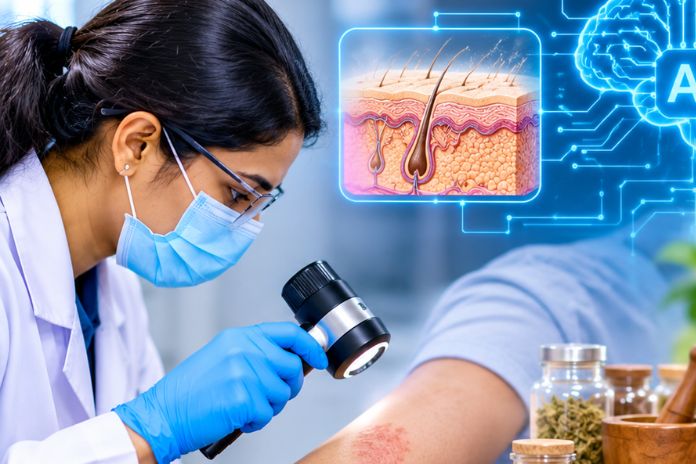
Will AI Change The Face Of Ayurvedic Dermatology? New Review Looks at the Future of Skin Disease Diagnosis
A narrative review in 2026 looks at how AI-based image analysis may augment traditional Ayurvedic diagnostic principles, while underscoring important clinical research gaps.
Introduction: Can technology add a new dimension to Ayurvedic skin diagnosis?
People often go to the doctor for skin problems. Acne, eczema, psoriasis, pigmentation disorders and skin infections can have a negative impact on physical comfort, confidence and quality of life.
Accurate diagnosis is essential as several skin disorders can look similar but need different treatment strategies.
Artificial intelligence (AI) is studied increasingly in dermatology. AI-based systems can help health care professionals identify and assess skin conditions by analysing clinical photographs, recognising patterns and processing patient information.
But can these technologies also be complementary to the traditional Ayurveda approach in understanding skin diseases?
This possibility has been explored in a recent review published in International Journal of Ayurvedic Medicine. In the paper titled “Integrating Artificial Intelligence and Ayurvedic Diagnostic Methods in Dermatology: A Narrative Review of Current Evidence and Future Directions,” the authors talk about the possible association between modern AI tools and Ayurvedic diagnostic principles.
Its central message is particularly interesting: although AI has made progress in conventional dermatology and is being explored in Ayurveda, its direct integration with classical Ayurvedic skin disease diagnosis remains largely unexplored.
What the researchers looked at
The authors sought to investigate three important issues:
- Contemporary uses of Artificial Intelligence in modern dermatology.
- Twak Roga, Ayurvedic methods of examination and diagnosis of skin disorders.
- The opportunities and challenges of combining these two approaches.
The researchers wanted to see if AI could be helpful in documenting, analysing and interpreting the clinical signs considered during Ayurvedic dermatological evaluation.
Instead of conducting a clinical trial or testing a new diagnostic application, the authors reviewed the literature that has already been published for existing developments and possible future research.
What’s the review process?
Researchers searched electronic databases such as PubMed and Google Scholar and selected journals covering Ayurveda, dermatology and digital healthcare.
The literature search was conducted for publications from January 2017 to December 2023.
The narrative review consisted of 14 articles:
- 3 articles regarding AI applications and developments in Ayurveda.
- four addressing AI in dermatology developments.
- Selected dermatologic areas including psoriasis, skin lesion analysis, skin cancer diagnosis, and atopic dermatitis were reviewed for seven AI applications.
The authors performed a descriptive analysis of these publications, categorising the results into major themes concerning AI in dermatology, Ayurvedic diagnostic principles, potential integration, and limitations of research.
Applications of Artificial Intelligence in contemporary dermatology
Artificial intelligence (AI) tools can assess large amounts of clinical information and detect trends that may be difficult to evaluate consistently by visual inspection alone.
A number of important applications are discussed in the review.
1. Skin lesion classification
Artificial intelligence systems can examine images of skin lesions and identify visual features such as colour, shape, borders and patterns. These systems are being investigated to help assess suspicious skin lesions, such as those related to skin cancer.
2. Assessment of psoriasis
Image-processing systems can evaluate features like plaque size, redness and scaling. These measurements may be helpful in documenting severity of disease and monitoring change over time.
3. Identifying Atopic Dermatitis
Machine learning systems can scan electronic health records, including clinical notes, medication information and diagnostic records, for patterns that are linked to atopic dermatitis.
4. Disease progression follow-up
Artificial intelligence systems could assist in documenting changes in the size, appearance and distribution of lesions by comparing photographs taken at different times.
5. Teledermatology
AI-assisted image assessment has the potential to allow for remote initial assessment of skin conditions, which could improve access to specialist services in areas where dermatologists are not readily available.
Such applications show the potential of AI as a clinical assistance technology. However, the review also notes that the performance can be influenced by image quality, skin tone, dataset diversity and clinical validation.
Ayurveda & Skin Disease Diagnosis: What’s Ayurveda’s Approach to Skin Diseases?
Skin disorders are looked at in the wider context of Twak Roga and the principles of Roga Pariksha (examination of disease) and Rogi Pariksha (examination of the patient) in Ayurveda.
Unlike the examination based only on the visible appearance of a skin lesion, Ayurvedic examination considers several clinical and individual factors.
The review points to the importance of:
- Hetu: Possible causes
- Dosha: Evaluation of the presence and dominance of Vata, Pitta and Kapha.
- Dushya: Tissues of the body involved in the disease process
- Lakshana: Symptoms and signs.
- Samprapti: Conceptual understanding of disease pathogenesis and progression.
- Prakriti: Personal constitutional traits.
The authors also talk about the traditional ways of examination like Trividha Pariksha:
- Darshana: Inspection.
- Sparshana: Touching for examination.
- Prashna: The art of getting the history of the patient through questions.
This approach seeks to understand not only the visible skin problem, but also the entire clinical picture of the individual.
Where Can AI and Ayurvedic Diagnosis Go Hand-in-Hand?
One of the most interesting parts of the review is how it discusses how visible diagnostic parameters in Ayurveda might be recorded and analysed via digital technologies.
For instance:
Varna (colour): Digital image analysis may assist in documenting variations in skin and lesion colour.
Sparsha (texture): A structured assessment and appropriate imaging technologies could help document features such as dryness, roughness, scaling and thickening.
Vedana (pain and discomfort): Digital questionnaires could be standardised to capture patient-reported data.
Srava (discharge): The quality and properties of discharge associated with skin lesions may have been documented in clinical records.
Akruti (lesion morphology): Image analysis can be useful in documenting lesion shape, distribution and appearance.
The review also suggests possibilities like digital Ayurvedic dermatology atlases, AI-assisted clinical decision-support systems, remote preliminary assessment, and longitudinal monitoring of disease progression.
These are suggested applications, not technologies whose efficacy in Ayurvedic dermatology has already been established.
What are the key research gaps?
The combination of these approaches may be promising, but the review reveals a significant gap: none of the 14 included publications directly examined the integration of AI with classical Ayurvedic diagnostic methods for Twak Roga.
The authors also note a number of challenges.
Lack of standardisation: The diagnostic terminology and clinical interpretations in Ayurveda may vary from one practitioner to another. These observations must be consistently documented before they can be reliably used in standard artificial intelligence systems.
Skin tone and dataset diversity: AI tools trained on limited or unrepresentative images may not perform equally well across different skin tones and different populations.
Image quality: Diagnostic performance can be affected by lighting, camera angle, image resolution and lesion visibility.
Privacy and data security: Clinical photographs and personal health information should be adequately protected and handled with due responsibility.
Limited Clinical Validation: Ayurveda has only a few clinically validated tools, and several AI applications are under development or validation.
Thus the authors advocate for interdisciplinary research involving Ayurveda, dermatology, computer science and clinical research.
What does this mean to the man in the street?
For patients, AI-assisted dermatology may in future offer additional support in documenting skin conditions, monitoring changes and improving access to initial assessment.
Digital documentation of clinical observations may offer opportunities for more structured assessment and research for Ayurvedic practitioners.
However, the review does not provide evidence that an integrated AI-Ayurveda diagnostic system is currently effective or ready for routine clinical use.
AI-generated assessments do not replace the review by qualified healthcare professiona