


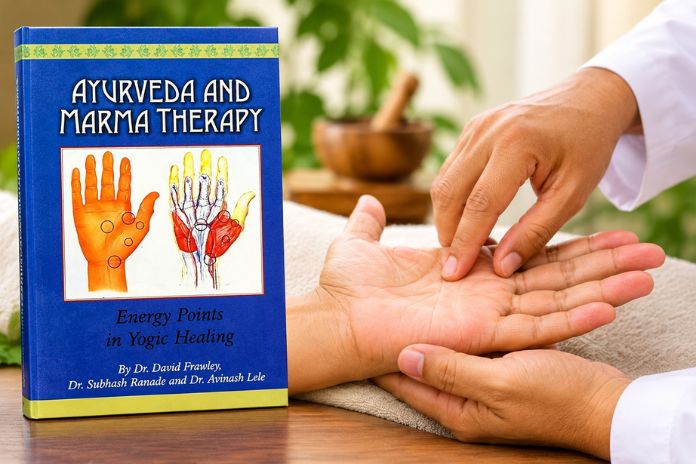
Ayurveda and Marma Therapy: The Ancient Science of Energy Points in Yogic Healing
Ayurveda gives an in-depth knowledge of health, which goes beyond the treatment of physical symptoms and encompasses the relationship between body, mind and consciousness. In this traditional framework, Marma Vidya occupies a unique place. It deals with the vital points of the body which are important to understand the anatomical structures, physiological functions and the traditional principles of energy flow.
Ayurveda and Marma Therapy: Energy Points in Yogic Healing combines the perspectives of Ayurveda and Yoga to offer this niche area to readers. Authored by Dr David Frawley, Dr Subhash Ranade and Dr Avinash Lele, the work explores the traditional knowledge of Marma points and its relationship with Ayurvedic concepts and yogic practices.
The subject matter is especially timely, as interest in traditional Indian knowledge systems, integrative health approaches and the preservation of classical healing traditions continues to grow.
Understanding Marma Therapy with Ayurveda and Yoga
In Ayurveda, Marma points are traditionally understood to be vital anatomical points where a variety of bodily structures converge. These are muscles, blood vessels, ligaments, bones and joints. According to classical Ayurvedic texts, there are 107 main Marma points spread throughout the human body.
The classical Ayurvedic texts, especially the Sushruta Samhita, extensively discuss the concept of Marma. These texts analyse these locations from anatomical, surgical and clinical perspectives.
Marma knowledge is also deeply related to the traditional knowledge of Prana, the vital principle of life. In yogic philosophy Prana is linked to the functioning of the body and mind, whereas the subtle energy framework provides a different perspective to make sense of the connection between physical and mental well-being.
This book examines the intersection between Ayurveda and Yoga, revealing the traditional significance of Marma points and their role within a broader system of holistic health knowledge.
What are the Main Themes of the Book?
One of the main themes in Ayurveda and Marma therapy is the relationship between the body and the traditional idea of vital energy.
It is not only the anatomical points. It is a subject of Ayurveda and the Yogic knowledge.
The main areas of interest of the book are:
1. Marma in Ayurvedic understanding
The marma points are important components of classical Ayurvedic anatomy. They are traditionally located and described according to different bodily structures. Another dimension is obtained with the study of Sharira Rachana (anatomy) and Sharira Kriya (physiology) keeping these points in mind.
2. Marma points and Prana
Marma and Prana are interconnected and constitute an essential component of the traditional conceptual framework. The discussion links the physical sites to the larger Ayurvedic and yogic notions of vitality and life functions.
3. Yoga & Ayurveda
Ayurveda and Yoga share many of the same philosophical and practical foundations. The connection between them can be analysed through the notions of Dosha, Prana, the subtle body and the traditional idea of physical and mental balance.
Marma therapy offers an interesting way of looking at these interconnected knowledge systems.
4. Marma in the practice of traditional medicine
The subject also raises questions about the traditional use of Marma knowledge in healing and wellness contexts. For its study an understanding of the anatomical location, individual constitution and the importance of adequate professional training is required.
5. Integrated health approaches
Marma Vidya has a broader significance in that it enriches the traditional Indian view of the inter-relationship between bodily structures and physiological functions and mental well-being.
107 Marma Points: A Practical Guide
One of the most important aspects of the book is the systematic approach to the 107 main Marma points. In addition to theoretical explanations the work offers a structured presentation of their locations, characteristics and traditional methods of application.
The material is organised by various anatomic regions, including:
- Hands and arms.
- Legs and feet.
- Chest and belly.
- Hips back.
- Neck and head.
The regional organization provides the reader with a means to understand Marma points within the framework of the anatomical structures of the body. It also offers a useful framework for studying their specific characteristics and traditional therapeutic significance.
The book discusses various approaches to Marma therapy like massage, aromatic applications, herbal applications and yogic practices. It also includes specialised subjects like Ayurvedic Acupuncture, or Marmapuncture, and traditional procedures related to the treatment of Marma regions.
Its educational value is enhanced by the addition of illustrations, classifications, Sanskrit terminology and reference material. These features may be especially useful for readers who want to create a more structured understanding of this specialised area of Ayurvedic knowledge.
The Authors and Their Contributions
The book brings together three contributors who have backgrounds in the study of the Vedas and Ayurveda.
Dr David Frawley (Pandit Vamadeva Shastri) is a world-famous author and teacher of Vedic knowledge, Yoga, Ayurveda and Vedanta. His work has contributed to bringing Indian philosophical and traditional knowledge systems to international audiences. He has written many books and was awarded Padma Bhushan in 2015 for his contribution to the field of education and culture.
Dr. Subhash Ranade (1940–2025) was a leading Ayurvedic physician, an academician and an author. He contributed immensely in Ayurvedic education, clinical practice and international propagation of Ayurveda. During his academic career he served in teaching and leadership positions in Ayurvedic institutions and authored widely in several areas of Ayurvedic knowledge.
Dr. Avinash Lele is an Ayurvedic doctor with post graduate training in Shalya-Shalakya Tantra, the disciplines of Ayurveda dealing with surgery and specialised clinical practice. He has an Ayurvedic clinical practice, and teaches and does educational activities internationally.
Their backgrounds combine perspectives from traditional Vedic knowledge, Ayurvedic scholarship and clinical experience. An interdisciplinary background is very much in tune with a subject that relates classical anatomical notions with wider yogic and therapeutic contexts.
Significance in Ayurvedic Education, Clinical Practice and Research
This book would be of particular interest to students and practitioners of Ayurveda who wish to explore Marma Vidya beyond the introductory theory.
It offers a chance for undergraduate and post graduate students to study the classification, location and traditional significance of Marma points. The regional organization and the accompanying illustrations might also be useful to understand the relation between anatomical structures and the classical descriptions.
The discussion of traditional Marma applications adds more material for professional learning for Ayurveda physicians and Panchakarma practitioners. Descriptions of therapeutic techniques are, however, not to be taken as instructions for unsupervised treatment. Practical application requires adequate anatomical knowledge, clinical judgement & specialised training.
Yoga teachers and researchers with an interest in Ayurveda, Prana and yogic practices may find the subject of value. The book offers a window into the approach these ancient disciplines take to the relationship between the physical body and the subtle dimensions of human experience.
The subject provides an opportunity for researchers to further investigate the historical evolution of Marma concepts, their relation to classical Ayurvedic texts, anatomical correlations and evaluation of traditional therapeutic approaches.
However, it is important to differentiate traditional explanations of Prana and subtle energy from scientifically established physiological mechanisms. The book should be read as a contribution to the study of Ayurvedic and yogic knowledge, not as independent clinical evidence proving the effectiveness of each technique described.
Editorial View: Connecting Traditional Knowledge and Present Interest
One of the important contributions of Ayurveda and Marma Therapy is its effort to make a specialised area of Indian traditional knowledge available to a wider readership.
Marma Vidya is usually introduced with a brief description of the 107 vital points in Ayurveda. One needs to know their classification, anatomical locations, traditional functions and relationship with other Ayurvedic concepts to understand more systematically.
The book provides explanations of the Ayurvedic system, yogic practices, and descriptions of Marma points according to region, and is more comprehensive than a simple introduction.
It also captures the diversity of practices associated with Marma therapy, including massage, aromatic applications, herbal approaches and other traditional methods.
Nevertheless, readers should come to the subject with some sense of its traditional setting and the need to interpret carefully. Contemporary anatomical understanding and clinical evidence are related, but separate, domains of knowledge from classical descriptions. The inclusion of these requires further academic and scientific research.
Hence, the book is very useful as a reference book to study the basic principles and applications of Marma Vidya but not as a replacement for clinical training or evidence-based professional consultation.
Conclusion: Rediscovering the Importance of Marma Vidya
Ayurveda and Marma Therapy: Energy Points in Yogic Healing presents an important aspect of Ayurvedic knowledge through the integrated perspective of Ayurveda and Yoga.
The discussion of the 107 main Marma points, their anatomical locations, traditional classifications and associated therapeutic approaches makes it a relevant resource for students, practitioners, educators and researchers interested in this specialised subject.
The work also emphasises the need for preserving and studying traditional Indian knowledge systems while encouraging an informed dialogue with modern anatomical and healthcare research.
This book is a useful starting point for readers who want to understand the relationship between Marma, Prana, Ayurveda and yogic healing, and to explore Marma Vidya and its place in the traditional health heritage of India.
Book Description & Additional Information
- Book Title: Ayurveda and Marma Therapy: Yogic Healing with Energy Points
- Authors Dr David Frawley Dr Subhash Ranade Dr Avinash Lele
- Publisher: Lotus Press
- First Published: 2003
- Language: English
- Paperback and eBook
- Length: 272 pages (of the edition cited by the publisher)ISBN: 9780940985599. (paper)
- eBook ISBN: 9780940676510
- Ayurveda, Marma Vidya, Yoga & Traditional Healing.
Availability of books and further reading:
- Official Lotus Press book page
- See book on Amazon India (original provided link)- Google Books – Details and contents of the book
SOURCE LINK: https://amzn.in/d/08JuPwZH



