


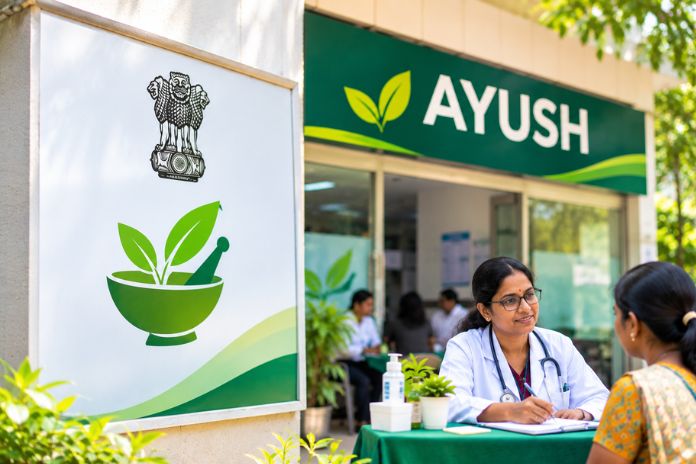
The Union Government has informed that as on December 31, 2025, 13,249 health facilities across India have been supported with AYUSH services with deployment of 25,322 AYUSH doctors and 5,666 AYUSH paramedics in States and Union Territories with funding support under the National Rural Health Mission (NRHM).
The figures were shared by the Ministry of AYUSH in a written reply submitted to the Lok Sabha in reply to Starred Question No. 98 on the integration of AYUSH systems into the national healthcare framework. The question was answered by Minister of State (Independent Charge) for AYUSH, Prataprao Jadhav on 24 July 2026. Digital Sansad
AYUSH services in primary, community and district level health facilities
The government’s response said that mainstreaming AYUSH is a core strategy under the National Health Mission (NHM) for improving access to affordable and quality healthcare.
The approach is intended for co-location of AYUSH facilities at Primary Health Centres (PHCs), Community Health Centres (CHCs), district hospitals and other public health facilities. The aim is to provide patients access to different systems of medicine in a common health care environment, it is stated.
The Ministry’s data as per the NHM Management Information System on 31 December 2025 showed AYUSH services available in the following facilities:
| Health facility type | Number |
|---|---|
| Primary Health Centres (PHCs) | 6,302 |
| Community Health Centres (CHCs) | 3,191 |
| District Hospitals (DHs) | 475 |
| Other health facilities | 3,281 |
| Total | 13,249 |
The government also said that 25,322 AYUSH doctors and 5,666 AYUSH paramedics have been deployed in States and Union Territories with the help of NRHM funding support.
Digital Parliament
12,500 Ayushman Arogya Mandir units helped
The reply also furnished details of development of Ayushman Arogya Mandir (AYUSH) facilities under National AYUSH Mission (NAM). 12,500 units have been supported to be operationalised across the country, the Ministry said.
The centres are intended to propagate the holistic wellness model based on AYUSH principles and practices. The services mentioned in the reply are Prakriti assessment, Yoga, promotion of medicinal plants, healthy lifestyle practices and basic out-patient department interventions.
The Ministry said that after upgrading the AYUSH dispensaries, states and Union Territories have noticed an increase in beneficiary footfall. The government reports the observation. There is no single nationwide figure putting a number on the increase in the reply.
Support integration with contemporary healthcare: research initiatives
The Ministry’s response highlighted research and collaborative projects undertaken by its research councils and national institutes.
For example, the Central Council for Research in Ayurvedic Sciences (CCRAS) has taken up studies on the feasibility of integration of Ayurveda in the health care settings including studies on knee osteoarthritis at Safdarjung Hospital, New Delhi and initiatives on reproductive and child health services at the primary care level.
The reply also mentions work on Ayurveda interventions in public health programmes for non-communicable diseases and a proposed advanced centre for integrative health research involving CCRAS and the Indian Council of Medical Research (ICMR) at AIIMS.
Other initiatives listed include Integrative Research and Clinical Services related to Siddha, Unani, Homoeopathy, Yoga and Naturopathy. These are listed as research, collaboration or service initiatives in the document. It does not prove that all of the interventions listed have shown effectiveness for all of the conditions involved.
Govt issues quality-control framework for AYUSH medicine
The parliamentary reply also described the regulatory measures governing AYUSH medicines.
The Ministry said the concerned traditional-system medicines are regulated by the relevant provisions of the Drugs and Cosmetics Act, 1940, and Drugs Rules, 1945, for their licensing and manufacture. These may include Good Manufacturing Practices and compliance with the applicable pharmacopoeial quality standards.
“The drug inspectors take samples from manufacturing units and sale outlets for testing,” the reply states. Where a sample is found not to be of standard quality appropriate action may be taken, under the applicable law.
The Pharmacopoeia Commission for Indian Medicine & Homoeopathy (PCIM&H) prescribes the pharmacopoeial standards and formulary specifications for the concerned medicines. The Ministry also mentioned Ayush Oushadhi Gunavatta Evam Uttpadan Samvardhan Yojana (AOGUSY), which gives assistance for strengthening and upgradation of AYUSH pharmacies and drug-testing laboratories.
Digit Sansad
Pharmacovigilance and Monitoring of Misleading Advertising
The ministry has established a three-tiered pharmacovigilance network for Ayurveda, Siddha, Sowa-Rigpa and Unani medicines and Homoeopathy drugs, it said. The network has a National Pharmacovigilance Coordination Centre, five intermediate centres and 97 peripheral centres.
Online Ayush Suraksha portal was launched on May 30, 2025 to capture reports on misleading / objectionable advertisements and suspected adverse drug reactions related to AYUSH medicines.
The response also mentions the quality certification programs like AYUSH Standard Mark and AYUSH Premium Mark under the scheme of Quality Council of India and Ayush Quality Mark Programme launched in December 2025.
Health care help for tribal areas
The Ministry has clarified that public health is a State subject and the primary responsibility of prioritising healthcare and research in tribal dominated areas lies with the State Governments.
However, Union Ministry extends support to States and Union Territories for strengthening AYUSH health care services including in tribal areas under Centrally Sponsored National AYUSH Mission. Support is given on the basis of proposals submitted via State Annual Action Plans.
The parliamentary reply has State- and UT-wise details of funds released under NAM from 2014-15 to 2025-26. It shows total releases of around ₹6,406.99 crore for listed entries for that period.
The AYUSH Policy Roadmap includes education, infrastructure and research
The Ministry has prepared an AYUSH Policy Roadmap to steer the development and integration of India’s traditional health care systems, it said.
The roadmap includes infrastructure, education and training, human-resource development, healthcare delivery, research and development, manufacturing, drug regulation, medicinal-plant resources, international cooperation and policy reforms.
In response, the Parliament has identified these areas as the priority areas for strengthening the AYUSH sector. It doesn’t state a single implementation deadline for all the measures outlined.



